
Data recovery on a hard drive like the Hitachi HCS545050GLA380 starts with identifying the failure type: electronic, firmware, or mechanical. Each requires a different approach, and misdiagnosis can make things worse. Here’s a quick guide to help you assess your situation and decide on the next step.
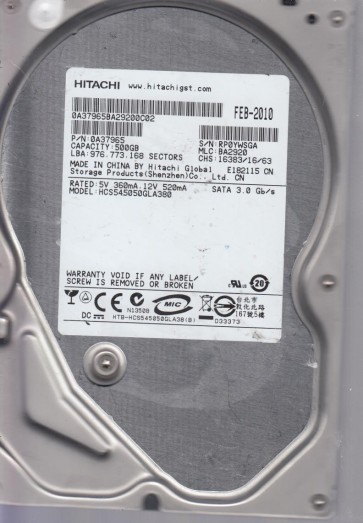
HCS545050GLA380 Hitachi 3.5″ hard drive with a storage capacity of 500GB and featuring a SATA interface.
Common Hard Drive Failure Causes & Data Recovery Method:
1. Logical / Software Failure Causes
- Deletion / format – human error.
- File system corruption – improper shutdown, malware, or OS crash.
- Partition loss – partition table damage or tool misuse.
- Bad sectors – platter aging or head degradation.
- Firmware corruption – sudden power loss corrupts service-area modules.
Data Recovery Method:
- Stop writing to the drive immediately.
- Prepare a healthy drive for recovered data.
- Install recovery software on the healthy drive – never the failing one.
- Scan and preview – quick scan first, then deep scan.
- Recover to a different drive after confirming files are intact.
Data Recovery Tools:
- Recovery Tools: Professional data recovery softwares such as: DiskGenius, R-Studio, DMDE, Recuva, EaseUS, TestDisk, PhotoRec, etc.
- Bad sectors: Use HDDSuperClone or ddrescue with low timeout and skip bad areas. Never force-read the same bad sector.
2. Physical / Hardware Failure Causes
- Head failure – stiction or scratched magnetic layer from aging, shock, or long power-off.
- Motor failure – driver chip burned out or bearing seized; platters stop spinning.
- Preamp failure – ESD or thermal stress damages the preamp IC on the head flex cable.
- PCB failure – power surge or overheating destroys board components or ROM data.
Data Recovery Method:
- Head / preamp: cleanroom head stack replacement + firmware transplant.
- Motor driver: replace chip + transfer original ROM to donor PCB (or reprogram with PC-3000).
- Severe bad sectors: DeepSpar, PC-3000 – control spindle speed and bypass internal error recovery.
- PCB failure: Donor PCB replacement and BIOS exchange.
Data Recovery Tools:
- ROM transfer Tool: Hot air rework station, CH341A programmer or reprogram with PC-3000.
- Bad sectors: DeepSpar, PC-3000.
- PCB replacement: Donor PCB and ROM transfer tool to transfer the BIOS chip from your original PCB to the donor PCB.
Conclusion
Bottom line: Logical issues can often be recovered with software. Physical issues require a cleanroom (Except for replacing the PCB) and professional service. In every case, stop writing to the drive immediately – that single step saves more data than any tool.
