
In the rapidly evolving landscape of digital forensics, few names carry as much weight as EnCase Forensic. For over two decades, this software suite has been the gold standard for law enforcement, corporate security teams, and independent examiners worldwide. Whether you are investigating a data breach, employee misconduct, or a complex cybercrime, EnCase provides the framework to acquire, analyze, and report on digital evidence with court-admissible rigor. This post explores the architecture, workflow, and enduring relevance of EnCase Forensic in modern investigations.
What is EnCase Forensic?
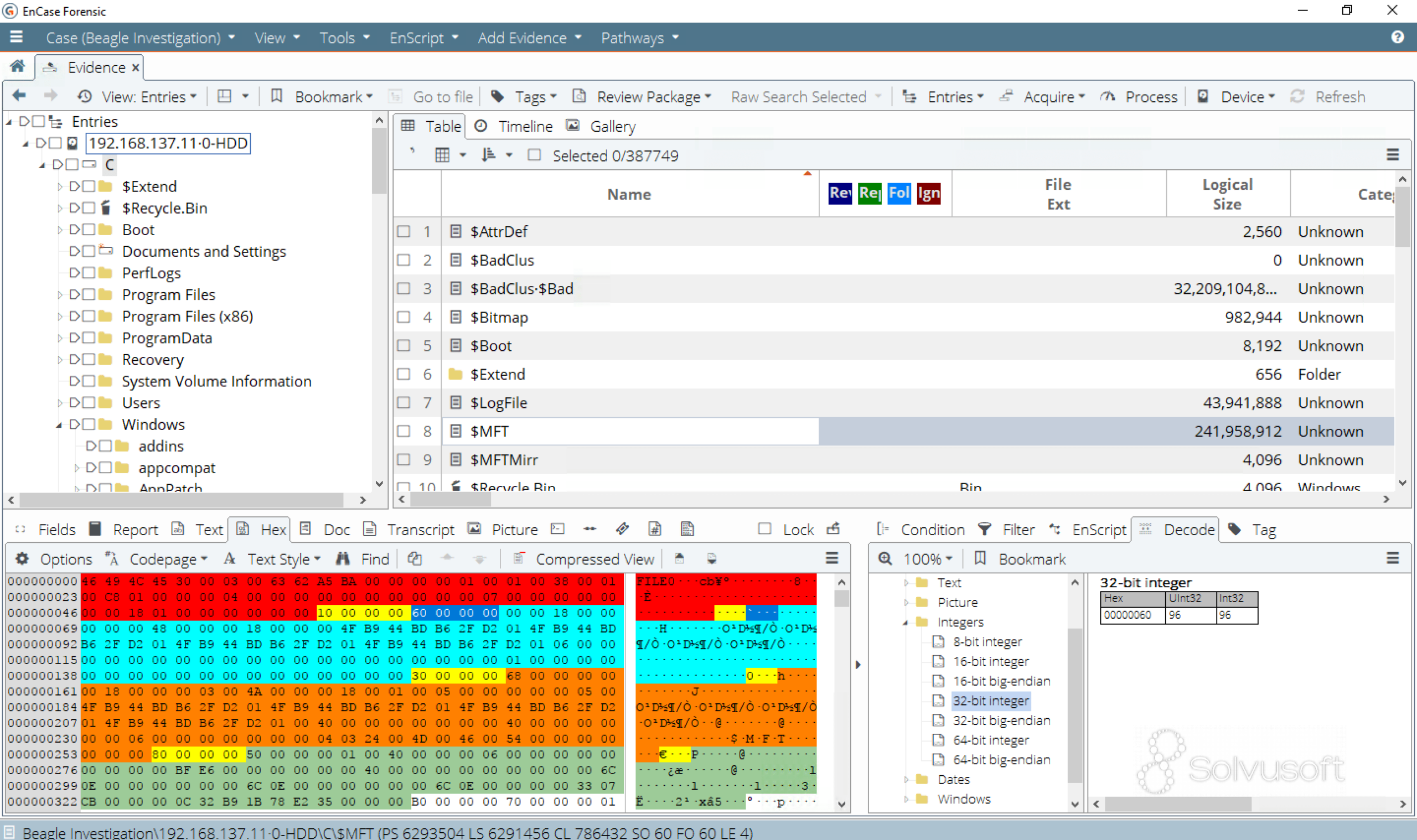
EnCase Forensic is a comprehensive digital investigation platform developed by OpenText. It is designed to handle the entire forensic lifecycle: from the acquisition of media, through in-depth analysis of file systems and unallocated space, to the generation of detailed reports. Unlike many single-purpose tools, EnCase integrates imaging, parsing, searching, and scripting into a unified environment. This integration reduces the need to switch between applications, thereby streamlining the investigative process and minimizing the risk of data contamination.
Core Capabilities
- Forensic Imaging: EnCase creates bit-stream images of hard drives, SSDs, mobile devices, and removable media. These images are cryptographically hashed (MD5 and SHA-1) to ensure integrity from the moment of acquisition.
- File System Analysis: The software natively parses FAT, NTFS, exFAT, HFS+, EXT, and other file systems, reconstructing directory structures even when the original metadata is partially corrupted.
- Keyword Searching: Investigators can run complex queries using literal terms, GREP expressions, or indexed searches to locate relevant artifacts across terabytes of data within minutes.
- Email and Archive Parsing: EnCase extracts and decodes emails (PST, NSF, MBOX) and compressed archives (ZIP, RAR, 7z), making it easier to review communications and extracted files.
- Scripting and Automation: The built-in EnCase EnScript language allows examiners to automate repetitive tasks, create custom parsers, and extend the tool’s functionality to meet unique case requirements.
The Investigative Workflow
Using EnCase effectively requires understanding its logical workflow. While each case is unique, most investigations follow a similar high-level process.
- Case Creation: The examiner creates a new case file, setting up evidence storage locations, case numbers, and examiner credentials. This step establishes the chain of custody from the start.
- Evidence Acquisition: The forensic imager connects to a source drive (either local or remote) and writes a compressed or uncompressed image file. EnCase supports live acquisition for systems that cannot be powered down, though write-blocked hardware is preferred for static media.
- Initial Analysis: Once the image is verified, the examiner runs automated processes such as file signature analysis to identify mismatched extensions, hash analysis to filter out known good files (e.g., operating system files), and a comprehensive directory listing.
- Deep Dive Examination: This is where the investigator’s expertise comes to the fore. Using filters, bookmarks, and viewing panes, the examiner drills into user folders, recycle bins, browser histories, and registry hives. The Gallery view allows rapid visual sorting of images, while the Timeline feature reconstructs system events chronologically.
- Reporting: EnCase offers a robust reporting module that compiles bookmarked items, found artifacts, and case notes into a PDF or HTML report. The report can be customized to include all necessary metadata, making it suitable for court submission.
Key Features in Depth
EnScript Capabilities
One of the most powerful aspects of EnCase is its scripting engine. EnScript is a C++-like language that allows forensic practitioners to write modules that parse proprietary file formats, recover deleted records, or even interact with external APIs. For example, a custom EnScript can automatically extract geolocation data from embedded EXIF metadata, cross-reference it with a timeline, and output a sorted list of coordinates. This flexibility turns EnCase from a generic tool into a tailored solution for niche investigations.
Encryption and Password Protection
Modern cases often involve encrypted containers, BitLocker volumes, or FileVault protected drives. EnCase integrates with various decryption methods, including the use of recovery keys, known passwords, or brute-force attempts through third-party modules. While brute-force is rarely practical on strong encryption, having the option to use dictionary attacks within the same environment ensures a seamless workflow.
Mobile Device Acquisition
While EnCase is traditionally known for computer forensics, recent versions include robust support for mobile devices. Through physical, logical, and file-system acquisitions, examiners can extract call logs, SMS, contacts, and application data from iOS and Android devices. However, for advanced mobile analysis, many labs still pair EnCase with specialized mobile tools, importing the extracted data back into the main case for unified reporting.
Advantages and Limitations
Advantages
- Court Admissibility: EnCase’s rigorous hashing and logging make its output widely accepted in legal proceedings worldwide.
- Unified Platform: The integration of imaging, analysis, and reporting reduces learning curves and operational friction.
- Scalability: Enterprise versions support distributed processing across multiple machines, reducing analysis time for large datasets.
- Training and Certification: OpenText offers a structured certification path (EnCE), which is highly respected in the industry.
Limitations
- Cost: Licensing fees for EnCase can be prohibitive for smaller agencies or independent consultants.
- Learning Curve: Despite its intuitive interface, mastering EnScript and advanced features requires significant time and practice.
- Performance on Very Large Drives: While capable, indexing and searching multi-terabyte drives can be resource-intensive and may require enterprise hardware.
Modern Alternatives and Coexistence
In recent years, open-source and lower-cost tools such as Autopsy, FTK Imager, and X-Ways Forensics have gained popularity. These tools offer specific advantages, such as speed or cost-effectiveness, but none provide the exact combination of depth, integration, and legal acceptance that EnCase offers. In practice, many forensic labs use a hybrid approach: employing EnCase for primary analysis and reporting, while supplementing it with specialized tools for carving, memory analysis, or cloud forensics. This coexistence speaks to EnCase’s role as a backbone rather than a complete replacement for all other utilities.
Best Practices for Examiners
To get the most out of EnCase Forensic, consider these guidelines:
- Verify Images Immediately: Always run verification hashes after acquisition and before starting analysis. Document the hash values in your case notes.
- Use Write-Blocking: Even though EnCase can write to evidence files, always connect source media through a hardware write-blocker to prevent accidental modification.
- Bookmark Early and Often: Mark artifacts of interest as you discover them. This not only speeds up reporting but also helps you revisit key evidence without re-searching.
- Maintain a Case Log: Use the built-in log feature to record every action, filter applied, and search executed. This creates a transparent audit trail.
Official Website & Resources
EnCase Forensic is now a product of OpenText, having been acquired from Guidance Software. For the most accurate and up-to-date information, direct access to the official product page and support resources is recommended. The official website provides comprehensive details on features, system requirements, and purchasing options.
You can visit the official product page at: https://www.opentext.com/products/encase-forensic.
For registered users, OpenText offers a support portal providing access to technical support, community forums, training resources, and EnScript downloads. Access to specific support features requires a registered account.
OpenText also provides official training and certification programs for EnCase, including options for live online classes, in-person training centers, and on-demand courses to help develop expertise in the software.
Conclusion
EnCase Forensic remains a pillar of the digital forensics community. Its robust acquisition methods, deep file system parsing, and powerful scripting engine provide a level of trust and reliability that is difficult to replicate. While the digital world continues to shift toward cloud storage, ephemeral messaging, and complex encryption, EnCase evolves in parallel—adding support for new artifacts, file systems, and integration points. For any professional serious about digital investigations, mastering EnCase is not just a technical achievement; it is a commitment to the standards of due process and evidentiary integrity. In a field where the smallest artifact can be the turning point of a case, EnCase delivers the precision and power to find it, preserve it, and present it with confidence.