
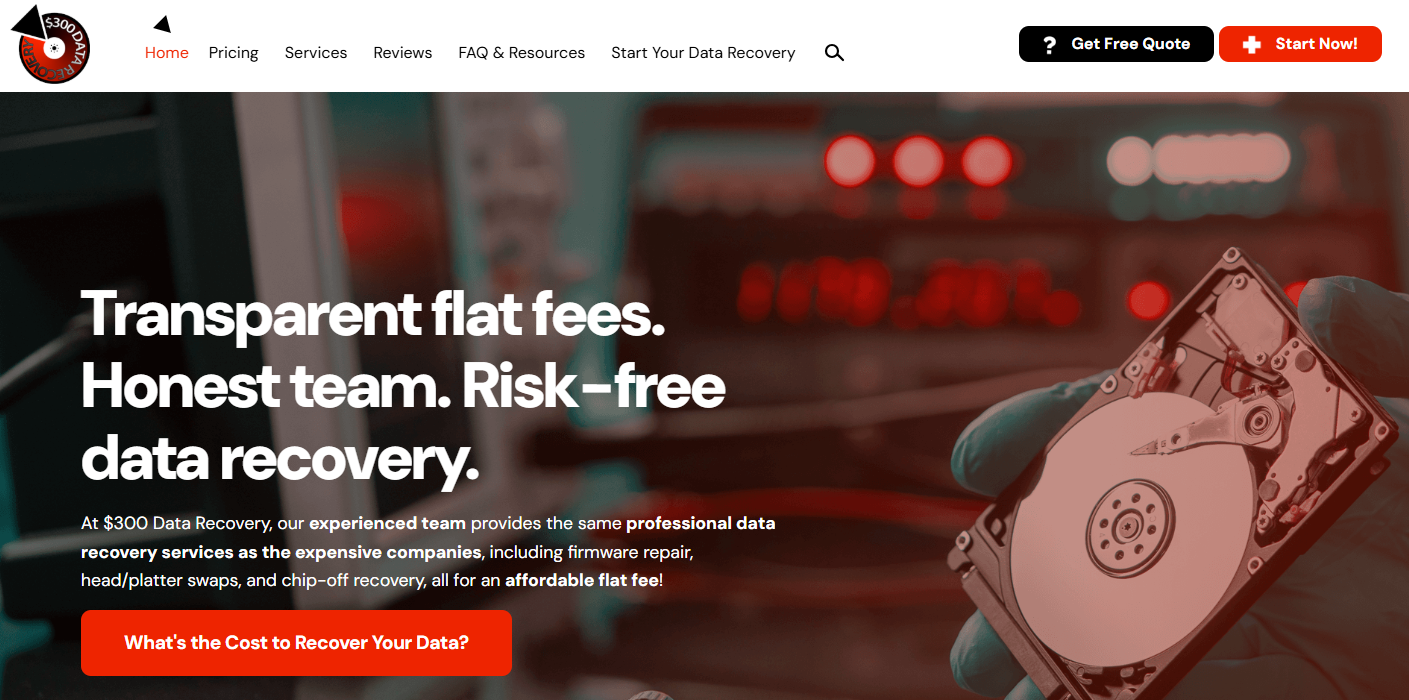
Founded by Brian Cometa, $300 Data Recovery has carved a unique niche by making professional data recovery services more affordable. Their core philosophy is built on transparency and honesty, offering flat rates regardless of the specific failure, which they claim is a stark contrast to competitors who use “diagnose-then-quote” models. They have a BBB A+ rating and thousands of positive reviews online. However, they also face a significant number of complaints, primarily about communication breakdowns and the quality of partial recoveries.
Official Website: 300dollardatarecovery.com
1. Core Business and Services
$300 Data Recovery provides a full spectrum of data recovery services designed to be accessible and reasonably priced.
| Category | Services Offered |
|---|---|
| Consumer Devices | Hard drives (HDD), Solid State Drives (SSD), USB flash drives, SD cards, and mobile phones. |
| Enterprise and Professional | RAID arrays (RAID-0, RAID-5, RAID-6, Drobo, etc.) without charging a premium for them. |
| Specialized Recoveries | Physical repairs (head swaps, platter swaps, chip-off), firmware corruption, and encrypted devices. |
In addition to physical repairs, they use an online form to give clients a pre-shipment price quote and a realistic probability of recovery before they even send their drive in.
2. Technical Strengths
The company’s technical capabilities are supported by a significant investment in equipment and a focus on in-house operations.
ISO-Certified Cleanroom
They perform physical repairs in an ISO 5 certified cleanroom, which is crucial for hardware-level work like head replacements.
In-House Operations
They emphasize that all work is done in-house by their team, avoiding the common industry practice of forwarding drives to larger labs. This contrasts with other companies that may have many “local” offices but send drives elsewhere.
Transparent Fixed Pricing
Unlike competitors who use a “range of prices,” $300 Data Recovery charges one of three predetermined rates, irrespective of the specific hardware failure or complexity.
3. Pricing and Policies
The company’s pricing structure is what sets it apart but also introduces unique financial terms. The base fees are $300, $500, or $700. RAID recoveries are charged per drive.
| Fee Type | Typical Cost | Notes |
|---|---|---|
| Return Shipping (USA) | $25 | Includes signature confirmation. |
| Transfer Drive (if bought) | 1TB: $100; 2TB: $125; up to 16TB: $375 | Clients may provide their own drive. |
| Priority (Rush) Service Fee | $100 up-front; +$200 if successful | Moves your case to the front of the queue. |
| Open Cover Fee | $100 up-front, non-refundable | Applies if the hard drive’s internal cover has been previously opened. |
| Donor Drive Parts | Exact cost of parts (non-refundable) | Required for head swaps; you may also provide your own donor drive. |
Key Policy Terms
- Full Recovery (≥99% Sectors): You are committed to pay the full rate.
- Partial Recovery (<99% Sectors): You can choose to accept the recovered data for the full fee or decline and pay a $100 labor fee.
- No Data: There is no charge, except for the cost of a donor drive, shipping, and any up-front fees.
- Deleted/Formatted Files: The full fee is charged up-front. If no workable files are found, the recovery cost is refunded minus a $100 labor fee.
4. Customer Feedback: A Stark Contrast
Reviews for $300 Data Recovery paint a divided picture, showcasing both exceptional success and notable failures.
Positive Experiences
Many customers praise the service for its affordability and effectiveness. Key themes include:
- Professionalism and Speed: Customers highlight the professionalism, efficiency, and customer-centric approach of the team, noting they recovered 100% of their data from failing drives with swift and seamless service.
- Recovery from “Unrecoverable” Drives: A common sentiment is that they succeeded where other companies failed. Customers frequently report recovering years of family photos and videos after other companies declared the drives unrecoverable.
- Cost Savings: Customers frequently compare the cost favorably to competitors, noting it would have been significantly more elsewhere.
Negative Experiences
Despite positive feedback, there is a notable volume of complaints. Common themes include:
- Partial or Unrecoverable Data: Some customers report not receiving all their data, with some recovering only a percentage of files with disorganized structures.
- Corrupted or Non-Functional Files: A significant complaint is that while files were recovered, many wouldn’t open properly.
- Missing Accessories: Several complaints mention that their USB cables or power supplies were not returned.
While the company boasts thousands of positive reviews, the number of complaints and the pattern of dissatisfaction regarding partial recoveries or corrupted files warrant consideration.
5. Pros and Cons Summary
| Pros | Cons |
|---|---|
| Extremely competitive and transparent fixed pricing ($300-$700) | Significant number of complaints regarding partial recoveries and corrupted files |
| In-house ISO 5 cleanroom and full-service lab | Complex payment terms with non-refundable upfront fees |
| Small, experienced team with direct communication | You are obligated to pay if 99% of sectors are recovered |
| High volume of positive reviews | Reports of slow communication and lost accessories |
| Reports of recovering data others deemed impossible | Mixed success on partial recoveries and file corruption |
6. Official Website and Contact
| Detail | Information |
|---|---|
| Website | 300dollardatarecovery.com |
| Headquarters | Los Angeles, California (Studio City) |
| Team Size | Small, close-knit team |
Editor’s Note
$300 Data Recovery is an intriguing player that has successfully challenged the “data recovery is expensive” narrative. Their disruptive pricing and insistence on transparency are refreshing, and their track record of reviving drives that other companies have given up on is commendable. However, the service is not without its risks. The mixed reviews concerning partial recoveries and file corruption should be a significant consideration. For a budget-conscious user who can accept the terms and the possibility of a less-than-perfect recovery, it represents a compelling alternative to the traditional, expensive giants of the industry.