
Data recovery on vintage hard drives like the Toshiba DT02ABA200V starts with identifying the failure type – electronic, firmware, or mechanical. Each requires a different approach, and misdiagnosis can make things worse. Here’s a quick guide to help you assess your situation and decide on the next step.
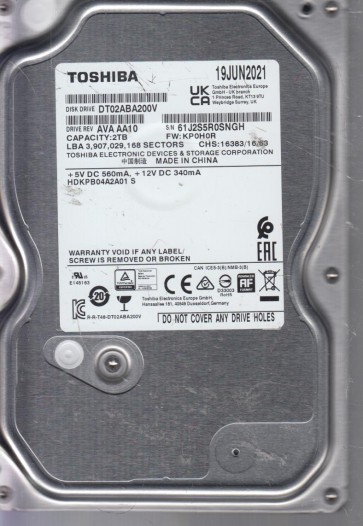
The Toshiba DT02ABA200V is a 2TB 3.5-inch SATA hard disk drive designed for surveillance and video recording applications. It operates at 5400 RPM and uses Conventional Magnetic Recording (CMR) technology. This drive is built with a helium-sealed design to reduce friction and power consumption. Key attributes include a large cache buffer, a robust actuator arm assembly, and a dedicated controller board that manages data flow and head positioning. The drive is rated for 24/7 operation in DVR and NVR systems, meaning it has a high workload rate limit (WRL) compared to standard desktop drives. The platters are coated with a specialized lubricant to withstand continuous read/write cycles. Failure modes for this model often relate to mechanical wear from prolonged use, electronic component degradation due to heat, or firmware corruption from power surges. Understanding these physical and operational characteristics is crucial for selecting the correct recovery approach.
Identifying Common Failure Types
1. Mechanical Head Failure (Clicking/Ticking)
Symptoms include repeated clicking, ticking, or scraping sounds during power-up. The drive may spin but fail to initialize, or it may be recognized intermittently. This typically indicates stiction (head sticking to platter), a crashed head, or a damaged actuator arm. For the DT02ABA200V, prolonged use in high-temperature environments can degrade the head suspension. This is a physical failure requiring specialized cleanroom intervention. DIY attempts to open the drive will almost certainly cause permanent data loss.
2. Electronic Component Failure (PCB/Controller Board)
A drive that is completely silent or spins without being detected by the system often suffers from a failed PCB. This includes blown TVS diodes, damaged preamplifier chips, or corrupted firmware on the controller. The DT02ABA200V uses a specific Marvell controller which is sensitive to voltage spikes. If the drive is not detected in BIOS or shows incorrect capacity (e.g., 0GB), the PCB is a likely culprit. In some cases, a simple component replacement (like a TVS diode) can be performed as a DIY fix, but swapping the entire PCB from a donor drive requires firmware adaptation, which is not trivial.
3. Bad Sector Degradation (Read/Write Failures)
Gradual performance decline, file system errors, or “CRC error” messages indicate bad sectors. The drive may still spin but takes a long time to read data. The DT02ABA200V’s helium seal can leak over time, leading to increased head flight height and surface contamination. This causes a growing number of bad sectors. While software tools can sometimes map out bad sectors, aggressive scanning can further stress the heads and damage the platter surface. This condition is often progressive and requires professional imaging to recover data before the drive fails completely.
4. Firmware Corruption (Drive Not Ready / Busy State)
The drive may spin up normally but become “busy” or “not ready” in disk utilities. The system may see it as an unknown device or require a hard reset. Firmware failure is common in Toshiba drives after power loss or improper shutdown. The drive’s adaptive tables or vendor-specific data may become corrupted. Professional tools like PC-3000 or MRT can repair the firmware without opening the drive. DIY methods are not recommended as incorrect firmware writes can brick the drive permanently.
Potential Recovery Paths
Professional Data Recovery Services (Recommended)
For any mechanical failure (clicking, scratching, head damage) or if the drive has been opened, send it to a professional lab with Class 10 cleanroom capabilities. Specialists can use donor parts from a matching DT02ABA200V drive to rebuild the head stack or perform a platter transplant. For electronic failures, labs use advanced tools to read firmware and perform chip-off recovery when the PCB is unresponsive. Expect costs ranging from $500 to $3000 depending on severity. Labs like Secure Data Recovery or Ontrack offer free evaluation and no-recovery-no-fee policies. Verify that the lab has experience with helium-filled Toshiba drives, as they require specific handling procedures to avoid gas leaks.
DIY Options (For Software/Electronic Issues Only)
PCB Capacitor/Diode Check: If the drive is completely dead, inspect the PCB for burned components. A multimeter can check for shorted TVS diodes (typically near the SATA power connector). Replacing a blown diode with a same-rated part can restore power. This requires soldering skills and a donor diode from a known-good board. Firmware Repair (Advanced): Using tools like PC-3000 or MRT (if you have them) can reinitialize corrupted modules. This is only for experienced technicians. Software Imaging: If the drive spins and is recognized but has bad sectors, use ddrescue on Linux or a professional imager like R-Studio with “read retry” disabled. Set the tool to skip sectors that fail after 3-5 retries. Never attempt a full CHKDSK or format. USB Adapter Hibernation: A USB adapter may not provide enough power for a 5400 RPM drive; use a direct SATA connection or a powered enclosure. If you must use a USB adapter, try a Y-cable for extra power.
What Not to Do
- Never open the drive. The DT02ABA200V is helium-sealed. Breaking the seal introduces contaminants and destroys the internal environment. Any DIY disassembly will void any chance of professional recovery and often results in irreversible platter damage.
- Do not run CHKDSK, format, or file system repair tools. These tools assume the file system is consistent and will overwrite critical directory structures. A failing mechanical drive can crash the heads during error correction.
- Avoid using hard drive recovery software that performs intensive scanning. Tools like TestDisk or Recuva can cause further damage by stressing the actuator. If the drive is clicking, immediately disconnect power to prevent head crashes.
- Do not attempt freezer or shock methods. Placing a modern helium drive in a freezer can cause condensation inside the sealed chamber, leading to head stiction or short circuits. Tapping or dropping the drive can misalign the heads permanently.
- Do not attempt PCB swap without firmware adaptation. Simply swapping the board from a donor drive will not work; the controller chip stores unique adaptive data. Without transferring the original ROM, the drive may spin but never become ready.
Summary
The Toshiba DT02ABA200V is a robust surveillance-grade hard drive but is susceptible to mechanical head failure, electronic component burnout, bad sector degradation, and firmware corruption. For best results, diagnose the failure type first: clicking or scratching means professional service; silent or unrecognized may be a PCB issue; slow performance or errors suggest bad sectors. Professional recovery is mandatory for mechanical and firmware issues. DIY is limited to simple PCB diode swaps or careful software imaging using ddrescue. Never attempt to open the drive or run repair utilities. Prioritize stopping use immediately upon failure to maximize recoverability. Always consult a certified lab with helium drive experience if data is critical.