
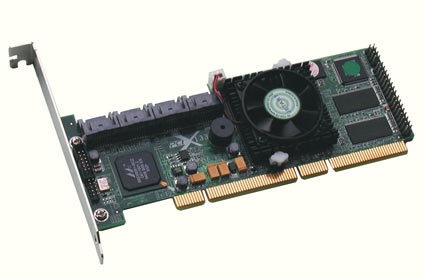
Fierce competition dominates the market for professionally-equipped Serial ATA RAID controllers. Shortly after manufacturers HighPoint and Promise became the first to launch their PCI-based products on the market, more well-known names like Adaptec and LSI Logic followed suit. A year ago, RAIDCore and NetCell also debuted their products, and made a good impression from the word go.
All of these manufacturers concentrated primarily on making their products better suited to the professional market, and are focusing particularly on offering devices on the PCI-X interface . Now, Taiwanese manufacturer Areca hopes to go them one better by supporting RAID 6.
RAID controllers are used most often in business settings, particularly for servers. The point of RAID is to increase the performance of the storage subsystem when using numerous hard drives simultaneously, and also protecting against data loss due to hard drive crashes. Even if regular backups are used, constant availability of storage systems is invaluable for business workflows, and this is what RAID provides.
A RAID Level 5 array is a common type, used in most normal business situations. In this arrangement, when data is written to the array, it is distributed to all drives but one. The controller generates a checksum (parity information) for the data set written, and writes the checksum to the final hard drive. This can be used to reconstruct the data if any one drive is lost. At the same time, performance is improved because data is being written to (or read from) many drives in parallel.
In RAID5, the drive chosen for the checksum changes for each data block written. Thus, it is an enhancement of RAID3, where a single dedicated drive is used for all checksums. RAID5 improves performance because in RAID3 the dedicated parity drive can create a bottleneck.
But there are also cases in which higher reliability is needed than can be met by RAID 5. Areca addresses this by offering the option of setting up a RAID 6 array. RAID 6 is like RAID 5 but uses two drives for parity data, which means two drives can fail without data loss. Naturally, this requires another hard drive to be put in the array. We took a close look at how well this RAID level functions, and how well it performs.