
Data recovery on vintage hard drives like the Maxtor 90430D3 starts with identifying the failure type – electronic, firmware, or mechanical. Each requires a different approach, and misdiagnosis can make things worse. Here’s a quick guide to help you assess your situation and decide on the next step.
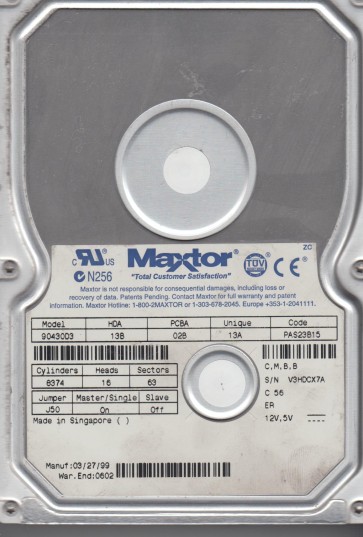
The Maxtor 90430D3 is a legacy hard disk drive from the early 2000s, part of Maxtor’s DiamondMax family. It features a 40 GB platter capacity, a 5400 RPM spindle speed, and an Ultra ATA/100 interface. This drive utilizes Giant Magnetoresistive (GMR) heads and a fluid dynamic bearing (FDB) motor in later revisions. Known for its vulnerability to head stiction and logic board failure due to aging capacitors, it is considered a challenging candidate for data recovery. The drive’s controller board (PCB) is highly sensitive to power surges and electrostatic discharge. Successful recovery often requires specialized tools and cleanroom access due to its age and construction.
Identifying Common Failure Types
1. Mechanical Failure: Head Crash or Stiction
Symptoms include audible clicking, grinding, or a repeated “tick” sound. The drive may spin up but fail to be detected. The most common cause is the read/write head contacting the platter surface (head crash), or the head parking ramp mechanism failing. Stiction occurs when the head sticks to the platter due to degraded lubricant. This is a hardware failure. Recovery requires professional cleanroom intervention to replace heads or extract platters.
2. Electronic Failure: PCB or Firmware Corruption
The drive may power on but be unrecognized, report a wrong capacity, or show no activity. This often stems from failed capacitors on the PCB, damaged preamplifier IC, or corrupted firmware modules. Symptoms can include the drive spinning fine but clicking after a few seconds. This is a hardware/software hybrid failure. A donor PCB with matched firmware is needed. The firmware is stored in the drive’s ROM and on a system area on the platters. Corrupted firmware can often be repaired with specialized tools like PC-3000 or a SeDiv.
3. Logical Failure: File System or Partition Corruption
The drive spins normally, is detected by the BIOS, but the operating system cannot read data, shows an unformatted partition, or prompts to initialize the disk. This is a pure software issue. Causes include improper shutdown, virus attacks, or accidental formatting. The underlying hardware is intact. Recovery is possible via software tools like R-Studio or DMDE, or by booting a live Linux environment to mount the drive read-only. No physical repair is needed.
4. Motor or Spindle Motor Failure
The drive will not spin up at all, or makes a high-pitched whine. The platters may be seized. This is a hardware failure. Often caused by a locked spindle bearing due to wear or contamination. DIY attempts are extremely risky. Professional recovery requires transplanting platters into a donor drive with a working motor assembly, a delicate procedure requiring a cleanroom.
Potential Recovery Paths
Professional Service
For any mechanical, electronic, or firmware failure, a professional data recovery lab is the only safe option. Look for labs that advertise experience with Maxtor drives and have cleanroom capabilities (Class 10 or better). Expect costs from $300 to $2000+ depending on the extent of damage. Labs use tools like PC-3000, DeepSpar Disk Imager, and specialized software to extract firmware and create sector-by-sector images. For the 90430D3, they may need to replace the head stack assembly (HSA) or the entire PCB. Do not attempt to open the drive yourself.
DIY Methods
For logical failures only: If the drive is detected but not accessible, try using a live Linux USB (Ubuntu) to mount the drive read-only and copy data. Alternatively, use software like R-Studio or TestDisk. Never write to the drive. For electronic failures (PCB swap): A donor PCB from an identical drive (same model, firmware revision, and date code) may work. Remove the original PCB carefully, clean the contact pads, and install the donor. This is risky because the firmware is matched to the drive’s unique head mapping. A mismatch will cause clicking and possible head damage. Only attempt this if you have a matching board and can transfer the original ROM chip. Never attempt to open the drive enclosure. DIY is not recommended for click, grinding, or no-spin issues.
What Not to Do
– DO NOT apply power repeatedly to a clicking or grinding drive. This can destroy the platter surface and heads. – DO NOT attempt to open the drive housing. The internal environment is class 100 cleanroom sealed. A single dust particle can ruin the platters permanently. – DO NOT use data recovery software on a mechanically failing drive. Running software like chkdsk, Disk Utility, or even a simple file copy can cause further damage. – DO NOT attempt to freeze the drive. This is a myth and can cause condensation, destroying the drive. – DO NOT tap or shake the drive to free stuck heads. This can cause head crashes. – DO NOT attempt a firmware fix if you lack proper tools. Writing incorrect firmware can render the drive unrecoverable. – DO NOT ignore warning sounds. Any unusual noise indicates a serious mechanical fault. Power off immediately.
Summary
The Maxtor 90430D3 is a vintage drive prone to head crashes, PCB failures, and logical errors. The key to recovery is correctly diagnosing the failure type. If the drive clicks, grinds, or fails to spin, stop all attempts and contact a professional lab. For logical errors (unreadable partitions), DIY software recovery is viable. For PCB issues, a matched donor board with ROM transfer may work but carries risks. Never attempt to open the drive or run destructive software. Prioritize creating a sector-by-sector image before any recovery attempt. Data recovery from this drive is complex and time-sensitive; acting quickly and correctly is critical to success. Professional assistance is strongly recommended for all hardware faults.