
Data recovery on vintage hard drives like the Western Digital WD64AA starts with identifying the failure type – electronic, firmware, or mechanical. Each requires a different approach, and misdiagnosis can make things worse. Here’s a quick guide to help you assess your situation and decide on the next step.
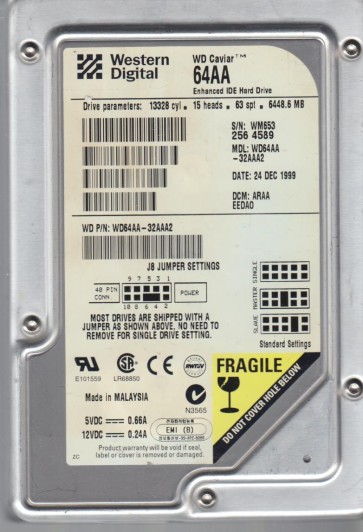
The Western Digital WD64AA is a legacy hard disk drive, typically from the Caviar family, known for its 64GB capacity, 5400 RPM spindle speed, and an EIDE/ATA interface. As an older drive, it is particularly susceptible to age-related failures. Key characteristics include a single-platter design (likely) and a high-density recording for its time. Understanding its mechanical nature and reliance on a specific controller chipset is critical for recovery planning. The drive’s firmware manages everything from head positioning to error correction, making it a focus point for both functional and non-functional issues.
Common Failure Types
1. Mechanical Failure (Head Crash / Stiction)
Symptoms: Loud clicking, grinding, or a high-pitched whine. Drive fails to spin up or spins up and immediately stops. Could be caused by a sudden shock, general wear, or parking mechanism failure. The read/write head makes contact with the platter surface, or the spindle motor seizes (stiction). This is the most severe failure type.
2. Firmware / Electronic Failure
Symptoms: Drive spins up but is not detected by BIOS/OS. It may report a 0GB capacity or a “SMART status bad” error. Cause can be a damaged system area (SA) on the platter, corrupted firmware modules, or a failed controller board component (e.g., TVS diode, preamp). The WD64AA often uses a Marvell or similar controller which can suffer from electrostatic discharge or age-related degradation.
3. Logical / File System Corruption
Symptoms: Drive is detected and spins normally, but shows as “uninitialized” or “RAW”. Files are missing, directories are corrupted, or Windows prompts to format the drive. This is often due to improper shutdowns, bad sectors that corrupt the Master File Table (MFT) or File Allocation Table (FAT32-based systems), or operating system errors. No physical damage to platters or heads.
4. Bad Sectors (Degradation)
Symptoms: System hangs when accessing certain files, slow read/write speeds, frequent CRC errors. SMART data shows increasing reallocated or pending sector counts. This is often a precursor to mechanical failure. The magnetic coating on the platters degrades over time, causing data loss in specific areas. The drive firmware attempts to remap these sectors, but capacity and performance degrade.
Potential Recovery Paths
DIY Methods (For Logical Issues Only)
Attempt these if and only if the drive is detected normally and makes no abnormal sounds. Use a write-blocker to prevent any accidental writes to the drive. Software tools like TestDisk or PhotoRec can scan for lost partitions and file headers. A sector-by-sector cloning tool (e.g., ddrescue or HDDSuperClone) can first image the drive to a healthy disk, skipping bad sectors. Do not attempt to repair the file system (chkdsk /f) on the failing drive itself; only on the cloned image. Always power cycle the drive several times if it is not recognized, as a transient electrical issue may be the cause.
Professional Service (For Mechanical / Firmware / Complex Issues)
For mechanical failures like head crashes or stiction, a Class 100 (or better) cleanroom is mandatory. A professional lab will replace the read/write head assembly with a compatible donor head from an identical drive (same head model, same firmware revision). For firmware damage, tools like PC-3000 or DeepSpar can access the system area, rewrite corrupt modules, or rebuild the translator. This is not a DIY task. For electronic failures, the lab can either repair the controller board (e.g., replace a burnt TVS diode) or perform a ROM transplant to a donor board. Costs typically range from $300 to $1500+ depending on the severity and required work.
What Not to Do
– Do not open the hard drive casing or attempt to see the platters. Even a single dust particle or fingerprint can destroy the magnetic surface and permanently lose data. The drive’s internal environment is filtered and sealed.
– Do not apply power to a drive that is making clicking or grinding sounds. Continuing to run a drive with a damaged head can cause it to scrape the platter surface, carving away data. Immediately power it off and seek professional help.
– Do not use disk utility software like chkdsk, fsck, or format on a drive you suspect is failing. These tools attempt to “fix” errors by writing to the drive, which can overwrite the very data you are trying to recover. Always work on a clone or image.
– Do not attempt to replace the controller board yourself by just swapping identical model numbers. The drive stores unique calibration data (adaptive parameters) in the ROM on the original board. A simple swap may not work and can cause further electronic damage. Professional adaptation requires reading and writing the ROM.
– Do not attempt to freeze the drive. This is an urban legend. Putting a hard drive in the freezer can cause condensation to form on the platters, leading to catastrophic corrosion and head crash upon power-up. It provides no reliable benefit for mechanical failures.
Summary
The Western Digital WD64AA is an aging hard drive particularly vulnerable to mechanical (head crash/stiction) and firmware issues. Logical corruption and bad sectors are also common. For any sign of physical trauma or abnormal noise, stop all DIY attempts and engage a professional data recovery lab. DIY recovery is only safe for logical errors (RAW drive, deleted files) using read-only methods. Avoid all risky actions like freezing, opening the drive, or running repair software on the original drive. A proper clone followed by file system repair is the safest general approach. The cost of professional recovery is almost always less than the value of the lost data.