
Data recovery on vintage hard drives like the Seagate ST3400633A starts with identifying the failure type – electronic, firmware, or mechanical. Each requires a different approach, and misdiagnosis can make things worse. Here’s a quick guide to help you assess your situation and decide on the next step.
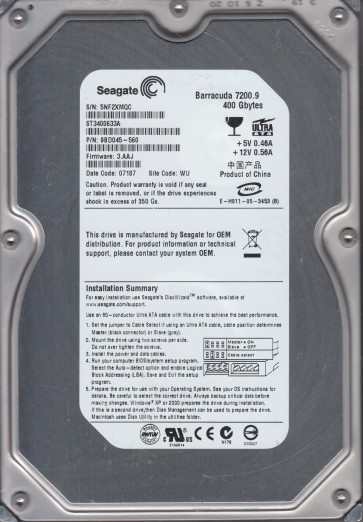
The Seagate ST3400633A is a 40GB 3.5-inch Parallel ATA (PATA) hard drive utilizing 3.5-inch platters and a spindle speed of 7200 RPM. It belongs to the older generation of drives known for their single-platter design and relatively simple electronic architecture compared to modern drives. Understanding that this drive uses a 40-pin IDE connector and operates with legacy power is critical. It is a 40GB model which indicates it uses older Giant MagnetoResistive (GMR) head technology and is typically found in systems from the early to mid-2000s. The drive’s controller board is sensitive and the mechanical components, particularly the read/write heads and motor bearings, are susceptible to age-related degradation. Data stored on this drive is at risk due to both physical wear and logical corruption common in older FAT32/NTFS file systems.
Identifying Common Failure Types
1. Electronics Failure (PCB / Controller Board)
The printed circuit board (PCB) on the bottom of the drive can fail due to power surges, capacitor aging, or component burnout. A classic symptom is the drive being completely dead: no spin-up sound, no drive detection in BIOS, and no audible clicks. Another common issue is the TVS (Transient Voltage Suppression) diode shorting, which protects the drive but effectively kills the power to the motor. Users may smell burning or see a blown diode visually. This is often a “repairable” failure at the board level. A less common issue is a failed preamplifier chip on the PCB which might cause sporadic detection but no data access.
2. Mechanical Failure (Head Crash / Motor Stiction)
Mechanical failure is serious. The most common is a “head crash” where the read/write heads physically contact the platter surface, scraping off the magnetic coating. Symptoms include a loud clicking or scraping sound (click of death) and the drive may spin up and then immediately stop. Another mechanical failure is “motor stiction” where the spindle motor bearings seize after long periods of inactivity (common in old drives). The drive may hum but not spin, or spin up very slowly. Mechanical failures require a cleanroom environment for repair. A head crash will produce visible scratches on the platter, making data irrecoverable on that section.
3. Logical / Firmware Corruption
The ST3400633A is known for firmware issues, particularly the LBA (Logical Block Addressing) table corruption or translator module damage. Symptoms include the BIOS detecting the drive but reporting an incorrect capacity (e.g., 0MB, 32GB, or a very small fraction), or the drive making a repetitive clicking sound after initial spin-up (often mistaken for a head crash). Another logical failure is “media scan” issues where the drive has bad sectors that cause the computer to hang when trying to access specific files. This can be caused by a failed file system (e.g., corrupted FAT/MFT) or a failing read/write channel. Logical failures are often recoverable with software but may require firmware-level tools.
4. Bad Sectors / Media Degradation
Over time, the magnetic platters can develop weak magnetic domains leading to Bad Sector or “S.M.A.R.T. status: bad” warnings. The drive may work but become excessively slow when reading certain areas. This is a sign of physical media degradation, not a head crash. The drive may also remap sectors, causing a slow-but-steady degradation. If the drive has hundreds of reallocated sectors in S.M.A.R.T. data, immediate cloning is recommended. This is often a precursor to a complete head failure.
Potential Recovery Paths
Professional Recovery Services
For any physical damage (head crash, motor seizure, burnt PCB, or unusual sounds), professional data recovery is required. A lab will perform a cleanroom transplant (replacing heads or platters) or PCB repair with firmware adaptation. For a Seagate ST3400633A, professional recovery costs typically range from $500 to $1500 USD depending on the severity and the lab’s expertise. This is the only safe path for mechanical failures and firmware errors that are not software-accessible. For PCB failures, a professional will either repair the existing board or source a matching donor board that has the exact same firmware revision, then transfer the drive’s ROM chip (if necessary). For head crashes, the lab will open the drive in a Class 100 or better cleanroom to replace the head stack assembly (HSA). Professional recovery is the only viable option for audio/data loss from a physically damaged drive.
DIY Recovery Options (Software / Logical Issues Only)
WARNING: DIY methods should only be attempted if the drive has NO abnormal sounds (clicking, grinding, scraping) and is detected by the computer with the correct model number and capacity. Any physical damage left unaddressed will worsen with DIY attempts.
- Step 1: Immediate Cloning. Do not work directly on the failing drive. Use a USB-to-IDE adapter (powered by a Molex power supply if needed, as USB bus power may be insufficient). Connect the drive as a secondary drive. Use a disk imaging tool such as HDDSuperClone (Linux Live CD) or ddrescue (GNU ddrescue). Create a sector-by-sector image to a healthy drive. This preserves the original data if the drive fails further. Command:
ddrescue -d /dev/sdX /mnt/image.img /mnt/logfile.log. This will handle bad sectors. - Step 2: File System Repair. Once you have a cloned image, work on the image file or the cloned drive using TestDisk or Recuva to recover lost partitions and files. For a corrupt file system, run
chkdsk /fon the image (not the original drive) but only as a last resort. - Step 3: Firmware Repair (Advanced DIY). If the drive is detected with wrong capacity but no physical symptoms, advanced users can attempt to rebuild the translator using tools like MHDD (running from a DOS boot disk). Commands like
NHPAorERASEare dangerous. Only attempt this with a full backup of the drive’s firmware modules. Do not attempt if you have no experience with ATA commands.
What Not to Do
- NEVER open the drive. Seagate ST3400633A is not sealed in a vacuum, but the internal environment is extremely sensitive to dust and humidity. Even a single fingerprint on a platter can destroy the delicate surface. Opening the drive outside a cleanroom will render professional recovery impossible.
- Do not power cycle repeatedly. If the drive makes a clicking or scraping noise, power it off immediately. Repeated attempts to spin up can cause the heads to crash further into the platters, scraping off more data.
- Avoid data recovery software on the failing drive. Do not run Recuva, EasyRecovery, or similar tools directly on the failing drive. This forces the heads to read bad sectors, causing strain and possible head failure. Always clone first.
- Do not use freezer trick (putting the drive in a freezer). This old myth can cause condensation, corrosion, irreversible platter damage, and motor bearing seizure. It is never a solution for any modern or legacy PATA drive.
- Do not attempt PCB repair without proper tools. Using a generic soldering iron to replace a TVS diode can damage the PCB layer or short other components. Always use a hot air station and proper ESD precautions. Improper repair can introduce additional electrical faults.
- Never use drive-manufacturer diagnostic tools like Seagate’s SeaTools if the drive is failing. These tools can issue low-level format commands or write zeros to bad sectors, permanently erasing your data. Only use them on a healthy drive.
Summary
The Seagate ST3400633A is an aging PATA drive vulnerable to mechanical, electrical, and logical failures. The most critical first step is to correctly diagnose the failure type based on symptoms: no sound = PCB failure; clicking/scraping = head crash; humming no spin = motor stiction; detection with wrong capacity = firmware issue. For any physical symptom, professional recovery is mandatory as DIY attempts using software or opening the drive will cause permanent data loss. For logical issues (bad sectors, deleted files, partition loss) where the drive is quiet and fully detected, a careful DIY cloning process using ddrescue or HDDSuperClone onto a healthy drive is the safest path. Always prioritize cloning over direct repair. Never ignore warning signs like unusual sounds or a burning smell. With correct handling, data from this classic drive can often be successfully recovered.