
Data recovery on vintage hard drives like the Toshiba MK1926FCV starts with identifying the failure type – electronic, firmware, or mechanical. Each requires a different approach, and misdiagnosis can make things worse. Here’s a quick guide to help you assess your situation and decide on the next step.
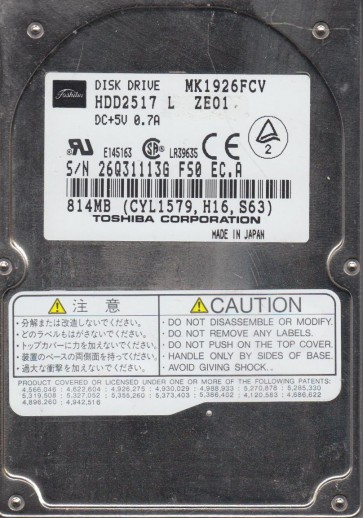
The Toshiba MK1926FCV is a 2.5-inch PATA (Parallel ATA) hard disk drive with a 192.6GB capacity and a rotational speed of 4200 RPM. It belongs to the MKxx26FCV family, typically used in consumer laptops and external enclosures from the mid-2000s era. This drive uses traditional magnetic recording (PMR) technology and a standard SATA-to-PATA bridge adapter in some external configurations. Key failure points include the aging spindle motor bearings, deteriorating read/write heads, and the weak 50-pin IDE connector. Because of its age (circa 2008), NAND-based degradation is not applicable, but mechanical wear is the primary concern. The drive firmware and controller board (PCB) are also vulnerable to electrical surges and component drift.
Identifying Common Failure Types
1. Mechanical Failure (Head Crash or Stiction)
Symptoms include clicking, grinding, or screeching noises when powered on. The drive may spin up but fail to initialize (no recognition in BIOS). This is often caused by physical contact between the read/write head and the platter surface, leading to media damage. For the MK1926FCV, head stiction is common after prolonged inactivity due to lubricant degradation. Data recovery is complex and typically requires a cleanroom environment.
2. Electronic Failure (PCB Failure)
The drive may be completely silent or show no signs of life (no spin-up). This is often indicated by a burned component on the circuit board, such as a TVS diode or the preamplifier chip. The MK1926FCV’s PCB is susceptible to voltage spikes from failing external power adapters. In some cases, the firmware stored on the PCB’s ROM can become corrupted, causing the drive to be detected with a wrong model or capacity (0GB).
3. Logical Failure (Corrupted File System)
The drive spins up and is detected, but the operating system reports it as “unallocated” or “raw,” or you encounter “disk not formatted” errors. This is often due to a corrupted MBR (Master Boot Record), partition table, or directory structure. For the MK1926FCV, this commonly results from improper shutdowns, bad sectors causing file system corruption, or virus attacks. The data is often still intact but inaccessible through standard OS tools.
4. Bad Sectors / Degraded Media
The drive may be unusually slow during read/write operations, frequently freeze, or produce “CRC errors” and “S.M.A.R.T. errors” (especially Reallocated Sector Count or Current Pending Sector count). This indicates that the magnetic media is physically deteriorating. The MK1926FCV is prone to developing a “touchdown” zone of damaged sectors near the inner diameter (ID) of the platters after years of use.
Potential Recovery Paths
Professional Data Recovery Services
Recommended for: Mechanical failures (head crash, stuck spindle, clicking), severe electronic damage (burned PCB), or when the drive has valuable or irreplaceable data. Process: A professional lab (e.g., DriveSavers, Secure Data Recovery) will assess the drive, perform a cleanroom head swap (replacing the heads with a compatible donor from a working MK1926FCV), or repair the PCB (e.g., replacing a blown TVS diode or transferring the original U12 ROM chip to a donor board). For logical issues, they will clone the drive sector-by-sector using specialized tools like PC-3000 or DeepSpar, bypassing bad sectors. Cost: Typically $500-$3000+ depending on severity. Success Rate: High (70-90%) for non-damaged platters.
DIY Recovery Methods (Software/Logical Issues Only)
Caution: DIY methods are only safe for logical failures or minor bad sectors. Do not attempt on a clicking drive. Step 1: Use a known-good PATA-to-USB adapter or connect directly to a desktop motherboard via IDE. Ensure the jumper is set to “Master” or “Cable Select.” Step 2: Download and boot from a live Linux distribution (e.g., Ubuntu) to avoid writing to the drive. Use `ddrescue` (via terminal) to create a disk image to a healthy large drive: `sudo ddrescue -d -f /dev/sdX /mnt/destination/image.img /mnt/destination/mapfile.log`. The `mapfile.log` allows you to retry bad sectors. Step 3: After imaging, attempt file recovery from the image using software like R-Studio, GetDataBack, or TestDisk. TestDisk can recover a lost partition table. Step 4: For severe bad sectors, freeze the drive’s PCB by placing it in a sealed anti-static bag inside a freezer for 2-3 hours (temporary fix to reduce bearing friction) and then attempt a single-pass ddrescue run. Do not leave the drive powered on for long.
What Not to Do
- Do not power on a clicking or grinding drive repeatedly. Each spin can cause further platter damage, making data unrecoverable.
- Do not open the drive enclosure. The MK1926FCV is not sealed in a cleanroom environment. Dust particles will destroy the heads and platters instantly.
- Do not attempt to write data to the drive. This includes running chkdsk /f, format, or installing an OS. Writing can overwrite the data you need.
- Do not use software recovery tools on a failing drive with bad sectors. Tools like Recuva or EaseUS Data Recovery scan the entire drive, which can stress the heads and cause the drive to fail completely.
- Do not try to swap the circuit board without transferring the original ROM (U12) chip. The firmware on the PCB is unique to each drive. Swapping boards without transferring the 8-pin SPI ROM will result in the drive not being recognized or reporting a wrong capacity.
- Do not use a standard USB-to-IDE adapter for data recovery if the drive is dying. Poor power delivery can cause read instability. Use a powered USB hub or direct motherboard connection.
Summary
The Toshiba MK1926FCV is an aging laptop hard drive prone to mechanical wear, electronic failure, and logical corruption. For any physical failure (clicking, no spin, burned PCB), professional recovery is the only safe and likely successful path. DIY recovery is limited to scenarios where the drive is fully detected and spinning normally but has logical damage (corrupted file system, deleted files) or a manageable number of bad sectors. Never attempt to repair the drive mechanically yourself (opening it, swapping heads). The most effective DIY strategy is to create a sector-level clone using `ddrescue` onto a healthy drive, then run file recovery software on the clone. Always prioritize the safety of the original drive by minimizing power-on time and avoiding any write operations.