
Data Rescue is a professional-grade data recovery software designed to retrieve lost, deleted, or inaccessible files from various storage devices, including hard drives, SSDs, USB flash drives, memory cards, and RAID arrays. Developed by Prosoft Engineering Inc., a California-based company founded in 1985 with a background in Mac utility software, Data Rescue has been one of the most recognized names in data recovery for nearly two decades, particularly within the Mac community.
Data recovery software is non-destructive and read-only, capable of providing safe and accurate retrieval of data from inaccessible, formatted, corrupted, or undetectable storage media. All data including photos, pictures, videos, audio files, music, documents, emails, archives, and other file types lost due to accidental deletion, virus damage, drive corruption, formatting, partition loss, software failure, or system crash can be effectively recovered from all types of storage devices such as internal/external HDDs, SSDs, USB flash drives, pen drives, thumb drives, SD cards, memory sticks, and digital cameras.
Data Rescue works with storage devices of all capacities and supports both Windows and macOS platforms. The software has been used by home users, forensic recovery teams, law enforcement, all major branches of the U.S. military, and major intelligence agencies.
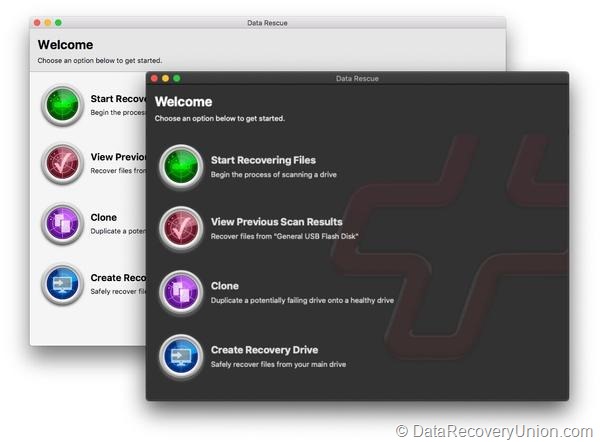
Key Features of Data Rescue
Here are the key features typically associated with Data Rescue:
Comprehensive Device Support
- Storage Devices: Supports HDD, SSD, USB flash drive, memory card (SD, microSD, CompactFlash), external hard drive, digital camera, and more.
- RAID Support: Supports RAID 0 and JBOD configurations in Professional versions.
- Disk Interfaces: Compatible with SATA, IDE, USB, and FireWire interfaces.
Multiple Data Loss Scenarios
- Accidental Deletion: Recovers files deleted from Recycle Bin (Windows) or Trash (Mac) or using permanent deletion commands.
- Formatting Recovery: Retrieves data from drives that have been quick-formatted or fully formatted.
- Partition Recovery: Restores lost or deleted partitions and rebuilds corrupted partition tables.
- Corrupted Drive Recovery: Extracts data from drives that appear as RAW or are inaccessible.
- System Crash Recovery: Creates bootable recovery drives to recover data from unbootable computers.
- Virus Attack Recovery: Recovers files hidden, deleted, or encrypted by malware.
File System Compatibility
Works with multiple file systems across different operating systems:
- Windows: FAT16, FAT32, exFAT, NTFS, ReFS
- macOS: HFS+, APFS (including encrypted and Fusion Drives)
- Linux: Ext2, Ext3, Ext4
- Other: XFS, UFS, and various RAID formats
Three Scan Modes
Data Rescue features multiple scan technologies for different recovery scenarios:
- Quick Scan: For recently deleted files and simple recovery scenarios. Fast and efficient for standard deletions.
- Deep Scan: For formatted, corrupted, or severely damaged drives. Scans every sector of the drive using signature-based recovery technology.
- File System Reconstruction: Attempts to rebuild corrupted file system structures to recover folder hierarchies.
Reconstruction Mode
One of Data Rescue’s standout features is its ability to reconstruct folder hierarchies when the file system is damaged. When standard scans cannot determine the original directory structure, Reconstruction Mode attempts to piece together folder structures from file system fragments and directory entries.
File Preview Functionality
Allows users to preview recoverable files before initiating the recovery process. The preview feature supports a wide range of file types including images, documents, videos, and audio files. This enables you to verify file integrity and content before committing to recovery, ensuring you only recover files that are intact and needed.
Selective & Filtered Recovery
Provides the option to selectively recover specific files or folders rather than restoring the entire drive content. You can browse the scan results, filter by file type, size, or date modified, and recover only what you need.
Clone/Image Creation
Data Rescue includes disk imaging capabilities, allowing you to create a sector-by-sector backup of a failing or problematic drive. This is particularly useful when the source drive has bad sectors or is physically unstable. You can then recover files from the disk image instead of the failing drive, reducing stress on the original hardware.
Bootable Recovery Drive
Creates bootable recovery USB drive for Mac, enabling data recovery from computers that fail to boot due to system crashes, blue screen errors, or other startup issues. This feature is especially important for Mac users, as macOS can be more difficult to recover from a non-booting state.
Real-Time Drive Health Monitoring
Data Rescue includes monitoring tools that track drive health and alert you to potential failures before data loss occurs. This proactive feature can help you back up important data before a drive fails completely.
Supported File Types
Data Rescue supports recovery of hundreds of file types across all major categories, including:
| Category | Supported File Extensions |
|---|
Documents
DOC, DOCX, XLS, XLSX, PPT, PPTX, PDF, RTF, TXT, HTML, XML, ODT, ODS, ODP, PAGES, NUMBERS, KEY, WPS, PST, EML, MSG, MBOX, VCF, CSV, INI, LOG, CHM, HLP, MDB, ACCDB, SQLITE, One, ORF, PSP, PSD, PUB, QBB, QBW, QDF, QEL, WK4, WPD, WPS, XLR, XLSM, XLSX, XLT, XLTX, XLW, XPS, ZDB, ZUT, 3DM, 3DS, 3FR, 3G2, 3GA, 3GP, 3MF
Images & Graphics
JPG, JPEG, PNG, BMP, GIF, TIFF, PSD, CR2, CR3, NEF, ORF, RAW, ARW, DNG, HEIC, HEIF, WEBP, SVG, AI, EPS, CDR, DWG, DXF, ICO, CUR, ANI, WMF, EMF, PCT, PIC, PCX, PPM, PGM, PBM, XBM, XPM, TGA, VSD, VSDX, CDR, CGM, HPGL, PLT
Audio & Video
MP3, WAV, WMA, AAC, FLAC, M4A, OGG, MKA, APE, AU, AIFF, MID, MIDI, RA, RAM, RM, AVI, MP4, MOV, WMV, MKV, FLV, 3GP, MTS, M2TS, M4V, MPEG, MPG, RMVB, VOB, SWF, ASF, DVR-MS, DVR, IVF, M1V, M2P, M2T, M2TS, M2V, M4E, M4U, M4V, MJ2, MJPEG, MJPG, MK3D, MKS, MKV, MOV, MP2, MP2V, MP4, MP4V, MPA, MPE, MPEG, MPG, MPV2, MPV4, MPV, MQV, MSWMM, MTS, MXP, MXF, NSV, NUV, OGM, OGV, OMG, OMV, PSS, PVA, PVR, RM, RMVB, ROQ, RPL, RT, RTS, RTV, SDP, SER, SMK, SMO, SMV, SPL, SQZ, SSM, STR, SUP, SVCD, SWF, THP, TMF, TP, TPR, TRP, TS, TTS, TUD, TVG, TY, TY+, ULR, UNC, USM, VCD, VDR, VEV, VFW, VIV, VOB, VP6, VP7, VP8, VR, VRM, VRO, VTX, WCP, WEBM, WLMP, WM, WMV, WMX, WV, WVX, WX, XEA, XEL, XFL, XMV
How to Use Data Rescue
Follow these steps to recover your lost data using Data Rescue:
- Download and Install – Download Data Rescue from the official website. Important: Do not install the software on the drive from which you want to recover data, as this may overwrite lost files. Install it on your local hard drive or another safe location.
- Launch and Select Recovery Mode – Launch Data Rescue. The software offers different recovery modes:
- Quick Scan: For recently deleted files
- Deep Scan: For formatted or corrupted drives
- Reconstruction Mode: For rebuilding folder structures
- Select the Target Drive – Choose the drive, partition, or storage device you want to scan. Data Rescue displays both connected drives and physical disks for easy selection.
- Configure Scan Settings – Select the file types you want to recover (Documents, Images, Videos, Audio, Archives) to speed up the scan. You can also choose to scan the entire drive or only specific areas.
- Scan the Drive – Click “Start Scan” to begin the recovery process. Data Rescue displays found files in real-time as the scan progresses. Scan time depends on drive size and condition – a deep scan of a 1TB drive may take several hours.
- Preview and Recover – Once scanning is complete, browse the recoverable files. Files are organized by file type and by folder structure when available. Use the preview function to verify file integrity. Select the files or folders you wish to restore, then click “Recover” and save them to a different drive to avoid data overwriting.
Editions and Pricing
Data Rescue offers multiple editions to accommodate different user needs:
| Edition | Price | Description |
|---|---|---|
| Free Trial / Demo Version | Free | Allows scanning and previewing of recoverable files. Recovery is disabled or limited in the trial version. Use the trial to verify that your files can be recovered before purchasing. |
| Data Rescue Standard (Mac) | Approximately $79 (one-time) | For home users. Recovers from HDD, SSD, USB, memory cards. Includes Quick Scan, Deep Scan, and file preview. One user, one computer. |
| Data Rescue Professional (Mac) | Approximately $119 (one-time) | Adds RAID 0 and JBOD recovery, reconstruction mode, bootable recovery drive creation, and priority support. |
| Data Rescue for Windows | Approximately $79 (one-time) | Full recovery capabilities for Windows users. Includes all standard features. |
Note: Data Rescue is known for being one of the leading data recovery solutions for Mac users, with a long history dating back to the early 2000s. The Professional version is recommended for users who need RAID recovery or bootable media capabilities.
System Requirements
Before installing Data Rescue, ensure your system meets the following requirements:
- Processor: Intel or Apple Silicon processor (Mac) / Intel-compatible processor (Windows)
- RAM: 2GB minimum (4GB recommended)
- Hard Disk Space: 100MB for software installation, plus additional space for recovered files
- Supported Operating Systems (Mac):
- macOS Sonoma, Ventura, Monterey, Big Sur, Catalina, Mojave
- macOS High Sierra, Sierra, El Capitan
- Supported Operating Systems (Windows):
- Windows 11, 10, 8.1, 8, 7 (32-bit and 64-bit)
- Windows Server 2022, 2019, 2016, 2012
- Permissions: Administrative privileges required for installation and certain recovery operations
Known Limitations
While Data Rescue offers professional-grade recovery features, users should be aware of the following limitations:
- No Free Recovery Tier: The free trial version allows scanning and previewing only. You cannot recover any files without purchasing a license, unlike some competitors that offer 1GB-2GB free recovery.
- Price Higher than Some Competitors: Data Rescue’s pricing ($79 Standard, $119 Professional) is higher than some alternatives like Disk Drill ($89) or EaseUS ($149 lifetime) but comparable to other professional tools.
- Mac-Focused History: While Data Rescue is now available for Windows, its strongest feature set and longest history are on macOS. Windows users may find other tools more feature-rich.
- Deep Scans Take Time: Deep scanning large capacity drives (2TB+) can take many hours. A 2TB drive may take 3-6 hours or more for a complete deep scan.
- Physical Damage Not Covered: Cannot recover data from physically damaged drives (broken connectors, burned circuit boards, water damage, or mechanical failures). Hardware repair is required first.
- Overwritten Data Cannot Be Recovered: If lost files have been overwritten by new data on the drive, recovery becomes impossible regardless of software quality.
- TRIM on SSDs: On modern SSDs with TRIM enabled, recently deleted files may be permanently erased almost immediately due to garbage collection. This affects all data recovery software, including Data Rescue.
- Limited File System Preview: Some users report that the file preview feature does not work for all file types, particularly older or less common formats.
Comparison at a Glance
| Feature | Data Rescue | Typical Competitors |
|---|---|---|
| Free Tier | Scan & preview only (no recovery) | Often 1GB-2GB free recovery |
| Lifetime License | ✓ One-time payment ($79-$119) | Often $70-$150 one-time |
| RAID Recovery | ✓ RAID 0 and JBOD (Professional) | Rarely available or limited |
| File Preview | ✓ Included | Standard feature |
| Bootable Media | ✓ Included (Professional) | Often premium feature |
| Disk Imaging | ✓ Included | Not always available |
| Reconstruction Mode | ✓ Unique feature | Not typically available |
| Platforms | Windows & Mac | Often Windows only |
Common Data Loss Scenarios Where Data Rescue Excels
- Accidental Deletion on Mac: For Mac users who have emptied the Trash or permanently deleted files, Data Rescue is a trusted solution with decades of Mac experience.
- APFS Recovery: Data Rescue has strong support for Apple’s APFS file system, including encrypted APFS and Fusion Drives, which some competitors struggle with.
- Formatting Recovery: Whether quick format or full format on Mac or Windows drives, Data Rescue can retrieve data through Deep Scan.
- Corrupted or RAW Drive: When the file system is damaged, Data Rescue’s Reconstruction Mode can attempt to rebuild folder structures from fragments.
- System Crash on Mac: When macOS won’t boot, Data Rescue’s bootable recovery drive feature allows recovery without a working operating system.
- USB Drive and Memory Card Recovery: Effective for recovering photos and videos from corrupted memory cards.
- RAID 0 and JBOD Recovery: The Professional version can recover data from simple RAID configurations.
Support and Customer Service
Prosoft Engineering offers customer support options for registered users:
- Email Support: Available for technical questions and troubleshooting
- Knowledge Base: Online documentation, tutorials, and FAQ covering common issues
- Priority Support: For Professional version users
- User Guide: Comprehensive manual included with the software
Final Verdict: Is Data Rescue Right for You?
Data Rescue is a well-established, professional-grade data recovery tool with a particularly strong reputation in the Mac community. With nearly two decades of development and a user base that includes government agencies and military branches, it has proven its reliability in demanding environments.
This software is ideal for:
- Mac Users: Data Rescue is one of the most trusted and mature data recovery solutions for macOS, with strong support for APFS, HFS+, and Fusion Drives.
- Professional Users: IT professionals and data recovery specialists who need reliable, enterprise-tested software.
- Users with Damaged File Systems: The unique Reconstruction Mode can recover folder structures when other tools cannot.
- Government and Military Users: Data Rescue has been validated by major government agencies and military branches.
- Users Who Need RAID Recovery: The Professional version supports RAID 0 and JBOD recovery.
Consider alternatives if:
- You need a free recovery tier – Data Rescue offers no free recovery (scan/preview only), while competitors offer 1GB-2GB free recovery.
- You are a Windows user with simple needs – Windows-focused tools like EaseUS or Disk Drill may be more feature-rich for Windows.
- You need advanced RAID recovery beyond RAID 0 and JBOD – tools like R-Studio or Ontrack EasyRecovery support more RAID levels.
- You prefer a lower upfront cost – competitors like Disk Drill ($89) are slightly less expensive than Data Rescue Professional ($119).
- Your drive is physically damaged – professional hardware repair services are required regardless of software.
Pro Tip: After data loss, stop using the affected drive immediately. Do not add new files, run disk repair tools like Disk Utility (Mac) or CHKDSK (Windows), or attempt to format the drive. For Mac users with APFS drives, time is especially critical – APFS can be more aggressive with TRIM and garbage collection. Use Data Rescue’s free trial first to scan and preview your files – this confirms whether your data can be recovered before you purchase a license. Always save recovered files to a different drive than the one you’re recovering from.
Official website: www.prosofteng.com
Disclaimer: Recovery success depends on multiple factors, including how long ago data was lost, whether the drive has been used since the loss, and the extent of corruption or physical damage. No data recovery software can guarantee 100% recovery in all situations. This article is for informational purposes only. All product names, logos, and brands are property of their respective owners.
“`
