Articles

CD Data Recovery

It is not the end of the world. It is no longer the end of your life or the world if you had just lost your favorite photos, music files or any important information. With this method – CD Data Recovery, your lost information can be completely recovered in most cases.

This method can help you to recover your data if you have lost your data on a CD-R, CD-RW or DVD. What are the reasons for data lost or failure on a CD?

1)  Due to virus attacks.
2)  Lost partitions.
3)  Configuration errors.
4)  The performance of the drives when reading the files to the CD.

The above reasons make the recovery of data on a CD often complicated, but rest assured that there is always hope for recovering your lost data.

There are some software that are able to help you to recover your data from a CD. Some of them are fully automatic and simple rewrites the lost files back to the hard drive, recovering missing or lost data from documents, images, and even applications.

They are cheap with high level of success. It also does not overwrite the files on the CD, which often can cause problems.

Another software such as “Multi Data Rescue” are used by many IT experts to recover their lost data from CDs. This program is usable in the Windows interface and is considered to be very user friendly. It can be used to recover data from CDs and DVDs, supports digital media recovery, and can even recover data from memory cards and USB related data issues.

With so many programs in the marketplace, CD data recovery is no longer about trying the impossible but rather about getting your lost files and documents back as soon as possible.

Recovering in a quick manner is what all it matters right now though it is no longer a concern how much data had been lost.

Having said that, technology can be both a blessing and hindrance at times, but in the end, there are always tools to help us out. There will more and more advanced programs to help you to recover your data fast.

CD Data Recovery Read More »

Flash Data Recovery

Flash disks have become ubiquitous media for everything from computer data, mp3 players and digital cameras. It has replaced the floppy disk as means to carry data around. Flash disks are solid-state devices and, therefore, have no moving parts. Plugging it into the USB drive, the flash drive is automatically recognized by the computer without any need of installing additional software. With expected lifetime measured in hundreds of thousands of write-erase cycles, flash drives are expected to last up to 10 years. That’s more than twice that of a hard disk.

Flash disk portability however leads to a higher probability of damage due to environmental factors. Aside from the regular causes of drive failure, flash drives could get wet in the rain, the casing could shatter when it is accidentally dropped, or it could be damaged while inside the camera.

The difference in data storage between a flash drive and a regular hard drive or a floppy is due to the data residing on a chip. This allows for a truly random access across the whole media. In fact, the disk access algorithm makes sure that the data is spread evenly among data sectors with the use of “wear leveling algorithm.” The flash disk has a finite number of write/erase cycles. If it were to keep on writing to a particular sector, that sector would literally wear out from use much earlier than the other sectors. The wear leveling algorithm ensures that the sectors wear out evenly. And also because of the wear leveling algorithm, when a data sector wears out, the rest of the disk is sure to quickly follow.

In some instances, the camera cannot distinguish between the file system on the flash disk and force a format. Early flash disks used FAT12 or FAT16. FAT32 is used by current generation large capacity flash disks. If the digital camera fails to detect the flash drive’s capacity it might wrap around data while writing the photo and over-write system areas.

There are times the flash disk could not be read by the computer. Though attributed to the computer, this is an error caused by the camera or MP3 player OS. Unplugging the drive while it’s writing data may also cause a corrupted flash drive.

Flash data recovery in most ways is like recovery from any other media using FAT. The only difference is the location of the media files. The data can be recovered by using data recovery tools capable of reading FAT. Typically for cameras, the file structure is fixed. The camera’s limited operating system will write to a specific folder on the directory. The same goes with MP3 players. The mp3 files have to be located in a specific directory for the mp3 player to locate and play them. Some specialized tools look for the specific folder where the media files should be.

Treating all the data on the disks as data files, disk recovery programs or other utilities are capable of correcting any errors. The Windows CHKDSK utility treats the disk like any other drive.

In case of lost data, flash data recovery is just like recovering data from any other medium but, again, with slight differences. Because the data is stored differently, there are more tools available for flash data recovery. Available tools and utilities include flash data recovery specializing in picture files or mp3 music files. Other specialized utilities which can be used for flash data recovery are those which specifically recover data from FAT drives. In case the pictures were accidentally erased from the camera, these utilities are also able to recover them and recover the picture.

In some cases, data recovery can be even simpler. A flash disk recovered from a lake or which got wet from the rain may still be usable after making sure that the circuitry is completely dry. And a flash disk with a broken case might even be usable. In both instances, it would be good to test first by plugging it in. If the drive is still readable, just copy the files before deciding what to do with the flash drive.

Flash drives’ typical failures:

When we are coming to the topic of flash data recovery, it’s very necessary for us to have a general view of the typical failures of flash drives such as the SD, CF, SM ,MMC, XD, USB Pendrive, MemoryStick, etc.

It’s believed 90% of flash drives’ failures are due to corruption in the lookup tables which convert logical addresses (what your computer sees) to physical addresses (what the controller sees). Other failures are usually caused by controller failures, power surges, and worn or broken solder joints.

NAND memory has many quarks.
* Each block is only good for a finite number of writes after which bit errors occur, for example the word “flash” may become “slash”.
* Data can be read in pages (2K bytes) but must be written in blocks (128K bytes).
* Before a write can occur the block must be erased, if power is lost before a write completes the sector remains erased.

Lookup tables

Lookup table is an array or matrix of data that contains items that are searched. Lookup tables may be arranged as key-value pairs, where the keys are the data items being searched (looked up) and the values are either the actual data or pointers to where the data are located. Sometimes, lookup tables contain only data items (just values, not key-value pairs).

Each word (two bytes) contains the block number which holds that sectors data. For example 0×001A is the block number for sector 0, 0×0419 is the block number for sector 1, etc. If the block numbers are incorrect the controller won’t know where the actual data is stored. In this example some of the block numbers are incorrect because of bit errors caused by an aging NAND chip. Some controllers may automatically detect the error and prevent further writes. In this case the user may get an error message asking them to format the drive.
damaged-translation-table
In this example the flash drive was unplugged before a write operation on the lookup table completed leaving the table filled with 0xFFFF from the erase cycle. The user may be prompted to insert removable media, the drive may be displayed as 0MB in size, if the drive is listed it may be shown as an unknown device.

As NAND memory ages bits inside a block can become stuck, newer high density MLC chips are plagued by this problem. To combat this controller manufactures use ECC (Error Correcting Code) to fix a limited number of bit errors. Once the number of correctable bits per sector is exceeded flash drives may act strangely for example frequent file system corruption may occur or the drive will stop working. In these cases I’ll often see color shift in pictures, half the image will be normal and the other half will be a different tint. This is because part of the image was stored in a good block while the other part was in a bad block with sticky bits.

Weak Solder Joints

Wear and tear on the drive can cause solder joints on the NAND memory chip or controller to weaken. If the drive is recognized the total capacity will only be a few megabytes. If you connect the drive while applying LIGHT PRESSURE to the controller and NAND memory you may be able to retrieve the data. Remember, weak solder joints account for LESS THAN 10% of failures. DON’T APPLY MORE PRESSURE if this doesn’t work, you may damage the NAND memory chip if you press too hard.

Hacked USB Flash Drives

Some unbranded or counterfeit flash drives are hacked to display the wrong drive size using the manufactures mass production tool and then sold as larger capacity drives. For example a flash drive with a 4GB NAND chip will report itself as 8GB drive. These drives often work until the user starts to fill the drive with data after which it becomes unreadable. These fake flash drives are usually sourced from china and sold on eBay. If your data is NOT important you can download the mass production tool for the drives controller and reformat the drive using the correct capacity.
Broken USB Connector

If the USB connector was broken off the USB Flash drive you can recover the data by repairing the trace using a conductive pen.

1. Use a set of tweezers to place whats left of the trace on its original path
2. Expose the copper at the end of the broken trace by scraping off the sealant with an XACTO knife
3. Use a conductive solder pen (available online or at radio shack) and carefully recreate the broken trace.
4. Let the paste dry, then use a needle or XACTO knife to scrape off any excess.
5. Make sure the trace is repaired by doing a continuity test with a multi-meter from the pad to the end of the trace.
6. Quickly solder the old USB connector back on the board. The paste left by the pen won’t hold up to heat for very long, don’t spend too much time trying to make the joint perfect.
7. CAREFULLY connect the flash drive to your computer, the connection is VERY weak and easily broken. I recommend connecting the drive to a USB extension cable for easier insertion.

Bad Surface Mounts

Leaving a flash drive plugged constantly in may cause premature failure of the surface mounts which regulate voltage to the flash drive’s components. Often the resistance or capacitance values of a surface mount will fall out of spec and not produce the correct voltage. This often represents itself as a dead flash drive (no led, not acknowledge by the computer) or overheating.

As for flash data Recovery,  the NAND memory chip must be removed and read with an external reader, then the lookup table is reconstructed to retrieve your data.

As for flash data recovery tools, there are not many good ones to recommend, so far ACE flash data recovery tool and the coming flash doctor can be worth a try. There are many data recovery providers who have their own tools for this kind of recovery, but according to customers, the result is not ideal!

Flash Data Recovery Read More »

Flash Memory

Flash memory is a form of non-volatile memory that can be electrically erased and rewrite, which means that it does not need power to maintain the data stored in the chip. In addition, flash memory offers fast read access times and better shock resistance than hard disks. These characteristics explain the popularity of flash memory for applications such as storage on battery-powered devices.

Flash memory is advance from of EEPROM (Electrically-Erasable Programmable Read-Only Memory) that allows multiple memory locations to be erased or written in one programming operation. Unlike an EPROM (Electrically Programmable Read-Only Memory) an EEPROM can be programmed and erased multiple times electrically. Normal EEPROM only allows one location at a time to be erased or written, meaning that flash can operate at higher effective speeds when the systems using; it read and write to different locations at the same time. Referring to the type of logic gate used in each storage cell, Flash memory is built in two varieties and named as, NOR flash and NAND flash.

Flash memory stores one bit of information in an array of transistors, called “cells”, however recent flash memory devices referred as multi-level cell devices, can store more than 1 bit per cell depending on amount of electrons placed on the Floating Gate of a cell. NOR flash cell looks similar to semiconductor device like transistors, but it has two gates. First one is the control gate (CG) and the second one is a floating gate (FG) that is shield or insulated all around by an oxide layer. Because the FG is secluded by its shield oxide layer, electrons placed on it get trapped and data is stored within. On the other hand NAND Flash uses tunnel injection for writing and tunnel release for erasing.

Although it can be read or write a byte at a time in a random access fashion, limitation of flash memory is, it must be erased a “block” at a time. Starting with a freshly erased block, any byte within that block can be programmed. However, once a byte has been programmed, it cannot be changed again until the entire block is erased. In other words, flash memory (specifically NOR flash) offers random-access read and programming operations, but cannot offer random-access rewrite or erase operations.

This effect is partially offset by some chip firmware or file system drivers by counting the writes and dynamically remapping the blocks in order to spread the write operations between the sectors, or by write verification and remapping to spare sectors in case of write failure.

Due to wear and tear on the insulating oxide layer around the charge storage mechanism, all types of flash memory erode after a certain number of erase functions ranging from 100,000 to 1,000,000, but it can be read an unlimited number of times.

Flash Card is easily rewritable memory and overwrites without warning with a high probability of data being overwritten and hence lost.

Flash Memory Read More »

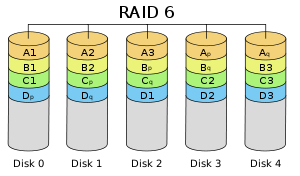
Raid Level 6

Striped set with dual distributed parity. Provides fault tolerance from two drive failures; array continues to operate with up to two failed drives. This makes larger RAID groups more practical, especially for high availability systems. This becomes increasingly important because large capacity drives lengthen the time needed to recover from the failure of a single drive. Single parity RAID levels are vulnerable to data loss until the failed drive is rebuilt: the larger the drive, the longer the rebuild will take. Dual parity gives time to rebuild the array without the data being at risk if a (single) additional drive fails before the rebuild is complete.

Raid Level 6
Advantages

  • RAID 6 is essentially an extension of RAID level 5 which allows for additional fault tolerance by using a second independent distributed parity scheme (dual parity).
  • Data is striped on a block level across a set of drives, just like in RAID 5, and a second set of parity is calculated and written across all the drives; RAID 6 provides for an extremely high data fault tolerance and can sustain multiple simultaneous drive failures
  • RAID 6 protects against multiple bad block failures while non-degraded
  • RAID 6 protects against a single bad block failure while operating in a degraded mode
  • Perfect solution for mission critical applications

Disadvantages

  • More complex controller design
  • Controller overhead to compute parity addresses is extremely high
  • Write performance can be brought on par with RAID Level 5 by using a custom ASIC for computing Reed-Solomon parity
  • Requires N+2 drives to implement because of dual parity scheme

Recommended Applications

  • File and Application servers
  • Database servers
  • Web and E-mail servers
  • Intranet servers
  • Excellent fault-tolerance with the lowest overhead

RAID 6 VS RAID 5

RAID 6
In complex arrays (12-24 drives), RAID 6 applications would be a preferred choice due to the fact that Serial ATA drives used in the arrays have a lower duty cycle and may be more likely to fail in 24/7 or business-critical applications.

Raid 5
In small arrays (4-12 drives), RAID 5 applications can quickly repair a failed drive and restore lost data-without taking down the array. It’s perhaps the most cost-effective, fault-tolerant data protection solution currently available for small storage devices.

Pro
Raid 6
Designed for tolerating two simultaneous HDD failures by storing two sets of distributed parities.

Raid 5

  • Simplified hardware implementation
  • A matured industry standard

Con
Raid 6

  • For RAID 6, one needs a more complex system with a method for encoding, as well as XOR calculations. For that, one really needs hardware acceleration, otherwise the performance suffers.
  • Uses 2 drives for parity

Raid 5

  • The risk of simultaneous drive failures grows in proportion to the drive array and can increase if customers purchase all of the disks in an enclosure at one time.
  • If the system finds a faulty sector on another drive during this degraded state (one drive down, spare drive being rebuilt), the RAID 5 system would be unable to restore the data onto the spare drive, resulting in data loss.

Recommended Configuration
Raid 6
Disk array consists of 12 disks or more

Raid 5
Disk array consists of 10 disks or less

Recommended Solutions

Raid 6

  • Desktop: EnhanceRAID T8
  • Rackmount: EnhanceRAID R14; UltraStor RS16

Raid 5

  • Desktop: EnhanceRAID T4HCR, T5,T8
  • Rackmount: EnhanceRAID R4,R6,R8; UltraStor RS8 or RS2080

Raid 6 Rebuild Software

Raid Level 6 Read More »

Switching Storage Controllers w/o Reinstalling Windows

One of the trends in personal computing these days is the prevelance of more options for hard disks and RAID systems than have been available in the past. As a result, many people want to move towards one of these systems as an upgrade, but at the same time want to avoid the hassle of reinstalling Windows and all applications. This has been exceedingly difficult and in some cases even impossible do to. However, with this guide, you’ll be able to perform this task in most cases with most hardware configurations.

What You Can and Cannot Do With This Guide

This guide is applicable to the person who has Windows currently starting up from one hard disk/hard disk controller combination, and wants to start that same Windows installation up from a different hard disk/hard disk controller on the same computer. For instance, you may want to upgrade from a single-disk installation of Windows to a RAID installation, or from an IDE drive to a SCSI drive, or from an IDE drive to a native-mode SATA drive. In general, this guide will work for any situation where the mass storage controller that has to be used for Windows startup is going to change.

This guide is NOT for adding another drive or controller to an existing system when the Windows installation doesn’t move from it’s existing controller. That is a much easier task and can be done with standard driver installation and the Disk Management utility in Windows. This guide is NOT for moving a Windows installation to completely different hardware (like changing your motherboard). There are some procedures posted on the Internet for that already. The guide is NOT for moving a hard drive within a system where the disk controller that is being used either does not change or uses the same drivers as the old one, or where Windows already has built-in drivers for the new controller (like a standard IDE controller).

Windows and Mass Storage Controllers

Windows treats all mass storage controllers the same way. Whether it’s a standard IDE controller, SATA controller, SCSI controller, or RAID controller, Windows has to have a driver for it in order to use it. Once Windows has a driver installed for the controller, Windows can start up from a hard drive attached to that controller as long as the machine’s BIOS can use the controller as the boot device.

When installing Windows for the first time on a system, most of the time no concern need be given to the mass storage controller, because in the past, 90% of the time, the storage controller is a standard IDE controller which Windows already has drivers for on its installation CD. Windows will detect the standard IDE controller and use it’s own drivers for it, thus enabling Windows to start up from the IDE controller.

If Windows does not have a driver on its CD for your system, the Windows text-mode setup program tells you that Windows cannot find a mass storage controller in your system, and prompts you to insert a manufacturer-supplied driver disk. This is the method to install mass storage controller drivers for most SCSI, RAID, and now some SATA controllers. Windows reads the driver off the floppy disk, and uses that driver to start up after installation.

If any situation arises where Windows does not have a driver installed for the mass storage controller you’re starting up from, you will get a blue screen STOP error, usually with the error STOP 0x0000007B (INACCESSIBLE_BOOT_DEVICE). If you’ve ever tried to copy a Windows installation from one controller to another with one of the partition copy tools and then tried to start it up, this is probably what you got.

The key item in this procedure that makes it work is that the procedure loads drivers for a storage controller that Windows will start up on before moving Windows to that storage controller. Once Windows has seen the storage controller and has had drivers loaded for it, Windows can now use that storage controller as the startup controller.

Requirements to Proceed

To proceed with this procedure, you will need the following:

* The Windows installation that you want to move must be Windows 2000 Pro, 2000 Server, 2003 Server, or XP.
* The old hard drive controller is currently installed in the system, drivers for it are installed in Windows, and the hard drive holding the current Windows installation is attached to that controller, and Windows currently starts up in this configuration.
* You will need some type of tool to copy a partition from one drive to another if you will be moving the Windows installation to a different hard drive as well as a different controller. The recommended tools are: Norton Partition Magic, Norton Ghost, Acronis True Image, or BootIt Next Generation/Image for DOS. There are a few other products out there as well. Be aware that Partition Magic will only run on Windows 2000 Pro or Windows XP – it does not support copying partitions containing a server operating system. For copying server partitions, I recommend Norton Ghost.
* You need the ability to have both the old disk controller and the new disk controller installed in the machine at the same time. If you can’t do this for whatever reason, there is a work-around that will be addressed later in the guide.
* If you will be copying the startup Windows partition to a different drive, the disk controllers involved in the copy operation must support Extended INT13h extensions so that they can be seen by the partition copy software. (Most SCSI and RAID controllers, and all modern IDE/SATA controllers support this).
* You need drivers for the new disk controller already downloaded and decompressed (if required) on your C: drive.
* You need to prepare a DOS-mode startup media for the partition copy program you will be using. For Partition Magic, you can boot the Partition Magic CD. For Norton Ghost, you need to create a Ghost boot floppy. For Acronis True Image, you can boot the Acronis True Image CD. For BootIt Next Generation/Image for DOS, create a startup floppy.

Disclaimers

This procedure carries some risk. It is not possible to forsee all possible hardware combinations, and there may be some that this procedure doesn’t work on. There is a risk of losing your data, all the way from minor problems to loss of the entire hard drive. As with any procedure where data loss is a risk, having a current backup of your data is strongly advised. I can’t be responsible for data loss, and I don’t guarantee that this procedure will work in all situations, nor that it will work at all times.

Procedure

This procedure assumes you’re using a different hard disk as well as a different disk controller. If you’re changing the disk controller only, skip steps 13-18 and just move your hard drive to the new disk controller in place of those steps.

1. Backup all important data. Use a different hard drive other than the ones that will be used in this procedure, or backup to a network storage device or tape drive.
2. Shut down the system (power off).
3. Install the new disk controller in the system, but do not connect any drives to it.
4. Power on the system, go into the system BIOS.
5. Make sure in the boot order, that your original disk controller and hard drive are still set to be the boot device.
6. Save changes in the BIOS if necessary, and restart the system.
7. Allow your existing installation of Windows to start up.
8. Once Windows is started up and has reached the desktop, the Found New Hardware wizard should start, indicating that the system wants to install drivers for the new disk controller.
9. Install the drivers according to the manufacturer’s directions. Make sure you’re installing the correct driver. Many manufacturers provide a driver package that has drivers for several different, but similar products. Make sure you pick the driver for the exact disk controller that you have installed in the system.
10. When you’re done, Windows may ask you to restart. Do so now.
11. After the restart, check Windows device manager, make sure your new disk controller appears in the device list (under IDE ATA/ATAPI Controllers if it’s an IDE/SATA device, or under SCSI and RAID Controllers if it’s a SCSI card or RAID device). Make sure there is no yellow exclamation point or red X on the device. Double click it to make sure Windows says that the device is working properly.
12. Shut down the system (power off).
13. Attach your new hard drive(s) to the new disk controller.
14. If your new controller is a RAID controller and your intention is to create a new RAID array for your Windows installation, power on the system, go into the RAID BIOS Utility and create the RAID array on the new drives according to the manufacturer’s directions.
15. Power on the system and start up the DOS-mode partition copy utility that you have, either from CD or floppy.
16. You should now see the existing Windows partition on your old disk controller/hard disk, and a blank area on the new disk controller/hard disk/RAID array. Following the manufacturer’s directions for your partition copy utility, copy the partition from the old drive to the new drive/array.
17. Exit the partition copy utility and shut down the system (power off).
18. Remove the old hard drive from the old disk controller, but leave the controller installed.
19. Power on the system, go into the system BIOS. Make sure that in the boot order, the new disk controller is set as the startup device.
20. Save changes to the BIOS, and restart the system.
21. Windows will now start up on your new disk controller & hard drive.
22. Once started up and at the desktop, go into Device Manager.
(Note: steps 23-25 should not be done if the old disk controller will be hosting other drives, such as a second hard drive or CD/DVD).

23. Right-click and uninstall the old disk controller (under IDE ATA/ATAPI Controllers if it’s an IDE/SATA device, or under SCSI and RAID Controllers if it’s a SCSI card or RAID device).
24. Shut down the system (power off).
25. Remove the old disk controller from the system (or disable it in the system BIOS if it’s a motherboard-embedded device).

Congrats, your system is now starting up on a different disk controller.

Example

Earlier in the guide, I mentioned that you need to be able to install both the old and new disk controllers in the system for the procedure to work. There is a work-around if this isn’t possible. What you do in this case is use an intermediate disk controller, and perform the procedure twice. 😯

Let’s use an example for a typical scenario. Let’s suppose I have a motherboard with an Intel ICH7R south bridge (this south bridge chip is typically paired with the 975X north bridge chip). I currently have my Windows installation installed on a single 120GB SATA hard drive connected to the ICH7R, and the ICH7R is currently in native SATA (AHCI) mode. I want to move the existing Windows installation to a RAID-0 configuration, where the ICH7R is in RAID mode, using two new 150GB WD Raptors.

The problem with this move is that the ICH7R can be in SATA mode or RAID mode, but can’t be in both at the same time. Thus, we can’t have both the old controller and the new controller installed simultaneously. What we will do in this case is install an inexpensive SATA PCI card, like the Promise SATA300 TX2plus, move the Windows installation to that controller using the procedure above (1st pass), change the ICH7R to RAID mode, install the Raptors, create the RAID array, and then move the Windows installation from the Promise card to the RAID array using the procedure above again (2nd pass).

So, step-by-step:

1. Backup all important data. Use a different hard drive other than the ones that will be used in this procedure, or backup to a network storage device or tape drive.
2. Shut down the system (power off).
3. Install the Promise SATA300 TX2plus disk controller in any PCI slot, but do not connect any drives to it.
4. Power on the system, go into the system BIOS.
5. Make sure in the boot order, that the ICH7R disk controller and 120GB SATA drive are still set to be the boot device.
6. Save changes in the BIOS if necessary, and restart the system.
7. Allow the existing installation of Windows to start up.
8. Once Windows is started up and has reached the desktop, the Found New Hardware wizard should start, indicating that the system wants to install drivers for the Promise SATA300 TX2plus disk controller.
9. Install the drivers according to Promise’s directions. Make sure you’re installing the correct driver.
10. When you’re done, Windows asks you to restart. Do so now.
11. After the restart, check Windows device manager, make sure the Promise SATA300 TX2plus disk controller appears in the device list (under IDE ATA/ATAPI Controllers). Make sure there is no yellow exclamation point or red X on the device. Double click it to make sure Windows says that the device is working properly.
12. Shut down the system (power off).
13. Since the old connection to the ICH7R was SATA, and the Promise card also supports a single SATA drive, we don’t need another hard drive, nor do we need to copy the partition. Simply unplug the 120GB SATA drive from the ICH7R and reconnect it to the Promise SATA300 TX2plus.
14. Power on the system, go into the system BIOS. Make sure that in the boot order, the Promise SATA300 TX2plus disk controller is set as the startup device.
15. Save changes to the BIOS, and restart the system.
16. Windows will now start up on the Promise SATA300 TX2plus disk controller & 120GB SATA hard drive.
17. Once started up and at the desktop, go into Device Manager.
18. Right-click and uninstall the ICH7R driver (under IDE ATA/ATAPI Controllers – it will be listed as Intel 82801FR SATA Controller).
19. Restart the system.
20. Go into the system BIOS, change the ICH7R from SATA mode to RAID mode.
21. Allow the existing installation of Windows to start up.
22. Once Windows is started up and reached the desktop, the Found New Hardware wizard should start, indicating that the system wants to install drivers for the ICH7R in RAID mode.
23. Install the drivers according to Intel’s directions. Make sure you’re installing the correct driver.
24. When you’re done, Windows asks you to restart. Do so now.
25. After the restart, check Windows device manager, make sure the ICH7R RAID mode disk controller appears in the device list (under SCSI and RAID Controllers). Make sure there is no yellow exclamation point or red X on the device. Double click it to make sure Windows says that the device is working properly.
26. Shut down the system (power off).
27. Attach the two 150GB Raptors to the ICH7R disk controller using SATA cables.
28. Power on the system, go into the Intel Matrix Storage Manager RAID BIOS Utility (Ctrl-I).
29. Create a RAID-0 array using the two 150GB Raptors, making a 300GB virtual disk.
30. Restart the system and start up the DOS-mode partition copy utility that you have, either from CD or floppy.
31. You should now see the existing Windows partition on the Promise SATA300 TX2plus disk controller and 120GB SATA drive, and 300GB of space on the RAID array attached to the ICH7R. Following the manufacturer’s directions for your partition copy utility, copy the partition from the 120GB SATA drive to the 300GB RAID-0 array. You will either need to resize the partition afterwards to 300GB (Partition Magic) or define the size of the destination partition as 300GB before the copy (Ghost).
32. Exit the partition copy utility and shut down the system (power off).
33. Remove the 120GB hard drive from the Promise SATA300 TX2plus disk controller, but leave the controller installed.
34. Power on the system, go into the system BIOS. Make sure that in the boot order, the ICH7R/RAID array is set as the startup device.
35. Save changes to the BIOS, and restart the system.
36. Windows will now start up on the RAID-0 Raptors on the ICH7R.
37. Once started up and at the desktop, go into Device Manager.
38. Right-click and uninstall the Promise SATA300 TX2plus disk controller (under IDE ATA/ATAPI Controllers).
39. Shut down the system (power off).
40. Remove the Promise SATA300 TX2plus disk controller disk controller from the system.

Testing
I have tested this procedure using the following:

* An Intel D925XCV motherboard (925X north bridge, ICH6R south bridge)
* Windows 2000 Server
* A 120GB SATA Maxtor drive installed on the ICH6R in SATA/AHCI mode, holding the Windows 2000 Server installation.

1. I moved the Windows 2000 Server installation to an Adaptec 29160LP SCSI card with a 9 GB Seagate Cheetah SCSI drive.
2. I removed the Maxtor 120GB, changed the ICH6R to RAID mode, installed two 74GB WD Raptors, and created a 148GB RAID-0.
3. I then moved the Windows 2000 Server installation to the 148GB RAID-0.
All steps were successful. Norton Ghost was used as the partition copy utility.

References

My primary impetus for trying and deveoping this procedure is a Microsoft support KB article entitled Stop 0x0000007B error after moving the Windows XP system disk to another computer. This article says within it that installing a mass storage controller driver before moving the Windows installation will work. This is what I decided to test.

Some other Microsoft KB articles that deal with this, and other related issues are:

Moving a Windows Installation to Different Hardware
How to troubleshoot “Stop 0x0000007B” errors in Windows XP
How to perform an in-place upgrade (reinstallation) of Windows XP

Conclusion

I hope this procedure works for you and gives you additional options for your mass storage scenarios.

Switching Storage Controllers w/o Reinstalling Windows Read More »

Mac Data Recovery Softwares

Mac File Recovery1. Stellar Phoenix Macintosh Data Recovery Software

Company: Stellar Data Recovery
Supported Mac Type: HFS, HFS+, HFSX, HFS Wrapper and FAT file system volumes
Price: $ 129.00 – $ 349.00

FAT file system support.
Updated Audio & Video preview support (using Qt’s class).
Save Scan Information of Lost Volume list.
Check Destination (not scanned drive) during create image, save scan and saving of files.
Check free space of destination during saving of files/ create image.
Not saving empty folder when filter is applied.
Updated KDC and CRW file format.
Recovers Apple Mail, HTML, FileMaker and Quick Book primary data in exact file format and size.
Recovers exact file size of M4V and 3GP files from Quark Series (QXD Motorola, QXD Intel, QXP Motorola and QXP Intel) processors.
Exact file size of ARW, DNG, ERF file format.
Updated Audio and Video preview support (using Apple Quicktime class).
Refresh Drive List

2. Kernel for Macintosh Data Recovery

Company: Nucleus Data Recovery
Supported Mac Type: HFS, HFS+ partitions
Price: $ 145.00 – $ 249.00

Provides Apple Mac Data Recovery
Recover formatted or deleted partition.
Recover mac data from Lost or Missing Mac folders.
Recognizes and preserves long file names when recovering Mac files & folders.
Full support for IDE, EIDE, SCSI and SATA drives.

3. Recover Data for Mac

Company: Recovery Data
Supported Mac Type: HFS & HFS+ partitions
Price: $ 129.00 – $ 229.00

Disk Initialization
Bad Sector in the disk
Master Directory Block or Volume Header Corruption
Partition Table Corruption
Extents or Extents Overflow file corruption
Catalog File’s node corruption

4. Quick Recovery Mac

Company: Unistal Systems Pvt Ltd.
Supported Mac Type:  HFS and HFS + file system
Price: $139.00 – $ 249.00

Mac Data Recovery Software, recovers data from damaged, deleted, or corrupted volumes and even from initialized disks. An exhaustive scan of the drive is performed to locate lost partitions. All found data in the lost partition is then presented in a tree structure so that you can copy your lost files to a working volume. Quick Recovery for MAC is a quick, simple and easy to use Mac data recovery solution that helps you in file recovery in moments of disaster of a disk crash.

Mac Data Recovery Softwares Read More »

Windows & Linux for Workstation & Servers

Windows is generally perceived as being easier to use and administer and mostly with good reason. Most companies choose Windows as their desktop environment and often for their intranet servers too. And yet some companies selected Linux as the desktop and server platform for their massive infrastructure upgrade. In the following paragraphs I will explain the rationale for the decision.

As Sever Machines: Linux VS Windows

For Example: we have embarked on a massive upgrade of our infrastructure with the addition of several 24/7 servers with RAID 1, QA automation machines, order processing machine and redundant internet connections. Each server machine will have RAID 1 and also have hot backup. The choice was between Windows server and Linux. Choose Linux for our server machines for the following reasons:

1. Web server runs on Linux for strategic and security reasons. It only makes sense to have the same server operating system and environment here to simplify maintenance.

2. There should have two machine (one for hot backup) to provide internet connection. The same machine will also host DNS server, Web server and database (for the applications). In short we should make it a near duplicate of our web server machine. The idea is to be able to use this machine to act as a emergency backup of our live server(s). Both the machines (files and database) will be synched several times a day. This machine can also act as backup DNS provider. However this cannot be used to distribute load under normal situations because the upload bandwidth is low as is normal in ADSL and Cable connections. Even then this should provide me with some peace of mind. It only makes sense to have similar configurations in this machine as our current web server machine(s).

3. High cost of Windows server machines for multiple licenses and complicated licensing schemes. The cost of procuring and ensuring that we are compliant is very high for small organizations, not simply in dollar value but also in terms of resource allocation. They will use commodity hardware and they will have to replace them from time to time. However, with Linux they can keep several hot backups and not worry about breaking their licenses. In intend to use Fedora Core as our experience with them has been very positive.

4. RAID 1 support: Both Windows 2003 server and Linux provide software RAID 1 support and also other RAID levels. Unfortunately Windows XP Pro or Windows 2000 do not provide RAID 1 support (mirrored). You must purchase the server version. Both operating systems work with hardware RAID 1. However at this time we choose the software route as it fits well with our strategy of using commodity hardware and having spare backup machines; also it is cheaper without compromising data integrity and availability. Generally in software RAID the performance is expected to be lower. Also in Windows RAID support you will first have to install the operating system on a non-RAID device before RAID can be enabled. Linux provide all the RAID support through software and for free. Their RAID support appears more configurable and all encompassing.

5. The server applications like Apache HTTP server, Subversion, MySQL, DNS Server runs equally well on both platforms.

As Workstations: Linux VS Window

Development & QA Automation Machines

These need to be high end machine. For Example: we use a code editor for php and Eclipse IDE for Java. Both of them are available in Linux as well as Windows XP. Linux comes with Bash shell which is significantly superior to cmd prompt in terms of scripting and task automation. Java and PHP work in Linux as well as on Windows platform.

Blogging Machine

As a blogger we simply need a web browser and a convenient feed reader. There are several PHP-MySQL based feed readers which will suitably serve our requirements. Firefox works fine with Linux as well as Windows. So you see Windows do not have any advantage here.

Email

Any machines require email access. In my experiments Thunderbird came slightly ahead of Microsoft Outlook for pure email purposes especially due to built in Naive Bayesian filter and close integration with Firefox, our web browser. For additional requirements like Calendar, Sunbird is a good choice.

Security

Linux is traditionally ahead of Windows in terms of security. We can get a reasonable protection with iptables alone. ClamAV serves as a decent anti-virus solution for Linux among others. Frankly Internet Explorer will not be missed.

Office Productivity Suite

Star Office competes well against Microsoft Office in this department.

Linux lacks behind in ease of use and requires more upfront training. However the increased security, availability of software RAID 1 (mirroring) and lack of licensing hassles give it a strong advantage over Microsoft Windows. This is just my opinion.

Windows & Linux for Workstation & Servers Read More »

Top 5 Disaster Recovery Tools

Disaster recovery toolsInformation technology is at the core of almost every organization today. The computer data is one of the invaluable assets for a company. Any computer related disaster can result in irreversible losses for the company. To avoid such disasters out of the blue most companies have a disaster recovery planning as a part of a business continuity planning. To over this important for every organization, you should plan a disaster recovery using with the help of disaster recovery tool. Disaster recovery tools are essentially a part of Disaster Recovery Planning (DRP). The DRP documents chalk out the plan of action prior to, during and following a disaster. The DRP helps a business to minimize its losses caused by a system crash and helps it to recover from a disaster in the shortest possible time by identifying critical systems, processes and methods for restoring the processes.
1. Acronis® True Image Echo™ Server for Windows
For disaster recovery and system migration in both physical and virtual environments, Acronis® True Image Echo Server for Windows delivers greater flexibility and value for SMBs and the Remote Office / Branch Office.

  • Create an exact Windows server disk image, including the operating system, databases, and applications;
  • Migrate your systems between any virtual and physical servers quickly and easily

2. UltraBac’s Image based disaster recovery
This image based disaster recovery technology works by taking scheduled snapshots of one or more disk partitions. These images are replica image of the partition frozen at a scheduled time. It ensures a good backup for the files which are open and in use. With the help of this disaster recovery tool the failed machine can be restored using minimum tool.  UltraBac offers two versions of disaster recovery tool -UBDR Pro for small to medium businesses and UBDR Gold for larger environments.

3. Living Disaster Recovery Planning System (LDRPS)
This is a business continuity software designed to offer disaster recovery planning. The LDRPS can also be hosted as Software as a Service (SaaS) solution that hosts Strohl Systems applications in the data center. Some of the key features in the LDRPS are customizable best-practices-based plan navigators, customizable reports, dependency maps and location resource management.

4. LBL ContingencyPro Software
This is a web-based browser software tool that provides the best practices for business continuity planning. It also includes hundreds of electronic tools guides, templates, and samples. This tool offers a proven methodology to recover from events of disaster.

5. TAMP DRS (Disaster recovery tool)
This tool creates and distributes business contingency plans that includes disaster recovery. It allows the user to manage and roll up documents,  developmental plans, inventory lists, spreadsheets,graphics and flowcharts into one plan. It is completely functional in a disaster afflicted environment.

Top 5 Disaster Recovery Tools Read More »

Software RAID VS Hardware RAID

RAID stands for Redundant Array of Inexpensive Disks which is a technology that employs the simultaneous use of two or more hard disk drives to achieve greater levels of performance, reliability, and/or larger data volume sizes.

There are different levels of RAID. The most popular RAID formats are RAID-1 & RAID-5. However today we will not focus on the various RAID format. Let’s go straight to the differences between software RAID and hardware RAID.

1. Hardware RAID:

  • A conventional Hardware RAID consists of a RAID controller that is installed into the PC or server, and the array drives are connected to it.
  • In high end external intelligent RAID controllers, the RAID controller is removed completely from the system to a separate box. Within the box the RAID controller manages the drives in the array, typically using SCSI, and then presents the logical drives of the array over a standard interface (again, typically a variant of SCSI) to the server using the array.

2. Software RAID:

In software RAID the software does the work of RAID controller in place of the hardware. Instead of using dedicated hardware controllers or intelligent boxes, we use particular software that manages and implements RAID array with a system software routine.

3. Comparing Hardware RAID & Software RAID

Portability

OS Portability

Software RAID is not usable across operating systems. So you cannot, for example, use two RAID disks configured in Linux with Windows XP and vice versa. This is big issue for dual booting systems where you will either have to provide a non-RAID disk for data sharing between the two operating system / use hardware RAID instead.

As you know, dual booting is mostly obsolete these days as you can run multiple operating systems on the same machine using virtualization software like VMware & xen.

Hardware Portability

  • Software RAID
    In Linux you can mirror two disks using RAID-1, including the boot partition. If for any reason the hardware goes bad, you can simply take the hard disk to a different machine and it will just run fine on the new hardware. Also with a RAID-1 array, each of the hard disk will have full copy of the operating system and data, effectively providing you with two backups, each of which can be run from a different hardware.Unfortunately in Windows it is not so easy to switch a operating system from one hardware to another, but that is the story of proprietary licenses and we will keep it for another day.
  • Hardware RAID
    Hardware RAID is not so portable. You cannot just swap the hardware to a different machine and hope it will work. You have to find a Motherboard which is compatible with your RAID controller card; otherwise you can kiss your data goodbye. Also there is a bigger issue of problem with the RAID controller itself. If it fails and you cannot get the same controller from the market (and it has probably become obsolete by then), then again you can kiss your data goodbye.

Easy & Speedy Recovery

It may seem trivial but for a busy and loaded server, an easy and speedy recovery, that too inside the operating system without having to reboot is what one can dream of. Imagine if during the peak hours, your RAID system crashes and you are forced to reboot the machine to make changes to it to restore your data! Software RAID’s like in Linux, not only continues working even when the hardware has failed, but also starts restoring the RAID array, should any spare disk be available. All of these happen in the background and without affecting your users. This is where software RAID shines brilliantly.

System Performance

Software RAID uses the CPU to do the work of the RAID controller. This is why high-end hardware RAID controller outperforms software RAID, especially for RAID-5, because it has a high powered dedicated processor. However for low end hardware RAID, the difference may be neglible to non-existent. In fact it is possible for the software RAID perform better than low end hardware RAID controller simply because today’s desktops and workstations are powered by very powerful processors and the task is trivial to them.

Support for RAID Standards

High-end Hardware RAID may be slightly more versatile than Software RAID in support for various RAID levels. Software RAID is normally support levels 0, 1, 5 and 10 (which is a combination of RAID 0 and RAID 1) whereas many Hardware RAID controllers can also support esoteric RAID levels such as RAID 3 or RAID 1+0. But frankly who uses them?

Cost

This is where software RAID again scores over hardware RAID. Software RAID is free. Hardware RAID is moderate to high priced and can put a strain on your budget if deployed widely.

But over the years the cost of hardware RAID has come down exponentially, so it may not be too far when more affordable RAID-5 cards will be built-in on newer motherboards.

Future Proof

Gone are the days when we could associate software RAIDs with bugs and OS problems. Nowadays software RAIDs are almost flawless. We are using software RAID in Linux operating system for several years and haven’t experienced any problem whatsoever. On the contrary, hardware RAID has a single point of failure and that is its hardware controller. If it crashes then your only option is to find another equivalent RAID controller from the market; by this time the model may become obsolete and you may not even find anything compatible. You are as such faced with the haunting prospect of losing all your data, should the RAID controller fail. Software RAID will never become obsolete and will continue to get updated with updated versions of your operating system.

4. In conclusion: Software or Hardware RAID?

In my opinion, software RAID is the way to go for most users, unless you want to extract the very last ounce of performance from your RAID array and budget is not a constraint.

Software RAID VS Hardware RAID Read More »

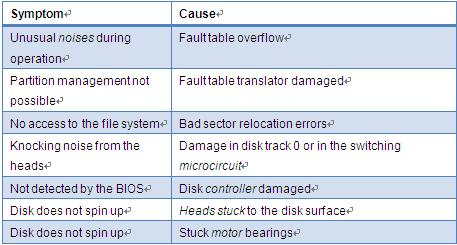
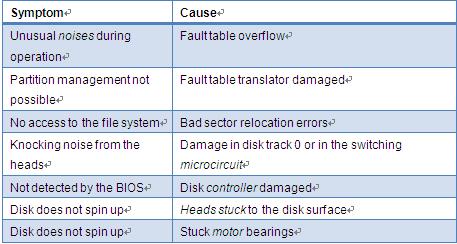
External Hard Drive Problems

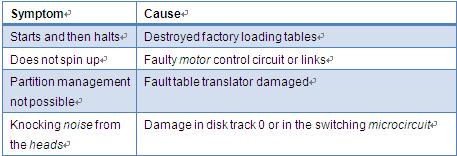
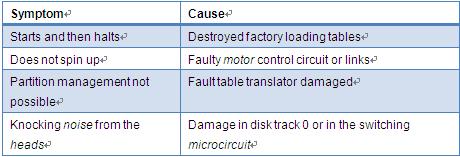
Seagate are presently among the most popular and reliable hard disks drives. The disks of the Barracuda ATA 4, ATA 5 and SATA series are relatively fast and advanced models, the only major drawback of which is their considerable heating during operation. Most frequently repairs are called for because of damaged controller components or stuck spindle motors. Disks from the U series also suffer from reading problems due to erratic development of unstable regions on the disk surface which are impossible to eliminate in any conventional way. Data recovery from Seagate HDD’s is a labor consuming process, especially in cases of mechanical damage, and may take up a lot of time, but the chances of success are typically high.

seagate external hard drive problems

Maxtor, former Quantum, are inexpensive and relatively fast disks, although with quite a few downsides. With time the motor noise increases, the disk tends to develop surface defects and detection failures by the system may occur with increasing frequency. It is not recommended to use these disks for storing critical information and regular backups are just obligatory. While in most cases repair works are attempted for the sole purpose of data recovery, the repaired disk itself can be operational for a long time, except for the slim models which usually fail again within several weeks. The owners of such disks are advised to consider replacement with a more reliable brand. Data from these disks can be recovered successfully, but the repair work must always be trusted to a specialized service shop.

maxtor external hard drive problems

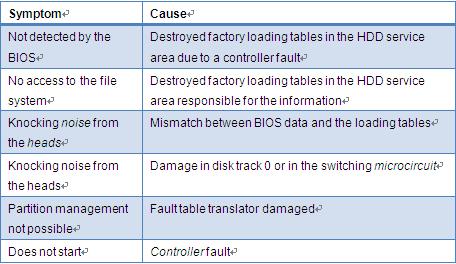
Western Digital disks, although quite widespread in the past, have never been regarded as very reliable. Disks manufactured only three or four years ago are now rarely to be found in a good operating condition. Current models of WD have a satisfactory price/capacity ratio. The new models of WD are called in for repair not very often, maybe also due to their low popularity. A characteristic feature of these disks is the sudden appearance and quick development of bad sectors in different areas of the disk surface. In some cases the disk fails to be detected by the BIOS because of faults in the switching microcircuits. The specific design and circuitry of these disks can sometimes make the task of data recovery after a physical damage too complicated.

wd external hard drive problems
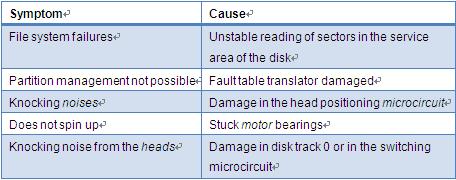
IBM (presently Hitachi) are fast and advanced hard disk drives, however not very reliable, especially the glass plate models (DTLA and AVER series). If during startup the disk is not detected or detection is slow, then repair time has certainly come. These disks are highly serviceable and, if treated properly, can continue to operate reliably for a long time. Exception are the cases when the disk repeatedly emits a strong squeaking noise, which is a sign of a serious physical damage of the magnetic surface. Data can still be recovered, but quite complicated situations are possible when the magnetic surface has begun to destroy, thus making the data recovery task more time consuming and problematical. Isolated batches (assembled in Hungary and Romania) with numerous identical defects have also been registered. The production of HDD’s by IBM was discontinued.

ibm external hard drive problems
Hitachi is successor to the IBM HDD manufacturing division. Most of the remarks about IBM disks are valid for Hitachi as well.

hitachi external hard drive problems

Samsung hard disks are noteworthy for their combination of good performance, high reliability and attractive price. Current models (SP series) are hardly ever called in for repairs, unlike earlier models (Wiener series) most of which are already out of use. Samsung disks usually fail suddenly and for no obvious reason. With the IDE models service problems begin to appear after at least one or two years of operation. Data recovery is very difficult because of the specific design of these disks. Therefore, regular backups are strongly advised.

samsung external hard drive problems
Fujitsu, while known in the past as expensive and extremely reliable, with the advent of the MPG series these disks now present a sorry sight. The disk begins to shut off during operation and periodically fails to be detected by the system. Next comes full inoperability of the disk. Hopes for spontaneous revival are illusory since these misfortunate events repeat again and again. Data recovery from a damaged disk is in most cases successful. The disk can be repaired, but it is impossible to guarantee its stable operation. Fujitsu is discontinuing the production of hard disks for personal computers.

fujitsu external hard drive problems

External Hard Drive Problems Read More »

Scroll to Top