

Data clock recovery circuit

1. A variable phase oscillator comprising:
an oscillator having a substantially fixed frequency output signal;

means for periodically generating coded phase values of said oscillator output signal, said generating means including means for quantizing the phase value of said oscillator output signal into a predetermined number of phase steps;

a source of a prescribed phase value; and

means for comparing said periodically generated coded phase values and said prescribed phase value to periodically generate output pulse signals.

2. The invention as defined in claim 1 wherein the relative phase of said output pulse signals in relationship to said oscillator output signal is dependent on said prescribed phase value.

3. The invention as defined in claim 2 wherein said source of said prescribed phase value includes means for obtaining a phase value which represents the phase difference between said coded phase values and an incoming data transition.

4. The invention as defined in claim 1 wherein said source of said prescribed phase value includes means for obtaining the coded phase value being generated upon occurrence of an incoming data transition.

5. The invention as defined in claim 4 wherein said source of said prescribed phase value includes means supplied with said coded phase values and being responsive to an incoming data transition for storing the coded phase value being generated upon occurrence of said data transition and for adding a predetermined phase value to said stored coded phase value.

6. The invention as defined in claim 4 wherein said source of said prescribed phase value further includes means for adding a predetermined phase value to said obtained coded phase value.

7. The invention as defined in claim 6 wherein said means for obtaining comprises means supplied with said coded phase values and being responsive to said incoming data transition for storing the coded phase value being generated upon occurrence of said data transition.

8. The invention as defined in claim 7 wherein said predetermined phase value is dependent on the incoming data bit period.

9. Data clock recovery apparatus comprising:
an oscillator having a substantially fixed frequency output signal;

means for periodically generating coded phase values of said oscillator output signal, said generating means including means for quantizing said oscillator output signal into a predetermined number of phase steps;

means supplied with said coded phase values and being responsive to an incoming data transition for generating a prescribed phase value in predetermined relationship to a coded phase value being generated upon the occurrence of said data transition; and

means for comparing said periodically generated coded phase values with said prescribed phase value to generate periodically clock recovery pulse signals.


10. The invention as defined in claim 9 wherein said means for generating said prescribed phase value includes means supplied with said periodically generated coded phase values and being responsive to an incoming data transition for storing the coded phase value being generated upon occurrence of said data transition and for adding a predetermined phase value to said stored coded phase value.

11. The invention as defined in claim 9 wherein said means for generating said prescribed phase value comprises means supplied with said periodically generated coded phase values and being responsive to an incoming data transition for storing the coded phase value being generated upon occurrence of said data transition and means for adding a predetermined phase value to said stored coded phase value.

12. The invention as defined in claim 11 wherein said coded phase values are coded in a Gray-code format.

13. The invention as defined in claim 11 wherein said predetermined phase value is selected in predetermined relationship to the incoming data bit period.

14. The invention as defined in claim 13 wherein said comparing means generates a clock recovery pulse when said supplied coded phase value equals said prescribed phase value.
Read More

Pulsar – Seagate Introduces Its First Solid State Drive (SSD)

Seagate Pulsar SSD

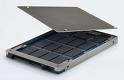
The Seagate® Pulsar™ solid state drive (SSD) is the first SSD product in the new Pulsar solid state drive family from Seagate. The Pulsar SSD is designed to meet OEM performance, power, size and reliability requirements for enterprise blade and general server applications.

December 7, 2009 – Seagate introduced the Seagate® Pulsar™ drive, the first product in its new enterprise solid state drive (SSD) family. Designed for enterprise blade and general server applications, the Pulsar drive uses single-level cell (SLC) technology, delivers up to 200GB capacity, and is built in a 2.5-inch small form factor with a SATA interface. The Pulsar drive leverages Seagate’s 30 years of leadership in meeting large enterprise customer needs in product development, qualification, and support.

“Seagate is optimistic about the enterprise SSD opportunity and views the product category as enabling expansion of the overall storage market for both SSDs and HDDs, Our strategy is to provide our customers with the exact storage device they need for any application, regardless of the component technology used. We are delivering on that strategy with the Pulsar™ drive, and you can expect additional products in the future from Seagate using a variety of solid state and rotating media components.” – said Dave Mosley, Seagate executive vice president, Sales, Marketing, and Product Line Management.

The Pulsar SSD delivers the necessary performance, reliability, and endurance to match the application environments of enterprise blade and general servers. It achieves a peak performance of up to 30,000 read IOPS and 25,000 write IOPS, 240MB/s sequential read and 200 MB/s sequential write. Its SLC-based design optimizes reliability and endurance and helps provide a .44% AFR rating with a 5-year limited warranty. As an additional safeguard, the Pulsar drive leverages Seagate’s enterprise storage expertise to protect against data loss in the event of power failure.

Seagate began shipping Pulsar units to select OEMs for revenue in September 2009. With Seagate’s enterprise knowledge and expertise, OEMs have peace of mind knowing that Seagate has the global enterprise systems, people and processes in place to support their largest requirements.

“To deliver and serve the enterprise SSD marketplace effectively, it is critical for suppliers to understand the needs of their storage system customers with respect to design, manufacturing, supply chain delivery, and support,” With its well-established OEM and eco-system relationships and a long history of serving global storage OEMs, Seagate is in a unique position to fortify its leading enterprise storage position with its entry into the enterprise solid state storage market.” – said Dave Reinsel, IDC group vice president.

As the worldwide market leader in enterprise storage and the first enterprise HDD vendor to deliver an enterprise-class SSD solution, Seagate brings credibility, experience and leadership to this new market segment.

“The enterprise SSD market is now primed and well-positioned for growth from both a revenue and unit perspective, with Gartner estimating unit growth to double and sales to reach $1 billion for calendar year 2010,” Superior enterprise SSDs provide transformational capabilities when optimized in storage and server environments.” – said Joseph Unsworth, research director at Gartner.

The Seagate Pulsar SSD is available to OEM customers for qualification.

Key Advantages

  • Single-level cell (SLC) technology optimizes SSD reliability and endurance
  • 0.44 percent AFR for high reliability and endurance
  • Up to 200GB capacity in a 2.5-inch form factor and 7mm z-height
  • Power loss data protection to ensure against data loss upon power failure
  • 5-Year Limited Warranty
  • SATA 3Gb/s interface to support current blade server chipsets
  • Leveraging industry-leading, global enterprise support
  • Industry-leading SSS and SSD standards development through JEDEC and SNIA

More information can be found at Seagate Pulsar SSD

Read More

SATA/EIDE Hard Drive is detected as a SCSI Device?

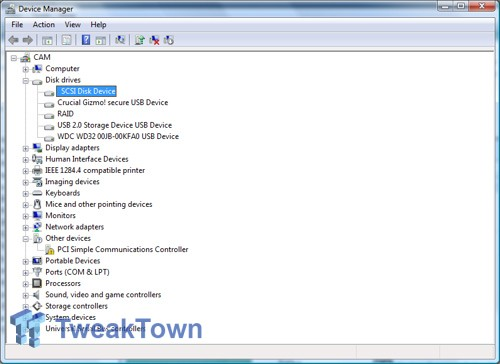
SATA/EIDE Hard Drive is detected as a SCSI Device?1. Why is my Serial ATA hard drive detected as a SCSI device in Windows?
A Serial ATA hard drive is detected as a SCSI device in Windows Device Manager.

This issue could have several causes:

  • The Serial ATA controller (on the motherboard or through a PCI controller card) is assigned default Windows drivers. If Windows is unable to determine exactly what type of device the Serial ATA controller is, it will attempt to assign the closest matching device drivers. Since Serial ATA works using the same principles as SCSI, Windows will assign a Serial ATA controller a SCSI designation.
  • The Serial ATA controller’s (on the motherboard or through a PCI controller card) bus architecture is taken from a SCSI HBA (Host Bus Adaptor). Many companies that produce Serial ATA controllers also produce SCSI controllers. These companies often use an altered version of a SCSI HBA on Serial ATA controllers.
  • The Serial ATA hard drive is connected to a Serial ATA RAID controller. RAID and SCSI controllers have the same device designation in Windows therefore a Serial ATA hard drive will be detected as a SCSI device.

Since this issue is “by design” of the Windows operating system, there is no resolution implied or necessary. Any Serial ATA hard drive designated as a SCSI device will work properly at full performance and capacity. There may be device drivers for the Serial ATA controller that will list the hard drive as a Serial ATA device. Please contact your computer, motherboard, or Serial ATA controller manufacturer for any driver or BIOS updates.

2. Why is my EIDE drive displayed as a SCSI drive in Device Manager in Windows 2000/XP?
An EIDE drive is displayed as a SCSI drive in Windows 2000/XP.

It is common for Windows 2000 and XP to list EIDE drives as SCSI devices in Device Manager when they are connected to non-standard IDE controllers such as a Promise or SIIG controller card. This also occurs when the drive is connected to a specialized ATA or RAID port that is integrated into the motherboard. As long as you have the proper drivers loaded for the controller and are not experiencing any issues while using the drive, there is no cause for concern.

Read More