Microsoft’s FAT32 File System
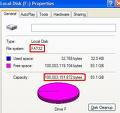
Windows 95 OSR2 provides an updated version of the File Allocation Table file system called FAT32. This updated file system allows for a default cluster size as small as 4K, as well as support for EIDE hard disc sizes in excess of 2 Gbytes. FAT32 provides many enhancements over previous implementations of the FAT file system.
Cluster & Partition Sizes
FAT32 supports drives up to 2 terabytes in size. FAT32 uses smaller clusters (that is, 4K clusters for drives up to 8 Gbytes in size), resulting in 10 to15 percent more efficient use of disc space relative to large FAT16 partitions. FAT32 will only work on 512 Mbytes and larger drives. Microsoft’s bundled disc tools (Format, FDISK, Defrag, and MS-DOS based ScanDisk) have been revised to work with FAT32.
Note: Please backup all data.
1. QUESTION
When I try to format a FAT32 file system partition larger than 8025 Mbytes from within Windows 95, I receive the following error:
Verifying xxx.xx M
Invalid media or track 0 bad-disk unusable
Format terminated
REASON
This error occurs if there is a non-DOS partition preceding the extended DOS partition and the primary DOS partition has been formatted using the real-mode FORMAT.EXE command.
SOLUTION
- Click the “Start” button, click “Shut Down”, click “Restart The Computer In MS- DOS Mode”, and then click “Yes”.
- Type format c: (where c is the drive letter for the partition you want to format), and press >ENTER>.
- When the format is complete, type exit and press ENTER to restart Windows 95.
2. QUESTION
When I try to partition a drive that is larger than 8 Gbytes in size, the maximum partition size is still 8 Gbytes.
REASON
This can occur if the hard disc controller does not fully support the interrupt 13 extensions. In order for a hard disc that is both larger than 8 Gbytes and using the FAT32 file system to be fully addressed, it must support interrupt 13 extensions. The file IO.SYS tests for the presence of interrupt 13 extensions, and if they are not found, uses the default CHS LBA limit of 7.9 Gbytes. This information applies to both ATA and SCSI hard disc drives.
SOLUTION
Contact the drive controller’s manufacturer for information about a possible BIOS upgrade to a version of the BIOS that fully supports interrupt 13 extensions.
3. QUESTION
When I check in FDISK to see if my partition is FAT32, it only shows FAT16. How do I get my drive to be partitioned in FAT32?
REASON
- You are either using the real-mode FDISK, which does not contain the “enable large disk support” prompt, or you did not answer “y” for yes to “enable large disk support”; or
- The drive you are attempting to partition with FAT32 is smaller than 512 Mbytes.
SOLUTION
Run the FDISK tool which came with OSR2 on a system with a drive over 512 Mbytes. FDISK will ask whether you wish to enable large disc support. If you answer Yes, any partition you create larger than 512 Mbytes is marked as a FAT32 partition.
4. QUESTION
When I try to dual-boot Windows version 3.x on a computer running Windows OSR2, I receive one of the following error messages:
- This version of Windows does not run on MS-DOS 6.x or earlier.
- You started your computer with a version of MS-DOS incompatible with this version of Windows. Insert a Startup diskette matching this version of Windows and then restart.
- The system has been halted. Press CTRL+ALT+DELETE to restart your computer.
- This version of Windows cannot be run on this version of DOS.
REASON
Starting with OSR2, dual-booting Windows 3.x is not supported in Windows 95.
SOLUTION
To dual-boot between Windows 3.x and Windows 95, install the retail version of Windows 95. If you have FAT32 partitions, remove them and create a FAT16 partition with the Windows 95 or MS-DOS 6.x version of FDISK.EXE.
Neither MS-DOS 6.x nor the retail version of Windows 95 will recognize a FAT32 volume. Windows 3.x was designed to use the FAT12 and FAT16 file systems. It could potentially damage a FAT32 volume.
5. QUESTION
When I try to compress my drive with DriveSpace or DriveSpace 3, I get the following error:
Drive C cannot be compressed because it is a FAT32 drive.
REASON
DriveSpace was designed to work with the FAT12 and FAT16 file systems and cannot be used with drives using the FAT32 file system.
SOLUTION
None at this time.
6. QUESTION
When I try to defragment a FAT32 partition, I receive the following error:
Windows cannot defragment this drive. Make sure the disk is formatted and free of errors. Then try defragmenting the drive again.
REASON
This can be caused by running an earlier version of DEFRAG.EXE than the version included with OSR2.
SOLUTION
Extract a new copy of the DEFRAG.EXE file from your original OSR2 CD-ROM or discs. For additional information about how to extract or obtain the OSR2 version of DEFRAG.EXE, contact you OEM vendor or Microsoft technical support.