Hard Drive Damage Types

Hard Disk Repair

Data loss might also occur in small drives such as the Hitachi MicroDrive. Ontrack was unable to recover any data in the above right example.

Damage to a drive’s circuit board or defects of the drive heads occur fairly often. In both cases, to access hard drive data, a data recovery specialist will substitute the defective component with a working one. In the best case scenario you regain 100% of your data.

A so called head crash – where a write/read head physically hits the magnetic platter – is much more severe. Simply hitting your drive might cause contact, since the distance between the head and surface of drives is minimal nowadays. It is almost always safe to say that a damaged magnetized surface causes the loss of saved bits. The head might even repeatedly get caught at the area of defect, carrying off more material with each additional contact. This material will be distributed inside the drive, causing scratches or other damage. There is nothing a customer can do in case of an intense head crash, because the head is simply unable to move across the defective area any more.

Overvoltage on write/read heads causing the permanent destruction of data areas or magnetization will also result in irreversible data loss. This means the physical destruction of memory sectors, not the simple deletion of saved bits. Depending on the drive, the data recovery specialist might be able to recover some data. Recovering data from defect Hitachi drives is usually impossible, since the manufacturer does not provide any kind of firmware information. Various other products allow at least reading data from other platters.

Strange but true: even internal imbalances can cause trouble. Irregular data platter rotation due to broken bearings will result in unwanted track changes of which the drive is not aware; the result is sometimes total data hodgepodge. Bearing failure is usually the result of improper handling during transportation of the drive. The data recovery specialist will often be able to recover saved data by balancing the drive (slightly shifting and centrally rearranging the platters).

Logical mistakes do not require processing in the clean room. Usually, those mistakes are accidental misuse or deletion of files, where the drive itself has no malfunctions. Even if the problem lies within the drive, it might be a simple defective sector and nothing more severe. Every drive has defective sectors: a primary list will carry a list of bad sectors from the factory; the secondary, so called growing list, will be updated in the course of operation if more sectors become useless. This occurs rather often and is normal, but if your hard drive S.M.A.R.T. feature tells you that you better save some data fast, you’re in trouble. This often means that the growing list is full and an above-average number of sectors are dying.

Now let’s talk about an irreversible defect. Your hard drive will die if fire or another heat source heats it up beyond the Curie temperature of the magnetic material of your drive; this cases the magnetization to be neutralized completely. The Curie temperature depends on the material used in a hard drive; magneto-optical devices use with Curie point principle on purpose (heating via laser), but hard drives do not.

A user who tries to solve issues by himself can make things worse, this is the biggest problem with data recovery. According to statistics, Europeans are worse than Americans in trying to solve problems on their own. Situations also turn bad if, for example, administrators are afraid of their bosses’ reactions. Once, someone even sent a floppy drive instead of the defective hard drive – this is a clear indication of pressure placed on the person involved.
Read More

Hard Drive History

Today marks the 50th anniversary of hard drive storage. When IBM delivered its first hard drive on September 13th, 1956, few could have imagined the impact it would have on our everyday lives. The RAMAC (also known as ‘Random Access Method of Accounting and Control’) was the size of two refrigerators and weighed a ton. It required a separate air compressor to protect the heads, had pizza-sized platters and was able to store a then whopping 5 megabytes of data. Now you can do all that with a mere pocket drive! What’s more – the RAMAC was available to lease for $35,000 USD, the equivalent of $254,275 in today’s dollars.

25 years later, the first hard drive for personal computers was invented. Using the MFM encoding method, it held a 40MB capacity and 625 KBps data transfer rate. A later version of the ST506 interface switched to the RLL encoding method, allowing for increased storage capacity and processing speed.

IBM made technological history on August 12, 1981, with the launch of their first personal computer – the IBM 5150. At a cost of $1,565, the 5150 had just 16K of memory- just enough for a small amount of emails. It’s difficult to conceive that as recently as the late 1980s 100MB of hard disk space was considered ample. In today’s era, this would be totally insufficient, hardly enough to install the operating system, not to mention a large application such as Microsoft Office.

When asked about the limitations of the early PC, Tom Standage, the Economist magazine’s business editor says: “It’s hard to imagine what people used to do with computers in those days because by modern standards they really couldn’t do anything.”

As a result of these major breakthroughs, the industry has grown from several thousand disk drives per year in the 1950s to over 260 million drives per year in 2003. During this period, the cost of magnetic disk storage has decreased from $2,057 per megabyte in the 1960s to $.005 today.

The future is bright
At present, the standard 3.5 inch desktop drive can store up to 750 gigabytes (GB) in data. But disk drives are set to become even smaller, more powerful and less costly. According to Bill Healy, an executive at Hitachi, drives containing hundreds of gigabytes will be small enough to wear as jewelry. “You’ll have with you every album and tune you’ve ever bought, every picture you’ve ever taken, every tax record.”

Having five disk drives in your household is becoming increasingly commonplace: PCs, laptops, game systems, TiVo® video recorders, iPod® – just to mention a few. Experts believe that someday households will have up to 15 disk drives, some of which may appear in your TV set, cell phone or car.

In fact, the industry is expected to deliver as many drives in the next five years as it did in the last 50 years. Industry analysts such as Gartner, IDC and TrendFOCUS believe that the global hard drive market will continue to experience impressive unit and revenue growth.

Take the good with the bad
As new devices hit the market, and the amount of stored data escalates the potential for data loss is greater than ever. No matter how strict your back-up policy or how heavily you invest in data protection – somewhere along the line data loss will occur.

Read More

Successful recovery of lost data after misoperation of hard disk partition merging

Case:Ms. Zhou’s computer hard disk, the original three partitions, in order: 200g, 300G, 350G, all important data data are stored in 350G partitions. The customer operates accidentally when installing the system, and the data is lost after merging the two partitions. Solution:The engineer test after data recovery, the hard disk partition error, there is no…

Read More

Data Recovery Equipment: CleanRoom Environment Control

Cleanroom

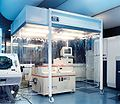
What is a Cleanroom?

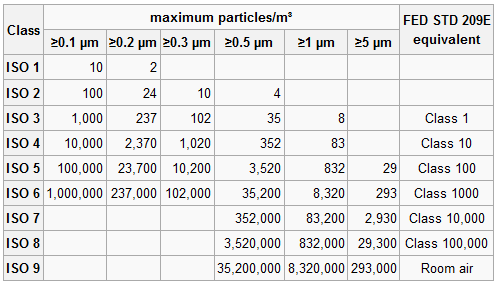
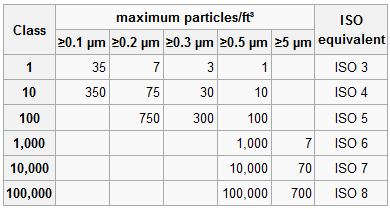
A cleanroom is an environment, typically used in manufacturing or scientific research, that has a low level of environmental pollutants such as dust, airborne microbes, aerosol particles and chemical vapors. More accurately, a cleanroom has a controlled level of contamination that is specified by the number of particles per cubic meter at a specified particle size. To give perspective, the ambient air outside in a typical urban environment might contain as many as 35,000,000 particles per cubic meter, 0.5 μm and larger in diameter, corresponding to an ISO 9 cleanroom.

If the hard disk needs to be opened up, one has to do it within a cleanroom. The gap between the Read-Write head and the data platter is just a few microns. Any dust particles that get into the gap will induce “crashing” of the Read-Write head onto the data platter (where your magnetic data bits are stored) resulting in total and permanent loss of data.

Cleanroom Standards

1. US FED STD 209E was officially cancelled by the General Services Administration of the US Department of Commerce November 29, 2001, but is still widely used.

Cleanroom Standard

2. ISO 14644-1 cleanroom standards

Cleanroom Standard

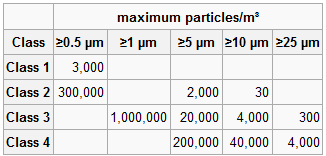
3. BS 5295 Class 1 also requires that the greatest particle present in any sample does not exceed 5 μm.

Cleanroom Standard

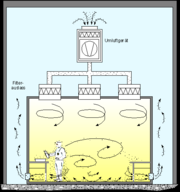
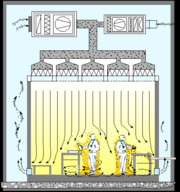
Cleanroom air flow principles

Cleanroom air flow principles Cleanroom air flow principles

picture 1: Air flow pattern for “Turbulent Cleanroom”
Picture 2: Air flow pattern for “Laminar Flow Cleanroom”

What makes cleanroom environment fail?

* Facilities

Walls, floors and ceilings

Paint and coatings

Construction material (sheet rock, saw dust etc.)

Air conditioning debris

Room air and vapors

Spills and leaks

* People

Skin flakes and oil

Cosmetics and perfume

Spittle

Clothing debris (lint, fibers etc.)

Hair

* Tool Generated

Friction and wear particles

Lubricants and emissions

Vibrations

Brooms, mops and dusters

* Fluids

Particulates floating in air

Bacteria, organics and moisture

Floor finishes or coatings

Cleaning chemicals

Plasticizers (outgasses)

Deionized water

* Product generated

Silicon chips

Quartz flakes

Cleanroom debris

Aluminum particles

Cleanroom Control Regulations for reference

1.  All personal items such as keys, watches, rings, matches, lighters and cigarettes should be stored in the personal locker outside the gowning room.

2.  Valuable personal Items such as wallets may be permitted in the cleanroom provided they are NEVER removed from beneath the cleanroom garments.

3.  NO eating, smoking or gum chewing allowed inside the cleanroom.

4.  Only garments approved for the cleanroom should be worn when entering.

5.  NO cosmetics shall be worn in the cleanrooms. This includes: rouge, lipstick, eye shadow, eyebrow pencil, mascara, eye liner, false eye lashes, fingernail polish, hair spray, mousse, or the heavy use of aerosols, after shaves and perfumes.

6.  Only approved cleanroom paper shall be allowed in the cleanroom.

7.  Approved ball point pens shall be the only writing tool used.

8.  Use of paper or fabric towels are prohibited. Use of hand dryers equipped with HEPA filters are suggested.

9.  Gloves or finger cots should not be allowed to touch any item or surface that has not been thoroughly cleaned.

10. Only approved gloves, finger cots (powder-free), pliers, tweezers should be used to handle product. Finger prints can be a major source of contamination on some products.

11. Solvent contact with the bare skin should be avoided. They can remove skin oils and increase skin flaking.

12. Approved skin lotions or lanolin based soaps are sometimes allowed. These can reduce skin flaking.

13. All tools, containers and fixtures used in the cleaning process should be cleaned to the same degree as the cleanroom surfaces. All of these items are a source of contamination.

14. NO tool should be allowed to rest on the surface of a bench or table. It should be place on a cleanroom wiper.

15. Only cleanroom approved wipers are allowed to be used. The wipers must be approved for the Class of cleanroom being cleaned.

16. ALL equipment, materials and containers introduced into a sterile facility must be subjected to stringent sterilization prior to entrance.

17.NO ONE who is physically ill, especially with respiratory or stomach disorders, may enter a sterile room. This is a good practice in any cleanroom environment.

Personal Actions Typically Prohibited in Cleanrooms

1. Fast motions such as running, walking fast or horseplay.

2. Sitting or leaning on equipment or work surfaces.

3. Writing on equipment or garments.

4. Removal of items from beneath the cleanroom garments.

5. Wearing the cleanroom garment outside the cleanroom.

6. Wearing torn or soiled garments.

Read More

Mac File Recovery

Mac is a series of personal computer designed, developed, manufactured, and marketed by Apple™ which uses its own designed and developed operating system called MAC OS. The original Mac used “Motorola” and “IBM” processors, however recently they have launched their new hardware based on Intel x86 processors. The Mac OS which is used natively on Mac hardware was originally known as “System Software,” the current version of Mac OS is Mac OS X which has been code named like puma, jaguar, panther, tiger and leopard.

Mac OS X saves data using HFS and HFS+ (Extended and Journaled) file system; like all other platforms, Mac users also face data loss, some of the most common causes for data loss which are supported at Disk Doctor Labs have been indicated below.

What are the Symptoms of a Data Device Failure?
Your data device might be displaying any one of the symptoms listed below. This can be due to physical damage to the storage device or logical corruption to the file system or operating system. Below, we have listed many of them.

• Mac Machine won’t boot
• Clicking sound heard from device
• Hard disk drive not spinning up
• Electronics controller card is damaged
• Smoke was observed / smelled
• Virus attack has corrupted the file system
• Accidentally deleted files / directories
• Accidental reformatting of partitions
• Missing or deleted partitions
• Applications are unable to run or load data
• Device firmware has become corrupt
• Hard disk drive components failure
• Fire or water damage
• Inaccessible drives / partitions

What are My Data Recovery Options?
Disk Doctors’ has been serving Mac users as well as printing, graphics design, animation, and entertainment industries that mostly use Mac platforms.

If your device has displayed any of the symptoms listed above, then you may consider any of the following recommendations.

DIY (Do It Yourself):
Although data storage devices in most of the Mac laptops and desktops are not easily accessible, but if one is technically savvy and comfortable in handling the data storage devices, and sure about physical fitness of their data storage device, then they can download demo versions of recovery software to determine whether the issue could be addressed using a recovery utility before spending money to purchase the software. If this helps, then more power to you.

Note: Data storage devices in most Mac machines are not easily accessible; and any attempt trying to get the hard disk drive out may result in unnecessary damage to the machine itself. Therefore, we do not recommend this solution to most; as we have observed the situations getting out of hand while attempting DIY quite often mostly due to inexperience. And often destroying any chances of future recovery attempts.

Get Professional Help:
If your data is vital, then seeking professional help to recover is the only way to go about it. Professional help includes only well established and reputed data recovery companies with a proven track record.

How Much Data Recovery Would Cost?
The recovery cost for a single Mac hard disk drive with HFS or HFS+ can run a wide range (anything from $350 to $3000 depending upon the nature of problem).

Read More