Use JetClean to enhance your PC’s health

PC health,JetClean,PC speedup toolUtilities developer BlueSprig just launched JetBoost 1., a totally free PC speedup tool made to optimize your computer by closing lower unnecessary processes. If the doesn’t have sufficient optimisation energy to your requirements, though, you can alternatively try the company’s new JetClean, a suite of tools with lots of more cleaning and repair options.

There’s a module to wash your Registry, for example. A “Windows Clean” tool helps you to release hard disk space by finding and removing leftover temporary files an “Apps Clean” tool keeps your privacy by removing your web, Home windows and application histories and also the Cutting corners Clean module finds and removes damaged cutting corners.

You are able to choose these power tools individually, or all at one time, simply by checking a couple of boxes. Click “Scan Now” as well as your selected modules will examine your computer, confirming back on whatever issues they’ve found. And you will then review them, if you want, or simply click “Repair” to repair them all at one time.

Just just in case that’s insufficient functionality, the designers also have provided a Tools tab that lists a couple of helpful extra supplies. So you receive a System Information program, for example. An Uninstaller module can help you find and take away undesirable programs. The Performance Booster basically offers the same functionality as JetBoost, temporarily closing lower unnecessary ways to release system assets. Along with a handy Portable option enables you to produce a single JetClean executable with all of these features, which you’ll then copy to some USB memory stick and employ with any convenient Home windows PC (this program operates on everything from 2000 to Home windows 8).

Fundamental

JetClean doesn’t have shortage of features, then. But exactly how will they perform?

The Hard Disk cleaner demonstrated just a little disappointing, finding only one.25GB of files on our test PC. It had been already reasonably well enhanced, true, but CCleaner accomplished a lot more, recuperating 2.11GB of drive space.

JetClean did better using the Applications Clean module, though, where it could erase more application activity histories than CCleaner could manage. The Registry Scanner and Cutting corners Clean modules also made an appearance to become reasonably thorough.

A few of the stand-alone tools really are a little around the fundamental side. The Un-install, for example, just calls the conventional application uninstaller. There’s no extra technology, no additional inspections to make certain that each trace of the application is taken away.

There’s nothing particularly clever concerning the Startup Optimisation module, either: it simply lists the programs which are set up to produce when Home windows begins, and optionally enables you to definitely disable them in a click. There’s no extra supplies you’ll get with a few of the competition, for example tips about things to disable and things to keep.

And also the program has got the periodic problem, which reminds you that it’s still very new. The Machine Information program, for example, reported our RAM was running at “NULL MHz”, and our memory stays were produced by “Manufacturer00” and “Manufacturer02”. Which isn’t as informative as we’d wished.

There’s still plenty to love about JetClean, particularly for PC beginners. It’s simple to use, lightweight and portable, and offers a lot of functionality in one small download. It’s also reasonably safe, with, for instance, a Save Center saving any erased Registry secrets, therefore if the cleaning goes a tad too far then your program’s changes may be easily un-tied later.

If you’re a skilled PC user, though, and also have already developed an individual assortment of great free software maintenance and cleanup tools, then JetClean won’t appeal a lot: the majority of the individual tools just aren’t yet effective enough to conquer the very best of your competition. Also it doesn’t help that key functions like a chance to schedule cleaning are restricted to the commercial JetClean Professional (a regular membership-based tool with prices beginning from $1.66 per month click Upgrade within JetClean to discover more).

There’s no harm in using the suite anyway, though, simply to see what you believe: JetClean is indeed a lightweight installation, without any browser tool bars or any other irritations to weigh you lower. Use a copy on your own, and discover just what the program can perform for you personally.

Read More

Data Backup Glossary (Letter H)

Heterogeneous environment
An IT environment that includes computers, operating systems, platforms, databases, applications, and other components from different vendors.

Hierarchical storage management
Hierarchical storage management (HSM) is a data storage system that automatically moves data between high-cost and low-cost storage media. HSM systems exist because high-speed storage devices, such as hard disk drives, are more expensive (per byte stored) than slower devices, such as optical discs and magnetic tape drives. While it would be ideal to have all data available on high-speed devices all the time, this is prohibitively expensive for many organizations. Instead, HSM systems store the bulk of the enterprise’s data on slower devices, and then copy data to faster disk drives when needed. In effect, HSM turns the fast disk drives into caches for the slower mass storage devices. The HSM system monitors the way data is used and makes best guesses as to which data can safely be moved to slower devices and which data should stay on the hard disks.

High availability
The availability of resources in a computer system in the wake of component failures in the system. High availability can be achieved in a variety of ways—from solutions that use custom and redundant hardware to ensure availability to solutions that provide software solutions using off-the-shelf hardware components. The former class of solutions provides a higher degree of availability, but is significantly more expensive than the latter class. This high cost has led to the popularity of the latter class, with almost all vendors of computer systems offering various high availability products. Typically, these products survive single points of failure in the system.

High-level format
(n.) A formatting method that initializes portions of the hard disk and creates the file system structures on the disk, such as the master boot record and the file allocation tables. High-level formatting is typically done to erase the hard disk and reinstall the operating system back onto the disk drive.

(v.) The process of performing high-level formatting.

Holographic data storage
A mass storage technology that uses three-dimensional holographic images to enable more information to be stored in a much smaller space. In holographic storage, at the point where the reference beam and the data carrying signal beam intersect, the hologram is recorded in the light sensitive storage medium.

Hosted service
A service in which day-to-day related management responsibilities are transferred to the service provider. The person or organization that owns or has direct oversight of the organization or system being managed is referred to as the offerer, client, or customer. The person or organization that accepts and provides the hosted service is regarded as the service provider. Typically, the offerer remains accountable for the functionality and performance of a hosted service and does not relinquish the overall management responsibility of the organization or system.

Hot backup
A technique used in data storage and backup that enables a system to perform a routine backup of data, even if the data is being accessed by a user. Hot backups are a popular backup solution for multi-user systems as no downtime to perform the backup is required. If a user alters the data during the backup process (for example, makes changes at the exact moment the backup system is processing that data) the final version of the backup may not reflect those changes. Hot backup may also be called a dynamic backup or active backup.

Hot potato routing
A form of routing in which the nodes of a network have no buffer to store packets in before they are moved on to their final predetermined destination. In normal routing situations, when multiple packets contend for a single outgoing channel, packets that are not buffered are dropped to avoid congestion. But in hot potato routing, each packet that is routed is constantly transferred until it reaches its final destination because the individual communication links cannot support more than one packet at a time. The packet is bounced around like a “hot potato,” sometimes moving further away from its destination because it has to keep moving through the network. This technique allows multiple packets to reach their destinations without being dropped.

Hot standby
A method of redundancy in which the primary and secondary (backup) systems run simultaneously. The data is mirrored to the secondary server in real time so that both systems contain identical information.

Read More

How to Repair Hard Drive PCB Circuit Boards?

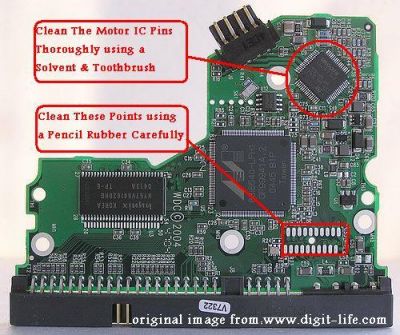
harddrivepcb Many hard drive failures are caused by problems with the PCB(HDD can’t spin; PCB board/chip be burnt; PCB interface broken; etc). If your hard drive does not spin when powered on, PCB replacement may allow you to recover your data. PCB replacement will not fix all hard drive failures, however, and like most other do-it-yourself repairs, it may void any remaining warranty on the drive. This process should be used only as a last resort after all other options have been exhausted. If you are not comfortable performing repairs yourself, many data recovery companies will perform this task — for a fee.

Before Repairing Hard Drive PCB Circuit Boards You Should Know:

  • Replacement HDD PCBs are almost always sold in limited quantities, so be sure to check auction sites and contact specialty vendors.
  • Don’t be tempted to use a similar-looking PCB that is not identical to the original; this will almost always cause damage.
  • Use caution when handling small electronic components. Hard drives are very sensitive to bumps; a small fall could do serious damage.

Instructions of Repairing Hard Drive PCB Printed Circuit Boards:

1. Confirm that the PCB actually needs to be replaced. If your hard drive spins when powered on or makes clicking noises, the fault is mechanical and will require professional data recovery. If the drive does nothing when powered on or shuts off intermittently, the PCB may be at fault.

2. Locate a suitable replacement PCB. To do this, you will need the model number of the PCB, which is usually etched somewhere on the board itself. To remove the PCB, simply remove the screws that fasten it to the drive and carefully disconnect the ribbon cable. Many hard-drive manufacturers use specially shaped star or hex screws, so be sure to use the appropriate screwdriver to prevent stripping. Tearing the ribbon cable will render the drive unrepairable, so be gentle; it should come free with minimal force.

3. Purchase a replacement PCB. These can often be difficult to find, though many online resellers offer a wide variety; be sure to contact as many vendors as you can. You will need an identical board, both in physical shape and size as well as model number; substituting different boards may cause permanent data loss.

HDDZone.com is recommended, they provide all kinds of hard drive PCBs including Seagate, Maxtor, Western Digital, Samsung and others with worldwide free shipping.

4. Connect the replacement PCB. Gently connect the ribbon cable; make sure that it’s fully connected before mounting the PCB to the drive with the screws you removed before. Be sure to mount the PCB exactly as the original was mounted.

5. Test that the new PCB is working by turning off your computer and connecting only the power line to the drive. When you press the power button to turn the computer back on, the drive should spin. If it appears to be spinning properly, turn the computer off again and connect the hard drive as it would normally be configured to recover your data.

6. Cut the power and disconnect the drive if the hard drive fails to spin or makes any unusual noises when powered on. Ensure that you connected the PCB properly and that it is mounted securely. If you have performed these steps as stated and the hard drive still fails to spin, the problem is likely mechanical and will require professional data recovery.

Related Links:

Hard Drive PCB Swap Guide (Seagate, Western Digital, Samsung, Maxtor and others)

Read More

MS Compound Document Files

(Includes documents, spreadsheets, templates and other MS office files)

MS OfficeNext we will look at carving MS Compound Document (and spreadsheet) files, as specified in the document “Open Office.org’s Documentation of the Microsoft Compound Document File Format.” For complete details of the file format specification, please refer to the hyperlink to the document, listed on page 1 of this paper.

As quoted from the above referenced document, “Compound document files are used to structure the contents of a document in the file.  It is possible to divide the data into several streams, and to store these streams in different storages in the file.  This way compound document files support a complete file system inside the file, the streams are like files in a real file system, and the storages are like sub-directories.”

All streams of a compound document file are divided into sectors. Sectors may contain internal control data of the compound document or parts of the user data.  The entire file consists of a compound document header and a list of all sectors following the header..  The size of the sectors can be set in the header and is fixed for all sectors then.

Example:
 HEADER
SECTOR 0
SECTOR 1
SECTOR 2
SECTOR 3
SECTOR 4
SECTOR 5
SECTOR 6
…and so on…

As we discussed in the section on Zip files, if you know what you are looking for, and where you expect to find it within the file, you can determine exactly what data belongs to the file in question and whether or not there is fragmented data within the file.

We start by searching for the Compound Document Header, “D0 CF 11 E0 A1 B1 1A E1,” to identify the beginning of each of the MS compound documents.  Next, at offset 0x1E from the beginning of the header we find a 2-byte value that identifies the sector size used in the document, which is usually 512-bytes/sector.  Now, knowing the size of each sector that makes up the file, we can start looking for document structures and where within the file they should be located.  As noted in the Zip file process mentioned earlier in this paper, the difference between the EXPECTED location of a structure and its ACTUAL location is the size of the fragmented data that doesn’t belong to the file.

At file offset 0x2C, we find the # of sectors used by the Sector Allocation Table (SAT).  Next, at file offset 0x30 we find the starting sector number (within the file) of the file’s Directory.  Another important file structure is the Short-Sector Allocation Table (SSAT), whose starting sector # is located at file offset 0x3C, followed by the number of sectors making up the SSAT, located at file offset 0x40.  Not all compound documents utilize a SSAT, in which case you can ignore these 8 bytes.  And lastly, we look at the Master Sector Allocation Table (MSAT), whose starting sector # is located at file offset 0x44, followed by the number of sectors making up the MSAT, located at file offset 0x48.  The following 436 bytes of data, which make up the rest of the first 512 bytes of the compound document file, contain the first 109 sector IDs (SID) of the MSAT and starts at file offset 04C.

So, now that you know where certain items should be located, the next step is to located them on the disk and find out if they are located at the expected sector number in relation to the start of the document.

First, using the first sector of the MSAT from the 4-byte value at offset 0x4C, search for “01 00 00 00 02 00 00 00 03 00 00 00 04 00 00 00” to find the beginning of the MSAT and compare the sector number you find the MSAT located at with the results of the sector # of the start of the document plus the 4-byte value at offset 0x4C.  If there is a difference, then a fragmentation occurs before the start of the MSAT.

Secondly, search forward for the beginning of the Directory, starting from the document’s header. The signature for the start of the Directory is “52 00 6F 00 6F 00 74 00 20 00 45 00 6E 00 74 00 72 00 79 00” (or “Root Entry” in case sensitive Unicode).  There may be left over instances of previous Directory Entries from previous file edits, so look for more than one instance of the “Root Entry”.  Once you find the sector # of the start of the Directory, subtract the sector # of the start of the document, and compare the result against the 4-byte value at file offset 0x30.  If the result matches your 4-byte value then no fragmentation exists between the start of the file and the Directory.  If there is a difference, the difference is the amount of fragmented data that doesn’t belong to the document.

And lastly, review of the individual Directory Entries for the starting sector numbers and stream size of the objects will assist in determining where, before or after each object, any file fragmentation occurs.

The largest object within the compound document is most likely the “WordDocument” object, or”Workbook” object for spreadsheets.  Which means that if fragmentation exists within a large compound document, it is likely that the fragmentation occurs within those streams.  As was mentioned earlier, through a process of elimination and/or manual review of the carved block for a block of data the size of your determined fragment for data that doesn’t belong to the document.

The directory is an array of directory entries.  Each directory entry is a 128-byte entry and is listed in order of their appearance in the document.  It identifies the starting sector # of that file object, at directory entry offset 0x74 and the size of that object (in bytes) at offset 0x78.

Read More

RAID Array & Server Glossary of Computer Terms (Letter U)

Usable storage capacity
Disk array capacity that is usable for data storage (vs. for mirroring or parity data). For example, under mirroring (RAID 1 and 0/1), usable storage remains a constant fifty percent (half of storage is always used for redundancy). This is in contrast to other RAID levels such as RAID 5, in which usable storage capacity is determined by the formula of “n-1”. “n” is the total number of disk drives and “1” is the number of disks worth of capacity used for parity (redundancy) overhead. So, as the number of disks in the array grows, the usable storage capacity percentage increases in relation to parity (redundancy) information.

Read More