Articles

Seagate Announced Restructuring Plan To Further Reduce Operating Costs

Seagate Technology announced it has initiated a restructuring plan that includes a reduction of approximately 1,100 employees or 2.5% of the company’s global workforce. This reduction is required to support a targeted run rate of product development and marketing and administrative costs of less than $300 million per quarter and to position the company to be cash flow and earnings positive within its fiscal year 2010.

The restructuring plan, which the company expects to be largely complete by the end of July 2009, is expected to result in total pretax restructuring charges of approximately $72 million. These charges will primarily be incurred in the June 2009 quarter and consist mainly of cash based employee termination costs which are expected to be substantially paid in the September 2009 quarter. The annual savings generated from this restructuring action is expected to be approximately $125 million.

Since the beginning of fiscal year 2009, and including today’s announcement, the company has reduced its global headcount through attrition and restructuring, resulting in a reduction in the company’s labor costs in excess of 25%. In addition, Seagate previously announced the realignment of its organizational structure to increase efficiency, as well as the closures of two recording media facilities and its Pittsburgh research facility, company-wide salary reductions announced in January 2009, and other cost reduction initiatives. Seagate continues to assess options to further reduce manufacturing operating costs.

Seagate Announced Restructuring Plan To Further Reduce Operating Costs Read More »

The Information about Linux Desktop from IBM

linux21 May 2009: IBM announced the results of a study conducted by the I.T. analyst firm Freeform Dynamics, commissioned by IBM, which showed that Linux desktops were easier to implement than IT staff expected if they targeted the right groups of users, such as those who have moderate and predictable use of e-mail and office tools

The research behind the report, “Linux on the Desktop: Lessons from Mainstream Business Adoption,” was designed, executed and interpreted independently by Freeform Dynamics. Feedback was gathered via an online survey of 1,275 I.T. professionals from the U.K., U.S., Canada, Australia, New Zealand and a spread of other countries across Western Europe and the Nordics. Ninety percent of the study’s respondents had direct experience with desktop Linux deployment in their business.

Those with experience of such migrations said that Linux on the desktop was best achieved when it was first targeted to groups of non-technical users. Transaction workers and general professional workers were seen as more than twice as likely to be primary targets for desktop Linux adoption than mobile and creative staff. A majority of the respondents indicated that Linux desktop deployments to these targeted groups was easier than anticipated.

“Some users care a great deal about their desktop computing environment and may be emotionally or practically wedded to Windows,” said Dale Vile, research director, Freeform Dynamics. “The trick is to avoid getting distracted by these, and focus on the users for whom the PC on their desk is simply a tool to get their job done. Migrating a general professional user who only needs to access a couple of central systems, an email inbox and light word processing is pretty straightforward.”

Key statistics of the study include:

71% of respondents indicated cost reduction as their primary driver for adoption.
35% stated the ease of securing the desktop was another primary driver
32% cited the lowering of overheads associated with maintenance and support in general were factors contributing to the benefit of desktop Linux adoption
Those with experience of Linux desktop rollouts are 50% more likely to regard non-technical users such as general professional users and transaction workers as primary targets for Linux
58% of those with prior experience of a Linux desktop rollout see general professional users as primary targets
52% of those with prior experience of a Linux desktop rollout see transaction workers as primary targets.
32% of those with prior experience of a Linux desktop rollout see power users as primary targets.
47% of respondents said usability was the main consideration when evaluating or selecting a desktop Linux distribution for use in a business environment

The study confirmed Linux on the desktop adoption is primarily driven by cost reduction. About twice as many of the respondents cited cost savings over security as the primary driver of why they’d adopt Linux on the desktop. Participants in the study indicated that both environments can be secured adequately — it’s just cheaper to secure a Linux desktop and maintain it that way.

“If a company is a ‘Windows shop,’ at some point it will need to evaluate the significant costs of migrating its base to Microsoft’s next desktop and continuing the defense against virus and other attacks,” said Bob Sutor, vice president of Linux and open source, IBM Software Group. “Savvy IT departments see the Linux desktop as a PC investment that actually saves money during this downturn. We see the recession fueling open source on the desktop.”

The user groups in the study were defined as:

IT operations/support staff
General professional users (relatively light and predictable use of e-mail, office tools, etc)
Transaction workers (mostly using enterprise applications in a routine prescriptive manner)
Other (non-IT) technical staff (e.g. engineers, technical designers/architects)
Office based power users (e.g. finance staff, marketing teams, knowledge workers, etc)
Highly mobile professional users (e.g. sales, roaming managers, etc)
Creative staff (non-engineering, e.g. graphic design)

For more information on IBM, you can visit http://www.ibm.com/think

The Information about Linux Desktop from IBM Read More »

External Hard Disk Box

images11. An external hard disk box, used for installing a hard disk, wherein there is a first fastening hole and a second fastening hole on a bottom and two sides of the hard disk, the external hard disk box comprising: a lower cover having a receiving space for receiving the hard disk, wherein there is a first positioning portion that corresponds to the first fastening hole on the bottom surface of the receiving space; an upper cover covering the lower cover; and at least one positioning structure located on one side of the receiving space, wherein the positioning structure has a second positioning portion that corresponds to the second fastening hole.

2. The external hard disk box as claimed in claim 1, wherein the positioning structure is located on one side of the hard disk, the first positioning portion is plugged into the first fastening hole, and the second positioning portion is plugged into the second fastening hole.

3. The external hard disk box as claimed in claim 1, wherein the positioning structure is a flexible flake, the flexible flake has a side board, and the second positioning portion is located on the side board.

4. The external hard disk box as claimed in claim 1, wherein the positioning structure includes an external mask, a spring flake, and a pushing element, the external mask has a through hole that corresponds to the second positioning portion, one end of the spring flake is connected with the external mask, a second end of the spring flake is a free end and has the second positioning portion, and the pushing element is slidably located in the external mask and contacts the second end of the spring flake.

5. The external hard disk box as claimed in claim 1, wherein the positioning structure is a flexible element, one side of the flexible element bends to form a linking flake, one end of the linking flake is a free end and forms a pushing portion, and the pushing portion extends to form the second positioning portion.

6. The external hard disk box as claimed in claim 5, wherein the upper cover is slidably assembled with the lower cover, two leg columns extend from two sides of the bottom surface of the upper cover, and the leg column corresponds to the pushing portion.

7. The external hard disk box as claimed in claim 6, wherein there is a first wedged portion and a second wedged portion on the lower cover and the upper cover.

8. The external hard disk box as claimed in claim 5, wherein each of the flexible elements bends upwards to form at least one curved portion, and the curved portion pushes and contacts a bottom surface of the upper cover.

External Hard Disk Box Read More »

Access control method and module with data recovery option for a hard disk

1. An access control method for a hard disk, comprising the steps of: (A) partitioning the hard disk into primary and secondary partitions; (B) in response to a write command from a host terminal for storing write data in an addressable space found in the primary partition of the hard disk, (i) creating a recovery file that includes a write time, an address of the addressable space, and recover information including a starting data found in the addressable space of the hard disk during the write time, and (ii) storing the write data in the primary partition at the address of the addressable space, and the recovery file in the secondary partition; and (C) in response to a recover command from the host terminal, (a) retrieving the recovery files from the secondary partition, the write time in each of the retrieved recovery files being not earlier than a recovery time associated with the recover command, and (b) based on the contents of the recovery files retrieved in sub-step (a), restoring the primary partition to the starting data initially found therein during the recovery time.

2. The method of claim 1, wherein, in sub-step (ii), the address of the addressable space, the write data and the recovery file are stored in a buffer prior to storage in the hard disk.

3. The method of claim 1, wherein the recover information further includes the write data.

4. The method of claim 1, wherein, in sub-step (b), restoring of the primary partition is performed in a chronological order of the write times in the retrieved recovery files starting from one of the retrieved recovery files having a latest write time.

5. The method of claim 1, further comprising the step of reporting a total storage capacity of the hard disk as being equal to that of the primary partition in response to a capacity inquiry command from the host terminal.

6. An access control module for a hard disk that is partitioned into primary and secondary partitions, said access control module being responsive to write and recover commands from a host terminal, and comprising: a processor; a first interface adapted to connect said processor to the host terminal; a second interface adapted to connect said processor to the hard disk; a command interpreter coupled to said first interface for interpreting the write and recover commands; and a recovery file creator coupled to said processor and said command interpreter; wherein, in response to the write command for storing write data in an addressable space found in the primary partition of the hard disk, said command interpreter enables said recovery file creator to create a recovery file that includes a write time, an address of the addressable space, and recover information including a starting data found in the addressable space of the hard disk during the write time, and further enables said processor to store the write data in the primary partition at the address of the addressable space, and the recovery file in the secondary partition; and wherein, in response to the recover command from the host terminal, said command interpreter enables said processor to retrieve the recovery files from the secondary partition, the write time in each of the retrieved recovery files being not earlier than a recovery time associated with the recover command, and based on the contents of the recovery files retrieved by said processor, to restore the primary partition to the starting data initially found therein during the recovery time.

7. The access control module of claim 6, further comprising a buffer coupled to said processor, said processor storing the address of the addressable space, the write data and the recovery file in said buffer prior to storage in the hard disk.

8. The access control module of claim 6, wherein the recover information further includes the write data.

9. The access control module of claim 6, wherein said processor restores the primary partition in a chronological order of the write times in the retrieved recovery files starting from one of the retrieved recovery files having a latest write time.

Access control method and module with data recovery option for a hard disk Read More »

Preventive recovery action in hard disk drives

1. A method in a data processing system for minimizing read/write errors caused by impaired performance of a hard disk drive during runtime operation of said hard disk drive, said runtime operation including an active mode during which read/write operations are performed and a standby mode during which no read/write operation is underway, said method comprising the steps of: monitoring at least one performance parameter of a hard disk drive during said standby mode of operation; and in response to detecting a degraded value of said at least one performance parameter during said monitoring, performing preventive recovery action only during said standby mode of operation, wherein said preventive recovery action includes restoring said performance parameter to an acceptable value without interfering with hard disk drive operation during an active mode.

2. The method of claim 1 wherein said performance parameter is signal resolution, and wherein said step of performing preventive recovery action comprises the step of adjusting a fly height of a read/write head within said hard disk drive, such that said signal resolution is maintained at an acceptable level.

3. The method of claim 1, wherein said data processing system includes a disk drive controller associated with said disk drive, said method further comprising the steps of: during said step of monitoring at least one performance parameter, detecting a degradation of said performance parameter beyond a pre-determined value; and in response to detecting a degradation of said performance parameter, performing preventive recovery action during said standby mode, wherein said preventive recovery action instructs said disk drive controller to undertake corrective action to rectify the degraded performance parameter.

4. The method of claim 1, further comprising the steps of: detecting a read/write error during said active mode of operation, said error having a cause that is correlated to said performance parameter; and in response to detecting a read/write error during said active mode of operation, examining said performance parameter during said standby mode, such that said cause may be diagnosed and further read/write errors prevented.

5. The method of claim 4, further comprising the step of correlating said preventive recovery action to said cause of said read/write error, such that said cause may be corrected.

6. The method of claim 4, wherein said step of examining said at least one performance parameter is preceded by the steps of: initiating a data recovery procedure during said active mode; and upon completion of said data recovery procedure, initiating preventive recovery action during said standby mode, such that a subsequent read/write error may be prevented.

7. The method of claim 6, wherein the step of initiating preventive recovery action during said standby mode is followed by the steps of: determining whether said cause has been corrected by said preventive recovery action; in response to said cause having been corrected, continuing said runtime operation of said hard disk drive; and in response to said cause having not been corrected, utilizing predictive failure analysis to issue a warning, such that said hard disk drive may be taken off-line.

8. A system for preventing read/write failures within a hard disk drive during runtime operation of said hard disk drive, said runtime operation including an active mode during which read/write operations are performed and a standby mode during which no read/write operation is underway, said hard disk drive including a controller for providing electromechanical control of said hard disk drive, said system comprising: means within a disk controller for monitoring a performance parameter of said hard disk drive during said standby mode of operation; means responsive to a detected degradation of said performance parameter for producing an error signal indicative of a potential hard disk drive failure; and means responsive to receiving said error signal for initiating preventive recovery action only during a standby mode of operation, wherein said preventive recovery action includes restoring said performance parameter to an acceptable value without interfering with hard disk drive operation during an active mode.

9. The system of claim 8, wherein said means for monitoring a performance parameter of a hard disk drive and said means for producing an error signal in response to detection of a potential hard disk drive failure, are predictive failure analysis instruction means.

10. The system of claim 9, further comprising: a controller for providing electromechanical control of said hard disk drive, said controller receiving and executing said predictive failure analysis instructions.

11. The system of claim 9, wherein said means for initiating preventive recovery action only during a standby mode of operation are preventive recovery action instruction means included within said controller.

Preventive recovery action in hard disk drives Read More »

Data clock recovery circuit

1. A variable phase oscillator comprising:
an oscillator having a substantially fixed frequency output signal;

means for periodically generating coded phase values of said oscillator output signal, said generating means including means for quantizing the phase value of said oscillator output signal into a predetermined number of phase steps;

a source of a prescribed phase value; and

means for comparing said periodically generated coded phase values and said prescribed phase value to periodically generate output pulse signals.

2. The invention as defined in claim 1 wherein the relative phase of said output pulse signals in relationship to said oscillator output signal is dependent on said prescribed phase value.

3. The invention as defined in claim 2 wherein said source of said prescribed phase value includes means for obtaining a phase value which represents the phase difference between said coded phase values and an incoming data transition.

4. The invention as defined in claim 1 wherein said source of said prescribed phase value includes means for obtaining the coded phase value being generated upon occurrence of an incoming data transition.

5. The invention as defined in claim 4 wherein said source of said prescribed phase value includes means supplied with said coded phase values and being responsive to an incoming data transition for storing the coded phase value being generated upon occurrence of said data transition and for adding a predetermined phase value to said stored coded phase value.

6. The invention as defined in claim 4 wherein said source of said prescribed phase value further includes means for adding a predetermined phase value to said obtained coded phase value.

7. The invention as defined in claim 6 wherein said means for obtaining comprises means supplied with said coded phase values and being responsive to said incoming data transition for storing the coded phase value being generated upon occurrence of said data transition.

8. The invention as defined in claim 7 wherein said predetermined phase value is dependent on the incoming data bit period.

9. Data clock recovery apparatus comprising:
an oscillator having a substantially fixed frequency output signal;

means for periodically generating coded phase values of said oscillator output signal, said generating means including means for quantizing said oscillator output signal into a predetermined number of phase steps;

means supplied with said coded phase values and being responsive to an incoming data transition for generating a prescribed phase value in predetermined relationship to a coded phase value being generated upon the occurrence of said data transition; and

means for comparing said periodically generated coded phase values with said prescribed phase value to generate periodically clock recovery pulse signals.


10. The invention as defined in claim 9 wherein said means for generating said prescribed phase value includes means supplied with said periodically generated coded phase values and being responsive to an incoming data transition for storing the coded phase value being generated upon occurrence of said data transition and for adding a predetermined phase value to said stored coded phase value.

11. The invention as defined in claim 9 wherein said means for generating said prescribed phase value comprises means supplied with said periodically generated coded phase values and being responsive to an incoming data transition for storing the coded phase value being generated upon occurrence of said data transition and means for adding a predetermined phase value to said stored coded phase value.

12. The invention as defined in claim 11 wherein said coded phase values are coded in a Gray-code format.

13. The invention as defined in claim 11 wherein said predetermined phase value is selected in predetermined relationship to the incoming data bit period.

14. The invention as defined in claim 13 wherein said comparing means generates a clock recovery pulse when said supplied coded phase value equals said prescribed phase value.

Data clock recovery circuit Read More »

Stored data recovery system

1. A method for recovering data from a flash data storage system, the method comprising the steps of: loading flash data storage media into a device using a flash data storage system, said device being connected to a technical workstation; loading all physical sectors of the flash data media into memory of the technical workstation or remotely controlling the flash data storage system through hardware/software; whereupon data storage on the flash data storage media can be diagnosed and rectified through operation of the data recovery computer portion of the technical workstation.

2. The method as defined in claim 1, further including the step of querying a flash data storage system for information through operation of a data recovery program by the technical workstation prior to loading sectors onto the data recovery computer portion of the technical workstation.

3. The method as defined in claim 2 wherein said step of querying said flash data storage system includes determining at least one of: the PC card type, the memory size, PC card geometry, chip type, firmware revision, and type of card.

4. The method as defined in claim 2, further including the step of querying the flash data storage system for identifying information through operation of a data recovery program by the technical workstation prior to loading all physical sectors of the flash data media into memory of the technical workstation.

5. The method as defined in claim 4 wherein the step of querying the flash data storage system for identifying information further includes the step of checking socket status for write protection and the status of the backup battery on the flash data storage system.

6. The method as defined in claim 2, wherein the step of identifying the flash data storage system includes monitoring the flash data storage medium containing the data recovery application programs.

7. The method as defined in claim 1 further including the step of executing a data recovery application program on the flash data storage system.

8. The method as defined in claim 7 wherein the step of executing a data recovery application program further includes the step of computing a CRC checksum over an entire PC card or section thereof.

9. The method as defined in claim 1, further including the step of executing a data recovery diagnostic program on the flash data storage system.

10. The method as defined in claim 9 wherein the step of executing a data recovery diagnostic program includes the step of generating DOS-Formats for SRAM and ATA cards.

11. The method as defined in claim 1, further including the step of downloading data to be recovered from the flash data storage system to said technical workstation.

12. The method as defined in claim 1, further including the step of logging all write activity, to be performed on a sector of the flash data storage media to a file on said technical workstation.

13. The method as defined in claim 12, further including the step of providing each entry within the file with an identifier which identifies the sector and the local storage device, as well as the latest data which was written to that sector.

14. A data recovery system for recovering inaccessible data from a flash data storage system, comprising: a flash data storage system selected from a group including: CompactFlash, ATA Type I, II, III or IV, digital film card, SmartMedia, Memory Stick, Multimedia Card (MMC), Secure Digital Card (SD) or other similar flash device; a data recovery system including a computer which computer accesses or controls the flash data storage system so that data on the flash data storage media of the flash data storage system can be diagnosed and rectified.

15. A data recovery system as defined in claim 14, further including a technical workstation which includes a second data storage media for storing data recovery application program means.

16. A data recovery system as defined in claim 14, further comprising a communications channel over which communications are established between the flash data storage system and the technical workstation, said communications channel using one of the group including a PCMCIA Adapter, Floppy type adapter, local area network, wide area network, Internet and proprietary adapter suited to the flash storage device.

17. A data recovery system as defined in claim 14, wherein the flash data storage system is operable from said data recovery computer so as to recover data from the flash data storage media.

18. A data recovery system as defined in claim 14, wherein a flash data storage device is operable from the data recovery computer so as to diagnose a data recovery situation on the flash data storage media.

19. A data recovery system for recovering inaccessible data from a flash data storage system to another flash data storage system, said data recovery system comprising: a flash data storage system selected from a group including: CompactFlash, ATA Type I, II, III or IV, digital film card, Smart Media, Memory Stick, Multimedia Card (MMC), Secure Digital Card (SD) or other similar flash device; a computer which accesses or controls the flash data storage system so that data on the flash data storage media can be diagnosed and rectified.

20. The data recovery system as defined in claim 19 further including: a communication channel over which communications are established between the flash data storage system and another flash data storage system, said communications channel using one of the group including an PCMCIA Adapter, a Floppy type adapter, local area network, wide area network, Internet, and proprietary adapter suited to the flash storage system.

21. A method for recovering data from a flash data storage system, the method comprising the steps of: establishing a data link between a technical workstation and a flash data storage media through operation of a data recovery application program by a technical workstation; and controlling flash data storage by a technical workstation; whereupon data on the storage media of the flash data storage system can be diagnosed and rectified through operation of said technical workstation.

22. A data recovery system as defined in claim 21, further including means for transferring all data, which is marked for being changed to an archival facility before making the changes to the flash card data storage media.

23. A data recovery system as defined in claim 21, further including means for logging all write activity, to be performed on a sector of a local storage device, or to a file on the flash card data storage media.

24. A data recovery system as defined in claim 21, wherein each entry within the file contains an identifier, said identifier identifying the sector and the local storage device, as well as the latest data which was written to that sector.

25. A data recovery system as defined in claim 21, further including means to select data recovery events during a data recovery process.

26. A method of data recovery comprising the steps of: establishing a communications link between a flash data storage system requiring recovery of data and a data recovery computer; enabling interaction between said flash storage system and said data recovery computer; diagnosing said flash data storage system; downloading a data recovery application program from said data recovery computer to said flash data storage system; and recovering data on the flash storage system.


Stored data recovery system Read More »

Background of the Magnetic disc drive head alignment system Invention

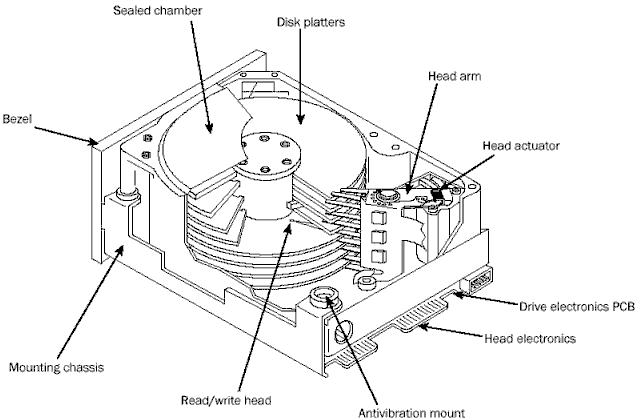
Magnetic disc drives for recording digital data are well known to the art. In such drives it is desirable to achieve the highest recording density possible, such recording density being a function of both the number of annular tracks per radial inch of disc surface and the number of bits per inch along each track. The optimum number of tracks on the individual discs is dependent on the precision of the head positioning system and on the precision in the alignment of the various read/write heads in the disc drive. The system of the present invention provides for the precise alignment of each of the read/write heads in the disc drive so that an optimum number of tracks per radial inch of the individual discs may be achieved.

The discs incorporated into present-day disc drives are usually referred to as a disc pack, and these discs are stacked one above the other to be sensed by a plurality of magnetic read/write heads mounted in vertical alignment and positioned by a single actuator. In one type of present-day head positioning system used in disc drives, one of the heads (servo disc surface) and one disc surface are dedicated to the generation of debit position signals for an associated servo system. A plurality of servo tracks are recorded in concentric circles on the dedicated servo disc surface, and the servo head produces the debit signals which are indicative of the relative position of the servo head and the servo tracks.

For interchangeability of the disc packs, the various tracks recorded on each of the disc surfaces must be closely aligned with the pre-recorded servo tracks on the dedicated servo disc surface so that the read back of the data from each disc pack is possible on recorders other than the one on which the data was recorded.

When the servo head is held in registry with the servo tracks on the dedicated servo disc surface, and the remaining read/write heads are aligned with the servo head, the remaining heads will be properly positioned over the corresponding data tracks on other disc surfaces. As mentioned above, an objective of the present invention is to provide a system which enables the remaining magnetic heads to be precisely aligned with the servo head, so that they will all be properly positioned with respect to the data tracks on the other disc surfaces.

The normal procedure for assuring that the read/write heads are in vertical alignment is to place a disc pack into the disc drive which has pre-recorded and precisely positioned servo tracks on all the disc surfaces. Such pre-recorded servo disc packs are commercially available for use in head alignment and are usually referred to as “CE” (Customer Engineer) packs. By reading the signals from the individual heads, as the heads read the various servo tracks, and by feeding such signals to a display device, each head can be adjusted until it is in precise tracking engagement with the tracks on the surface of the corresponding disc.

The present invention, as mentioned above, provides a system for reading debit signals generated by the various heads of a disc drive, as these heads read the various servo tracks on the pre-recorded servo disc pack, and it provides digital outputs representative of any misalignments of the various heads. Each head can then be adjusted to a position at which the digital output signal for that head indicates precise alignment.

Background of the Magnetic disc drive head alignment system Invention Read More »

Magnetic disc drive head alignment system

hard disk alignment1. In a disc drive which includes a plurality of read/write magnetic heads and a servo magnetic head mounted for simultaneous movement by an actuator in response to a servo signal from the servo head, and in which the positions of the read/write heads are individually adjustable with respect to the servo head, a system for indicating any misalignment of the individual read/write heads as the particular head produces a cyclic position signal in response to position signals pre-recorded on alignment tracks of an alignment disc, each cycle of said cyclic position signal having a first segment with positive and negative peak amplitudes and a second segment with positive and negative peak amplitudes, the positive and negative peak amplitudes of said first and second segments being equal when the particular head is in registry with the corresponding alignment track, and the positive and negative peak amplitudes of one or the other segments decreasing when the particular head moves out of registry with the alignment rack to one side or the other thereof; said system including balanced gating circuitry having four output circuits for respectively producing four gating signals respectively timed to occur in time coincidence with respective ones of the positive and negative peak amplitudes of said first and second segments; a balanced input circuit connected to the particular head and including first and second outputs respectively applying the cyclic position signal and its complement to said gating circuitry to cause said gating circuitry to cause said gating circuitry to produce said four gating signals at the respective output circuits thereof; peak detector circuitry including four peak detector circuits respectively connected to said four output circuits of said gating circuitry to be individually gated by respective ones of said four gating signals, means connecting two of said peak detector circuits to the first output of said balanced input circuit and further means connecting the other two of said peak detector circuits to the second output of said balanced input circuit, said four peak detector circuits collectively detecting the positive and negative peak amplitudes of each of the two segments of each cycle of said position signal and providing four analog outputs corresponding thereto; and output circuitry connected to the outputs of said four peak detector circuits in said peak detector circuitry for producing an analog output signal having an amplitude corresponding to the difference between the algebraic sum of the positive and negative peak amplitudes of the first segment and the algebraic sum of the positive and negative peak amplitudes of the second segment.

2. The system defined in claim 1, in which said balanced input circuit includes a linear amplifier, and in which said system includes a summing circuit connected to said four peak detectors in said peak detector circuitry for producing an output signal representing the algebraic sum of the outputs of the four peak detector circuits, and an automatic gain control circuit connected to said summing circuit and responsive to the output thereof for producing an automatic gain control signal for said linear amplifier.

3. The system defined in claim 1, in which said gating circuitry contains a frequency-independent phase-shifting circuit so that the system may be used with a wide variety of recorded signals without adjustment.

4. The system defined in claim 1, and which includes circuitry connected to said peak detector circuitry for limiting the analog outputs thereof to a predetermined maximum.

5. The system defined in claim 1, and which includes an analog/digital converter coupled to the output of said output circuitry to convert the analog output signal therefrom into a corresponding digital signal; and a digital display device coupled to the output of the analog/digital converter.

6. The system defined in claim 1, in which said gating circuitry includes first and second comparators interconnected to provide a quadrature shift to the cyclic position signal from said balanced input circuit which is independent of frequency.


Magnetic disc drive head alignment system Read More »

WD Passport – DML file extension – Encrypted files?

Problem: Copied all data from source PC to the Passport, then deleted the data from the source PC. When the Passport was next connected to the source PC it synced and deleted the data from Passport as well.

A lot of deleted data from the Passport have been recovered; however, the data in terms of file names and reported size but they are all .DML files. They cannot be opened by conventional methods or by changing the file ext. Is this a proprietary WD encryption format?

Solution: First things first: If you thought you had a secure backup of your data on a WD Passport and you plugged it into a computer that crashed/fried/etc. and planned to copy your lost files to your fixed-up PC from your WD Passport and found yourself (as another blogger said somewhere) like a deer in the headlights as you watched in horror as the WDSync software automatically started syncing your newly blank internal drive (or empty folders on your internal drive) and the Passport, thus “removing” all your “backed up” files from your Passport, you are not alone (and you’re not stupid).

DO NOT save ANYTHING to the Passport. The files are not gone yet because they have not been overwritten. They are “deleted” files, which typically could be recovered with some free recovery software from download.com, but alas, they are also encrypted, so just recovering them won’t help you. You also have to decrypt them (DMailer uses AES 128-bit encryption).

If you are computer savvy…you should realize that the WDSync software is not backup software and is, in fact, just syncing software. So, if you delete something from your desktop it will delete it from the Passport as well, next time you sync. However, EVEN IF you are computer savvy, you probably wouldn’t have guessed in a million years that DMailer would make “autosync” the default setting and that they wouldn’t tell you ahead of time or prompt you in some way before it started deleting files. So, if you want to use WDSync to sync your data between your computer and your Passport, before you do anything else, SHUT OFF autosync and always manually sync. If you are not interested in syncing your data and just want to backup your data, skip the WDSync software all together. Don’t use it. Just use the Passport like a jump drive and drag and drop your files to it. Your data won’t be encrypted or password protected, but download.com offers a number of downloads that will do this for you (specifically for external drives, jump drives, etc.).

If you are not computer savvy…don’t use the WD Sync software. Do what I just said. Drag and drop your files to the WD Passport as if it were just a jump drive. This way your data are backed up and you can delete whatever you want from wherever you want without worrying about all your data suddenly vanishing.

The headlights for the precious files disappear:

(1) Again, DO NOT save anything to the WD Passport after this happens or your files could be gone for good.

(2) Email DMailer (the company that makes WDSync software for Western Digital). Do NOT contact Western Digital, they will just tell you are screwed. WD’s customer support is awful. Go to http://www.dmailer.com and tell DMailer you just accidentally removed encrypted files from your passport that you need to recover.

(3) Just for kicks, ran some recovery software and turned up a lot of .dml files, but you shouldn’t have to use recovery software if you haven’t overwritten your files. Double click on the Passport icon to open the drive. Find the “WD Sync Data” folder. Open the folder for the computer you accidentally synced to (e.g., “office computer”). Open the “Data” folder. There you should find the .option file, the data base file and a folder containing the “deposited” files from the latest sync. In the Sync deposit folder are more folders which should contain the DMailer files (.dml).

(4) Wait for DMailer to get back to you with their data recovery tool.

WD Passport – DML file extension – Encrypted files? Read More »

Scroll to Top