
Articles

RAID Data Recovery Is Possible!

RAID Data RecoveryWhat if your hard drive decides to enter the Elysian Fields in this very moment? Sure, you could simply get a new hard drive to substitute for the defective one with a quick run to your favorite hardware store. And with last night’s backup you might even reconstruct your installation quickly. But what if you don’t have a backup? The truth to be more like this: many users don’t even have a backup, or it simply is too old and thus useless for recovering any useful files at all. In case of real hard drive damage, only a professional data recovery specialist can help you – say bye-bye to your vacation savings!

Hard drive failure is especially disastrous for smaller companies working with a single server and a single disk, if they do not have a complete and working data backup at hand. The whole situation is even more complicated if the broken hard drive is a member of a RAID array. Neither hard drive failure in RAID 1 nor RAID 5 will result in data loss, since this scenario has been taken care of by the choice of these RAID levels in advance. But the risk of human error increases: self-made data loss occurs if you accidentally substitute the wrong drive in a degraded RAID 5 array (one with a failed hard drive).

But not all hard drives that show failure symptoms are defective. Sometimes, so called “soft errors” can be fixed using data recovery software. But even in this case, you should weigh the risks to see if it makes sense to take care of the problem yourself or get help from professionals. You might not be able to detect a controller failure right away, for example; usually, users assume a problem with the hard drive. Here is our rule of thumb: if you hear clacking sounds in the potentially defective hard drive, or if the computer’s S.M.A.R.T. function indicates an error during the boot process, something is wrong for sure.

What can you do once you know that an important hard drive is definitely broken? Or what happens if you pulled the wrong drive out of the slot while you were desperately trying to save your data? First of all: don’t panic! You need to act systematically and thoughtfully to be successful, as well as to ensure that you spend as little as possible on recovery – costs can hits four digits easily.

RAID Data Recovery Is Possible! Read More »

Top 10 worst computer viruses (Sasser & I Love You)

2. Sasser
Shaun Nichols: Just how much damage can a virus do? Well, take the Sasser worm as one example. This relatively simple little attack managed to cripple airlines, news agencies and even knocked out government systems.

Perhaps most frustrating, however, was that Sasser infection was very easy to prevent. The vulnerability which the attack exploited had been patched for months, and all users had to do was install the most recent security updates from Microsoft.
Sasser was a stark warning that has yet to be heard by many. Unpatched systems are still pervasive around the world, leaving users vulnerable to Sasser and countless other malware attacks that target patched vulnerabilities.

Iain Thomson: I remember the Sasser outbreak well, as I was on holiday and staying with friends in New York when it struck. Being the token geek I spent a good few hours fixing my friend’s computer and cursing the fool who wrote the worm that had me sitting in front of a computer screen when I could be sipping cocktails in Greenwich Village.

The worm caused havoc, not just shutting down a news agency’s systems but causing Delta to cancel some flights and leaving the British coastguard crippled for hours, putting lives at risk. If I’d been a seaman in peril I’d want serious words with the 17-year old author, Sven Jaschan. He was caught after Microsoft put a bounty on his head, something they should do more often.

Jaschan got away with a suspended sentence because he wrote the code before reaching the age of 18. He also caused a storm by accepting a job with a security company in his German homeland. This is not done in the security industry and caused the company, Securepoint, to be shunned by others in the field

1. I Love You
Shaun Nichols: They say you always hurt the ones you love. In 2000, this was taken to extremes when the ILoveYou attack racked up some $5.5bn in damages.

The concept was pretty simple: a user receives a file from a known email contact under the title ‘LoveLetter’ or ‘ILoveYou’. When the attachment is opened, the virus is launched. After infecting the host, the virus then took control of the user’s email program and sent the same ‘ILoveYou’ message to every user in the host’s address book.

Love must have been in the air, because the virus was potent enough to infect some 10 per cent of internet-connected machines at its peak. At a time when many users were still trying to learn the finer points of the internet, ILoveYou was a major wakeup call to some of the dangers on the web.

Iain Thomson: Everybody wants to be loved and ILoveYou was brilliant social engineering. It helped that the virus was spammed out in the early days of internet use and there were a lot of newbies online who had only a vague idea about viruses and how dangerous they could be.

Email was a trusted format and, because the messages came from people the recipient actually knew, the likelihood of them being opened was much higher.

Things are different today, although there are still plenty of people who get caught by social engineering attacks, but ILoveYou makes it so high in the list because it was a brilliant piece of social engineering.

Top 10 worst computer viruses (Sasser & I Love You) Read More »

Top 10 worst computer viruses (Nimda & MyDoom)

Computer Viruses4. Nimda
Iain Thomson: A week after the 11 September atrocities a new virus hit the internet in a big way. Nimda was one of the fastest propagating viruses in history, going from nowhere to become the most common virus online in 22 minutes, according to some reports.

The reason for this speed was that Nimda used every trick in the book to spread itself. It used email, open network shares, IIS vulnerabilities and even web sites to spread. It hit pretty much every version of Windows available and appeared all over the place.

In the paranoid days after the terrorist attack some speculated that this was a digital 11 September, and some security consultants got large speaking fees for suggesting just that. In fact, it was nothing of the sort and was just another attempt at large scale infection.

Shaun Nichols: In the days following the 11 September attacks, everyone was on edge and all types of threats were given plenty of attention. This, in part, helps to explain why Nimda got the attention it did.

Nimda not only played on hype; the worm was also especially virulent due to the sheer number of methods it used to propagate. In addition to spreading via email, Nimda used web site exploits to infect HTML pages and local machine exploits to spread between individual files.

The result was an extremely effective virus circulating at a time when people were more sensitive to all types of threats, both online and offline.

3. MyDoom
Shaun Nichols: Ah yes, the old ‘infect the host then resend to the entire address book’ attack method. Like many other attacks, MyDoom used the tried-and-true practice of spreading through email and address books.

But MyDoom went a step further and targeted peer-to-peer networks. The worm not only spread itself through address books but through the shared folder of users who ran the Kazaa file sharing application.

While definitely skilled programmers, MyDoom’s creators also seemed to be fans of good old-fashioned vigilante justice. One of the early tasks performed by infected users was to take part in a denial-of-service attack against SCO, the infamous software vendor that once tried to lay claim to the patents for Linux.

Iain Thomson: MyDoom was interesting because it was one of the first to use peer to peer as a transmission device, as Shaun notes.

Kazaa was at the peak of its popularity and was causing headaches for Hollywood and the security community. If I had £1 for each time a security expert ranted about the stupidity of using peer-to-peer networks I’d be a rich man. Downloading a file onto your computer from an untrusted source? Madness.

The attack on SCO was also fascinating. SCO was, and to an extent still is, the most hated IT company among users, even more than Microsoft at the time. A worm that attacked a company was something new and raised all sorts of possibilities.


Top 10 worst computer viruses (Nimda & MyDoom) Read More »

Top 10 worst computer viruses (Storm & Melissa)

worst computer viruses6. Storm
Shaun Nichols: Before Conficker came around and got everyone worked into a lather, Storm was the big bad botnet on the block. First appearing in early 2007 as a fake news video on European flooding, the Storm malware menaced users for more than a year.

The huge botnet was also influential for its continued use of social engineering tactics. The malware disguised itself as everything from video files to greeting cards, and attacks were continuously refreshed to coincide with holidays and current news events.

While Storm has since been eclipsed by newer botnets, the name still brings to mind one of the most menacing attacks seen in recent years.

Iain Thomson: When extreme weather hit Europe the damage was bad enough, but the Storm code made things much worse. At a time when many were seriously concerned about the health and safety of friends and family, the last thing anyone needed was an infection.

But Storm was a classic piece of social engineering. At a time when people are concerned they don’t always  think of the consequences, be it approving torture or opening an email attachment.

This kind of social networking is nothing new, of course, but the Storm malware did it very well indeed and proved very effective as a result.

5. Melissa
Shaun Nichols: It was a classic love story. Boy meets girl, girl dances for money, boy goes home and writes computer virus for girl, computer virus gets out of hand and causes millions of dollars in damage. It’s the Romeo and Juliet of our time.

When a New Jersey hacker wrote a small bit of code named after a stripper he met in Florida, he had no idea of the chaos that would ensue. The Melissa virus, as it came to be known, got way, way out of hand.

The virus spread like wildfire throughout the net, and an unintended effect of the worm led to a glut of email traffic that overflowed servers and caused tons of damage and lost work time to corporate IT systems.

The hacker himself was later caught and sentenced to a year and half in prison. Next time he wants to impress a girl, hopefully he’ll stick to chocolates and jewelery.

Iain Thomson: Now, I’ve done some stupid things to impress girls, things that cause me to bite my fist with embarrassment nowadays and one that left me with a small amount of scar tissue, but writing a computer virus makes these pale by comparison.

The real damage of Melissa was not in the code itself, but in its spamming capabilities. The software caused a massive overload of email systems and generated enough traffic to make it highly visible. Current computer malware writers have taken note of code like Melissa and now fly much lower under the wire to attract less attention.

Top 10 worst computer viruses (Storm & Melissa) Read More »

Top 10 worst computer viruses (Conficker & ExploreZip)

computer viruses8. Conficker
Shaun Nichols: The global catastrophe that wasn’t, the third form of the Conficker attack provided nice theatrics but little in the way of actual damage.

The premise was pretty simple: Conficker.C would spread to as many machines as possible throughout March. Each infected machine was given a huge list of domains, one of which would be contacted by 1 April.

The deadline made all the difference. Now, Conficker wasn’t just a simple malware infection, it was a ‘ticking time bomb’, and a looming menace that would unleash carnage. Or at least that’s what the story turned into when unscrupulous security vendors and tech-newbie news outlets got hold of the story.

Then the deadline passed and, pretty much as every reasonable person in the industry predicted, Conficker didn’t do much of anything. The botnet remains intact and still poses a threat, but nothing near the utter cyber-carnage that many spoke of.

Iain Thomson: Conficker has now started its attacks and has proved to be just another botnet builder like most other malware.

However, the media panic over Conficker has shown that people are still scared of viruses. As Bruce Schneier pointed out at RSA last week, Conficker hit all the right buttons. It had a funny sounding name, was mysterious and was set to do something on a ‘magic’ date.

Conficker has, however, served a useful purpose. It spreads via a vulnerability that has had a patch available since last October. If my company’s servers got hit by a vulnerability that old, my IT manager would be getting a stern talking to, possibly involving a thumbscrew and a hot pair of pliers.

7. ExploreZip
Iain Thomson: ExploreZip was written over a decade ago but is still to be found in the wild today, a good example of how persistent these little programs can be.

ExploreZip, like most viruses of the time, targeted Windows systems a nd was spread via email. The recipient got an email reading ‘I have received your email and I shall send you a reply ASAP. Till then take a look at the attached zipped docs.’

Clicking on the attachment booted the virus onto the user’s computer and it immediately spammed itself out to all of the contacts in Outlook. More worryingly it also overwrote Word documents with lines of zeros, and did some damage to the operating system itself. As destructive worms go it wasn’t too bad, but in the pre-Millennium days of 1999 it certainly caused a panic.

Shaun Nichols: Often, viruses aren’t meant to be overtly destructive. Older viruses often did damage through unintended conflicts, while newer malware tries to remain undetected in order to steal data or hijack programs.

This wasn’t the case with ExploreZip, however. Upon receiving the virus, users would open an attachment that would immediately begin damaging the host computer.

This seems pretty scary at first. But when you think about it, a damaged hard drive is still far less serious than a hijacked bank account.

Top 10 worst computer viruses (Conficker & ExploreZip) Read More »

Top 10 worst computer viruses (Part Two)

10. Elk Cloner
Iain Thomson: Elk Cloner was written by a 15-year old high school student called Rich Skrenta as a practical joke. Unfortunately for him the joke turned bad very quickly.

The virus was developed for the Apple II system and was a boot sector virus that spread via floppy discs. Apparently Skrenta was a fan of pirated games and would swap them with his friends, sometimes with little messages added. After one too many of these infected discs, he devised a way to alter discs automatically and the Elk Cloner virus was invented.

It had little in the way of a payload. Every 50th time a person booted an infected disc the software ran a little program on the computer screen, and that was it. Nevertheless it was a serious annoyance and was a harbinger of things to come.

Shaun Nichols: And they say Apple computers don’t get viruses. What Skrenta did not realise was that he was helping to popularise what would later become standard practice for spreading viruses.

Elk Cloner spread through what is now known as a ‘boot sector’ infection. The virus copied itself into the boot sector of a floppy disk and then spread into all future disks. This became a popular attack method for Apple and PC computers, taking over as the preferred method of infection until the internet came along and email attacks emerged.

9. Klez
Iain Thomson: Klez is a persistent little devil, and variants are still doing the rounds today, seven years after it first turned up.

The most common varient, Klez H, spoofs email addresses by randomly picking one from an infected machine before sending itself on to other users. This makes backtracing the identity of the infected machine particularly difficult, since any email stored for any reason can be used.

It exploits a vulnerability in Outlook that allows it to boot up automatically on unpatched systems. It’s a cunning little devil but for all its ingenuity I still want to strangle the writer.

Shaun Nichols: The late 1990s and early 2000s were not only the golden age of the internet, they seemed to be the golden age for malware. Over that time period, few viruses were able to match the reign of Klez.

Like many other viruses of its time, Klez spread through email. Users were duped into opening infected files and, once the malware was installed, the victim’s address book was opened and copies of the attack were sent to contacts.

Klez, however, took this a step further. Not only did the virus send itself to people in your address book, it pretended to be from other people. Later, the worm wreaked further havoc by pretending to be its own removal tool.

Top 10 worst computer viruses (Part Two) Read More »

Top 10 worst computer viruses (Part One)

Computer SecurityAll this panic over a simple strain of flu got us thinking about some of the more virulent computer pandemics that have hit in recent years. While a computer virus pales in seriousness to a human outbreak, malware attacks can still take a huge toll on businesses throughout the world.

The viruses below may not have been the most widespread or effective, although many of them were. Instead they are the ones that stick in the mind as being particularly notable. There are been so many over the years, and viruses will always be a part of computing now, but these may bring back memories, not all of them pleasant.

Honourable mention: Creeper
Iain Thomson: Creeper was possibly the very first computer virus, although this is contested. It was invented back in 1971 by Bob Thomas, using the Tenex operating system, and used the precursor of the internet, ARPANET, to spread between DEC PDP 10 systems.

To delete the Creeper program another piece of code, Reaper, was created to hunt it down and destroy it. The first anti-virus virus, Reaper was an excellent idea and one that worked well.

Some don’t consider it a virus because it lacked many of the features of modern viruses, but I’m counting it anyway because it was an example of the harmlessness of the early age of computers. Creeper did nothing more than display the message ‘I’m the creeper, catch me if you can!’ No payload, no theft, it was an example of a simpler age.

Shaun Nichols: In computer years, 1971 was nearly prehistoric. No Apple, no Microsoft and the internet was still a wild, far-off concept. Still, in this era where computer programming was a highly-specialised skill, we saw many firsts.

Perhaps a sign of the early times, Creeper’s creator not only released the virus itself, but a cleaning program called Reaper that removed the Creeper code.

Honourable mention: Brain
Iain Thomson: Brain was the first virus written for Microsoft’s DOS operating system, back in 1986. It was originally developed to stop the copying of a medical software program developed by two Pakistani brothers, Basit and Amjad Farooq Alvi.

Brain spread by floppy disc and copied itself into the boot sector of the media. It displayed the names of the creators, and suggested the infected recipients got in contact to get disinfected.

It spread quickly and the two brothers were inundated with calls from people around the world demanding that their machines were disinfected. Such was the volume of calls that the two eventually had their phone lines cut off.

Shaun Nichols: Remember how much heat Sony took when it used a rootkit as part of its copy-protection software? Well, it turns out Sony wasn’t the first group to make that mistake.

Back in 1986, a pair of developers from Pakistan tried to stop piracy of their biomedical software by including a small snippet of code to track and report possible piracy. That code was soon removed and redistributed as a virus.

This was back in 1986, so the ‘FAIL’ meme had yet to be put into use, but if it had, Brain Computer Services would have no doubt more than earned the tag.

Top 10 worst computer viruses (Part One) Read More »

IBM pushes solid state drives to Power servers

IBM SSDIBM has announced new solid state drive (SSD) products, designed to help firms reduce costs and improve memory response times across its Power hardware platforms.

The firm said that, based on its own testing, it expected to see huge performance boosts in user systems, while the drives would also have a dramatic impact on the physical footprint of storage facilities.

Advertisement”The new offerings can improve performance by up to 800 per cent, while also reducing the physical footprint of the amount of storage needed by approximately 80 per cent, and energy consumption by up to 90 per cent,” IBM said in a statement.

“As it has no moving parts, or spinning disks, such as used in traditional storage, solid-state storage technology can conduct up to 20,000 transfers per second compared to one hard drive disk at approximately 200 data transfers per second.

“IBM is unveiling a more targeted approach than other SSD hardware vendors to implement Flash technology by leveraging and integrating IBM’s hardware, software and research expertise.”

As well as giving users the option to run SSDs on Power systems, the vendor announced software management tools for the technology. These included the IBM Data Facility Storage Management Subsystem and SSD Data Balancer, which it said would let administrators back up and save data to drives on IBM zSeries and DS8000 servers with ease.

IBM said it does not expect SSDs to completely replace other more conventional storage methods, adding that customers would favour hybrid environments using both SSDs and traditional disks.

IBM pushes solid state drives to Power servers Read More »

the Fastest Solid State Disks (SSDs)

images3You’ll often see news stories that say such and such a manufacturer has launched the “. But how can they all be true?

Sad to relate – but often they are not. Other storage publications – which only have a superficial grasp of this market – publish many claims which are completely wrong because they aren’t aware of the hundreds of other SSD products already available in the market.

Another problem is that many magazine and vendor published SSD benchmarks are unreliable due to halo effects.

If SSD speed is your thing – you’ve come to the right place. However, speed isn’t everything and it comes at a price. But if you need the speediest SSD then wading through the web sites of over 100 current SSD oems to find a suitable candidate slows you down. And the SSD search problem will get worse. I’ve done the research for you to save you time. And this page is updated daily from storage news and direct inputs from oems.

Speed isn’t everything – but it is important. According to the world’s first SSD Buyer Preference Survey – in answer to the question “Why Do People Use Solid State Disks?” – the #1 reason given was – “Application speedup” – cited by 76% SSD buyers.

the Fastest Solid State Disks (SSDs) Read More »

Data recovery apparatus and method used for flash memory

Flash data recovery1. A data recovery apparatus used for a flash memory that includes data areas and index areas in which values indicating whether data stored in the respective data areas are valid are recorded, comprising: a controller that performs a data operation at each of a plurality of logical addresses, and if the data operations performed at the plurality of logical addresses are successful, records a mark value in a last index area of a plurality of index areas respectively corresponding to the plurality of logical addresses.

2. The data recovery apparatus of claim 1, wherein the data operation is first performed on a middle portion of the flash memory and then on other portions of the flash memory, and the mark value is recorded in one of the index areas corresponding to the middle portion of the flash memory.

3. The data recovery apparatus of claim 1, wherein said plurality of logical addresses are consecutive logical addresses.

4. A data recovery apparatus used for a flash memory that includes data areas and index areas in which values indicating whether data stored in the respective data areas are valid are recorded, comprising: a controller that determines whether data respectively stored at a plurality of logical addresses prior to a predetermined logical address, through a data operation, are valid based on a mark value recorded in an index area corresponding to the predetermined logical address.

5. The data recovery apparatus of claim 4, wherein the mark value is recorded in index areas respectively corresponding to first and last logical addresses of the plurality of logical addresses when performing the data operation first on a middle portion of the flash memory and then on other portions of the flash memory, and determining whether data respectively stored at at least one of the plurality of logical addresses between the first and last logical addresses are valid based on the index areas in which the mark value is stored.

6. The data recovery apparatus of claim 5, wherein it is determined whether data stored at the predetermined logical address is valid based on whether data exists at a logical address subsequent to the predetermined logical address.

7. The data recovery method of claim 4, wherein said plurality of logical addresses are a plurality of consecutive logical addresses.

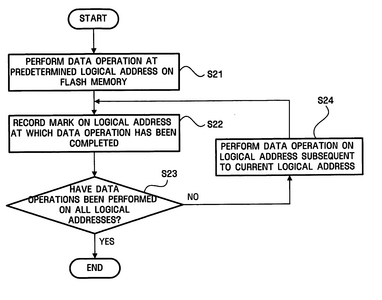
8. A data recovery method used for a flash memory that includes data areas and index areas in which values indicating whether data stored in the respective data areas are valid are recorded, the data recovery method comprising: performing a data operation at each of a plurality of logical addresses; and recording a mark value in a last index area of a plurality of index areas respectively corresponding to the plurality of logical addresses.

9. The data recovery method of claim 8, wherein, in the recording of the mark value, if the data operation is performed first on a middle portion of the flash memory and then on other portions of the flash memory, the mark value is recorded in an index area corresponding to the middle portion of the flash memory.

10. The data recovery method of claim 8, wherein said plurality of logical addresses are a plurality of consecutive logical addresses.

11. A data recovery method used for a flash memory that includes data areas and index areas in which values indicating whether data stored in the respective data areas are valid are recorded, the data recovery method comprising: identifying a mark value recorded in an index area corresponding to a predetermined logical address; and determining whether data respectively stored at a plurality of logical addresses prior to the predetermined logical address, through a data operation, are valid based on the mark value.

12. The data recovery method of claim 11, wherein in the determining operation, it is determined whether the data respectively stored at the plurality of logical addresses are valid based on a mark value recorded in an index area corresponding to one of the plurality of logical addresses where the data operation has performed most recently.

13. The data recovery method of claim 12, wherein, in the determining operation, if the data operation is performed first on a middle portion of the flash memory and then on other portions of the flash memory, it is determined whether data stored in the flash memory are valid based on the mark value recorded in the index area corresponding to the middle portion of the flash memory.

14. The data recovery method of claim 12, wherein it is determined whether data stored at a predetermined logical address is valid based on whether data exists at a logical address subsequent to the predetermined logical address.

15. The data recovery method of claim 13, wherein it is determined whether data stored at a predetermined logical address is valid based on whether data exists at a logical address subsequent to the predetermined logical address.

16. The data recovery method of claim 12, wherein said plurality of logical addresses are a plurality of consecutive logical addresses.

Data recovery apparatus and method used for flash memory Read More »

Scroll to Top