HDD Repair Tools: PC 3000 VS HD Doctor Suite

1. HD Doctor Suite (SalvationDATA Technology, LLC. China)

SalvationDATA HD Doctor Drive Restoration Suite is an integrated hardware-software combined system that fixes firmware issues for drives of all major manufacturers and popular drive families.

By using HD Doctors and our software suite, you can have 50 percent more capability in data recovery, thus have 50 percent more business, which makes you “a professional”.

Get More: HD Doctor Suite

2. PC 3000 Drive Restoration System (ACE Laboratory, Russia)

A drive restoration powerhouse developed by the data recovery experts at ACE Laboratory Russia, PC-3000 drive restoration system is the only system that fixes firmware issues for all hard disk drive manufacturers and virtually all drive families.
With PC-3000 drive restoration system, you can bring more drives back to life before you begin imaging and data retrieval.

Get More: PC 3000 System

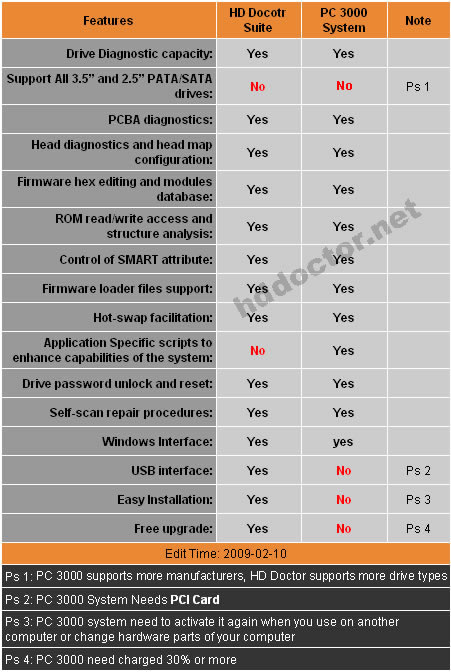
HD Doctor Suite vs PC 3000 System

Note: Whatever you are a PC 3000 System fans or a HD Doctor Suite user, If you are doing a job related to hdd repair or data recovery ,you should know both of them. They all provide great tools for  hdd repair. When you are using either of them. You should compare it with the other one.

This page will help you make a better choice! If you have a different opition. Feel Free to tell me by your comment! Let’ s make it better useful!

Read More

A slave hard drive is not assigned a drive letter in Windows 2000/XP

image Why is my slave drive not assigned a drive letter after either moving it from one system to another system or installing Windows 2000/XP?

Problem:
A slave drive is recognized in Disk Management, but it is not assigned a drive letter after Windows 2000/XP installation or moving it from one system to another system, with both systems running Windows 2000/XP.

Cause:
Proper steps were not taken to move the drive from one system to another.

Affected Products:
All EIDE drives in Windows 2000/XP.

Resolution:
The information below is provided as is without any warranty of any kind, either expressed or implied. Western Digital will not be liable to you for any damages, including any loss of profit or savings, arising out of the use or inability to use the information contained in this document.
The following information appears in the Microsoft Windows help file for Disk Management. It has been modified for formatting purposes only.

Before you disconnect the disks, make sure the status of the volumes on the disks is Healthy. If the status is not Healthy, you should repair the volumes before you move the disks.
Turn the computer off, remove the physical disks, and then install the physical disks on the other computer. Restart the computer that contains the disks you moved.

Using Disk Management:
To open Disk Management, follow these steps:

  1. Click Start, point to Settings, and click Control Panel
  2. Double-click Administrative Tools, and then double-click Computer Management.
  3. In the console tree under Storage, click Disk Management.

Once Disk Management is open, follow these steps:

  1. Click Action, and then click Rescan Disks.
  2. Right-click any disk marked Foreign, click Import Foreign Disks, and then follow the instructions on your screen.

Notes: You must be logged on as an administrator or a member of the Administrators group in order to complete this procedure. If your computer is connected to a network, network policy settings may also prevent you from completing this procedure.

Read More

Top 10 worst computer viruses (Storm & Melissa)

worst computer viruses6. Storm
Shaun Nichols: Before Conficker came around and got everyone worked into a lather, Storm was the big bad botnet on the block. First appearing in early 2007 as a fake news video on European flooding, the Storm malware menaced users for more than a year.

The huge botnet was also influential for its continued use of social engineering tactics. The malware disguised itself as everything from video files to greeting cards, and attacks were continuously refreshed to coincide with holidays and current news events.

While Storm has since been eclipsed by newer botnets, the name still brings to mind one of the most menacing attacks seen in recent years.

Iain Thomson: When extreme weather hit Europe the damage was bad enough, but the Storm code made things much worse. At a time when many were seriously concerned about the health and safety of friends and family, the last thing anyone needed was an infection.

But Storm was a classic piece of social engineering. At a time when people are concerned they don’t always  think of the consequences, be it approving torture or opening an email attachment.

This kind of social networking is nothing new, of course, but the Storm malware did it very well indeed and proved very effective as a result.

5. Melissa
Shaun Nichols: It was a classic love story. Boy meets girl, girl dances for money, boy goes home and writes computer virus for girl, computer virus gets out of hand and causes millions of dollars in damage. It’s the Romeo and Juliet of our time.

When a New Jersey hacker wrote a small bit of code named after a stripper he met in Florida, he had no idea of the chaos that would ensue. The Melissa virus, as it came to be known, got way, way out of hand.

The virus spread like wildfire throughout the net, and an unintended effect of the worm led to a glut of email traffic that overflowed servers and caused tons of damage and lost work time to corporate IT systems.

The hacker himself was later caught and sentenced to a year and half in prison. Next time he wants to impress a girl, hopefully he’ll stick to chocolates and jewelery.

Iain Thomson: Now, I’ve done some stupid things to impress girls, things that cause me to bite my fist with embarrassment nowadays and one that left me with a small amount of scar tissue, but writing a computer virus makes these pale by comparison.

The real damage of Melissa was not in the code itself, but in its spamming capabilities. The software caused a massive overload of email systems and generated enough traffic to make it highly visible. Current computer malware writers have taken note of code like Melissa and now fly much lower under the wire to attract less attention.
Read More