Two mechanisms of defect relocation

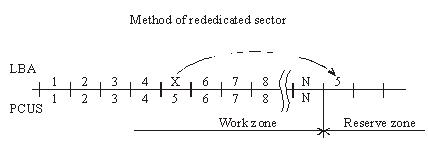
When the substitution (Assign) mechanism is used in a drive the latter records to the ID field of a BAD sector the flag of the relocated sector and writes to the data field the number of the reserved sector, i.e. the one, which should be accessed for data recording or reading. As a rule, it is the first available sector after user data area. (figure 2.).

Figure 2. Method of rededicated sector.
During data read/write operations accessing the defective sector drive controller will read the flag and assigned address and reposition the heads to the reserved zone in order to perform reading/writing from/to a good sector. Defective sectors in that case will disappear, but the drive will perform positioning to the reserved area each time it has to address a defective sector. The procedure is accompanied with clicking sounds and slight slow-down. The “Assign” procedure allows relocation only for defects in data fields. Errors pertaining to corruption of ID fields or servo fields cannot be relocated using the “Assign” method.

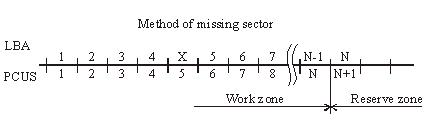
Another mechanism used for hiding defective sectors at manufacturing factories is skipping of defective sectors. When that method is used, the defective sector is skipped, its number is assigned to the following sector (and so on), and the last sector is shifted to the reserved zone. (figure 3.).

Figure 3. Method of missing sector.
Such method of sector hiding disrupts the continuous integrity of low-level format; the system of LBA conversion to PCHS should also take into account BAD sectors while skipping them. Therefore the method requires obligatory recalculation of translator tables and low-level formatting making it impossible to preserve user data if the method is employed. Exactly for that reason the said method of relocation is applied only in special factory mode of drive operation. It is used in the FUJFMT.EXE utility designed for relocation of defects in FUJITSU drives.

Read More

RAID Array & Server Glossary of Computer Terms (Letter E)

ECC
Error Correcting Code, a method of generating redundant information which can be used to detect and correct errors in stored or transmitted data.

Embedded Storage Controller
An intelligent storage controller that mounts in a host computer’s housing and attaches directly to a host’s memory bus with no intervening I/O adapter or I/O bus.

External RAID Controller
A RAID controller in its own enclosure, rather than incorporated into a PC or server. External RAID controllers are often referred to as a Bridge RAID Controller. Mylex SANArray FL, FF, FFx, and Pro FF2 controllers are external RAID controllers. Compare with Internal RAID Controller.

Exclusive OR (XOR)
A process based on a mathematical algorithm that is used by RAID levels 2, 3, 4, and 5 to compare computer data (binary 0s and 1s) created by a write request or by a read request during a drive failure. The result of the XOR process is parity information that will be stored along with data for real-time recovery in the event of a disk failure.

External array controller
In contrast to bus-based array adapters and microprocessor-based array controllers, external array controllers reside in the external RAID storage enclosure. They connect to the host through a standard SCSI or serial (such as Fibre Channel) host adapter interface. These external controllers are similar to bus-based, microprocessor-based array controllers, in that they include an on-board microprocessor to offload all RAID functions (I/O commands and RAID operations) from the host CPU. They are usually used in midrange and high-end servers, especially in clustering environments.


Read More