The Sorts of Data Recovery

Category 1 data recovery does not require clean room procedures. Typically, formatted hard drives, deleted files, data copy or transfer to a new hard drive, deleted, damaged or corrupt partition structure, virus or spyware infections, when your computer keeps rebooting, after power surges and outages fall into this category. Category 1 data recovery prices start at $299 and always costs less than $500. Basically, if your hard drive is recognized by the system but you cannot locate or access files you are looking at a category 1 data recovery.

Category 2 data recovery does not involve opening your hard drive but does require specialized equipment to rewrite firmware, modules and recalibrate or program your hard drive in order to get it reading so we can extract your files. In many cases it is necessary to perform low level access of your drive to gain access to your files. Pricing for Category 2 data recovery typically runs between $499 and will never exceed $999. Category 2 data recovery is often required when your drive shows up corrupt, some clicking, incorrect drive size, n40p, Athena, a model number only, Maxtor, ROMULUS, RIGEL, NIKE, PROXIMA, etc.

Category 3 data recovery involves some cleanroom procedures to access your hard drive and recover your data. Recovery may involve removing stuck heads from platter surfaces, realigning heads, cleaning platter surfaces, replacing PCB, electronic components and utilizing our imaging equipment to create a sector-by-sector image of your hard drive while bypassing bad areas. Category 3 data recovery procedures are labor intensive and prices start at $999 and are will never exceed $1500.00. You normally need a category 3 or 4 data recovery if your hard drive is clicking, making unusual sounds, not recognized by the system, it isn’t spinning or the heads are stuck on the platters.

Category 4 data recovery requires intensive cleanroom procedures to recover your files. Category 4 data recovery is the most intensive and time consuming and starts at $1379.00. Read heads are replaced, platters may be transplanted (requires high-tech equipment to remount and align properly), internal electronics may need to be replaced, platter surfaces are scratched, scarred or contain multiple head crashes. Platters may be warped from excessive heat or the spindle motor is frozen (often indicated by beeping, buzzing or musical sounds like Mario).

Read More

Intel RAID Controller: unable to complete the firmware update

I am unable to complete the firmware update; I get a message that the
firmware is intact or the system hangs during when entering StorCon

As the BIOS on server boards and RAID controllers are updated, it is possible that some
combinations of RAID controller BIOS and server board BIOS do not work together so that
updating RAID controller firmware through the normal update process is not possible. A
firmware recovery process is described here with an override that makes it possible to force the firmware update.

To force a firmware update, complete the following steps:

a. Move the recovery jumper on the RAID card to Recovery position.

b. Download the firmware recovery utility and update code from the website, or make a
firmware recovery diskette from the CD and boot to it.

c. Choose option 2, recover firmware.

d. The system creates a RAM drive and begins copying files to it. Press <Ctrl> <C> when
you see the prompt, “press CNTL C to interrupt the recovery process”. You will be
brought to a C: prompt.

e. Type “FRU -O” to force overwriting the firmware. (Note: “O” is the letter O for Overwrite,
not the number zero)

f. Indicate agreement at the following two prompts.

g. Green text will display at the top of the screen indicating that the recovery has started.
This will be followed shortly by text that provides the version (flashing) that is being
forced. The first few digits of this text are the firmware version number followed by
digits that refer to the build number.

h. When complete, replace the jumper into the normal position and reboot.
Troubleshooting Guide

Read More

RAID Data Recovery Is Possible!

RAID Data RecoveryWhat if your hard drive decides to enter the Elysian Fields in this very moment? Sure, you could simply get a new hard drive to substitute for the defective one with a quick run to your favorite hardware store. And with last night’s backup you might even reconstruct your installation quickly. But what if you don’t have a backup? The truth to be more like this: many users don’t even have a backup, or it simply is too old and thus useless for recovering any useful files at all. In case of real hard drive damage, only a professional data recovery specialist can help you – say bye-bye to your vacation savings!

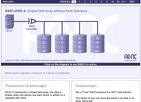
Hard drive failure is especially disastrous for smaller companies working with a single server and a single disk, if they do not have a complete and working data backup at hand. The whole situation is even more complicated if the broken hard drive is a member of a RAID array. Neither hard drive failure in RAID 1 nor RAID 5 will result in data loss, since this scenario has been taken care of by the choice of these RAID levels in advance. But the risk of human error increases: self-made data loss occurs if you accidentally substitute the wrong drive in a degraded RAID 5 array (one with a failed hard drive).

But not all hard drives that show failure symptoms are defective. Sometimes, so called “soft errors” can be fixed using data recovery software. But even in this case, you should weigh the risks to see if it makes sense to take care of the problem yourself or get help from professionals. You might not be able to detect a controller failure right away, for example; usually, users assume a problem with the hard drive. Here is our rule of thumb: if you hear clacking sounds in the potentially defective hard drive, or if the computer’s S.M.A.R.T. function indicates an error during the boot process, something is wrong for sure.

What can you do once you know that an important hard drive is definitely broken? Or what happens if you pulled the wrong drive out of the slot while you were desperately trying to save your data? First of all: don’t panic! You need to act systematically and thoughtfully to be successful, as well as to ensure that you spend as little as possible on recovery – costs can hits four digits easily.

Read More

The necessary condition of Hard Disk Data Recovery Training

Data Recovery Training Before you choose a hard disk data recovery training, you should know what is necessary condition of the training.

First, the Data Recovery course exposes you to a professional data recovery lab environment, which includes:

  • A Class 100 Clean Room Environment(maintains less than one hundred particles larger than 0.5 microns in each cubic foot of air space)
  • A SMD Rework station for diagnosis and removal of SMD components on Hard Disk Drives and Solid State Drives
  • Platter and head exchanging station with head combs for single and multi-platter swaps
  • Data recovery tools, write blockers, micro-tweezers and dental picks, anti-static gloves and finger cots, and much more.
  • Data Recovery Workstation with associated drive connectors and BIOS bypass tools.

It is imperative to learn how to perform physical data recovery in a Class 100 clean room training environment. Even the smallest piece of dust that falls on an exposed drive platter can damage it irreparably, making data unrecoverable.

A warning note to prospective students: Any data recovery training that is taught by self-proclaimed “industry experts” without a clean room is a likely an “edutainment show” or a potential rip-off. You won’t get the detailed instruction you need to do physical data recovery outside of a clean room environment.

Second, choose the training Institutions who can provide a professional data recovery lab experience for students. You will learn how to diagnose faulty PCBs, understand how to swap them with working PCBs. You will also learn critical Surface Mounted Device (SMD) rework skills using a heat gun. This includes identifying donor ROM SMDs and using rework flux to replace non-functional ROM chips.

Third, If you want to learn the all-around hard disk data recovery skills, learning how to exchange drive platters and heads is requisite. This is a critical skill that requires expert instruction. The proper method for head and platter swapping is detailed thoroughly in the Data Recovery course. It is the better if the institutions who also can teach you how to cover voice coil diagnosis and repair. Further more, teach you the secrets of Firmware and Service Area (SA) repair for many different types of drives, including Western Digital, Maxtor, IBM and Seagate hard drives.

The last, choose the classes do not rely on you purchasing any expensive tools, such as PC-3000 to perform data recovery.

Read More

List of Computer Forensics Tools

Computer Forensics Tools

what is computer forensics?

Computer forensics is a branch of digital forensic science pertaining to legal evidence found in computers and digital storage media. The goal of computer forensics is to examine digital media in a forensically sound manner with the aim of identifying, preserving, recovering, analyzing and presenting facts and opinions about the information. With these useful forensics tools we can finish this work shortly and accurately.

A) List of tools for computer forensics

1. SANS Investigative Forensics Toolkit – SIFT (GPL V2.0)
Multi-purpose forensic operating system
computer-forensics.sans.org

2. EnCase (Windows, commercial, V6.18)
Multi-purpose forensic tool
www.guidancesoftware.com

3. FTK (Windows, commercial, V3.2)
Multi-purpose tool, commonly used to index acquired media.
accessdata.com/products/forensic-investigation/ftk

4. PTK Forensics (LAMP, free/commercial, V2.0)
GUI for The Sleuth Kit
sourceforge.net/projects/ptk-forensics/

5. The Coroner’s Toolkit (Unix-like, IBM Public License, V1.19)
A suite of programs for Unix analysis
www.porcupine.org/forensics/tct.html

6. COFEE (Windows,Proprietary)
A suite of tools for Windows developed by Microsoft, only available to law enforcement
cofee.nw3c.org

7. The Sleuth Kit (Unix-like/Windows, IPL, CPL, GPL, V3.1.1)
A library of tools for both Unix and Windows
www.sleuthkit.org

8. Categoriser 4 Pictures (Windows, Free, V4.0.2)
Image categorisation tool develop, available to law enforcement

9. Paraben P2 Commander (Windows, Commercial)
General purpose forensic tool

10. Open Computer Forensics Architecture (Linux, LGPL/GPL, 2.3.0)
Computer forensics framework for CF-Lab environment

11. SafeBack (commercial, V3.0)
Digital media (evidence) acquisition and backup

12. Forensic Assistant (Windows, commercial, V1.2)
User activity analyzer(E-mail, IM, Docs, Browsers), plus set of forensics tools

B) Tools for Mobile device forensics

Mobile forensics tools tend to consist of both a hardware and software component.

1. Cellebrite Mobile Forensics (Windows, Commercial)
Univarsal Forensics Extraction Device – Hardware and Software

2. Radio Tactics Aceso (Windows, Commercial)
“All-in-one” unit with a touch screen

3. Paraben Device Seizure (Windows, Commercial)
Hardware/Software package

4. MicroSystemation .XRY/.XACT (Windows, Commercial)
Hardware/Software package, specialises in deleted data

5. Oxygen Phone Manager (Commercial)

C) Other computer forensics tools

1. HashKeeper (Windows, free)
Database application for storing file hash signatures

2. Evidence Eliminator (Windows, commercial, V6.03)
Anti-forensics software, claims to delete files securely

3. DECAF (Windows, free)
Tool which automatically executes a set of user defined actions on detecting MS’s COFEE tool
Read More

120G SATA III SSD or 1TB WD SATA III Caviar Black HDD

Since I now am returning my 1tb SATA III Seagate Barracuda I am stuck in a dilemma. I’m trying to decide between A. OCZ Vertex 3 or going with 1tb WD Caviar Black.

My pc will mainly be used to game with the possibility of overclocking. I want a drive I can put my games and OS unless there is a better configuration I’m just not thinking about. The SSD feels kind of limiting in size, but maybe the speed is worth the compromise? Money is an object and I’m at max only looking to spend $250, but lower than that is very welcomed. Thanks in advance.

1. OCZ 120GB Vertex 3 SATA 6Gb/s 2.5-Inch Performance Solid State Drive (SSD) with Max 550MB/s Read and  Max 4KB Write 85K IOPS

NAND Flash Components: 2Xnm Multi-Level Cell (MLC) NAND Flash Memory, Interface: SATA III 6.0Gbp/s, Form Factor: 2.5″ slim design form factor;

Life Expectancy: 2 million hours Mean Time Before Failure (MTBF), ECC Recovery: Up to 16 bytes correctable per 512-byte sector;

Max Read: up to 550MB/s, Max Write: up to 500 MB/s, 4KB Random Write: I/O Per Second (IOPS): 60,000 IOPS, Seek time: 0.1 ms, Controller: SandForce 2281;

2. Western Digital Caviar Black 1 TB SATA III 7200 RPM 64 MB Cache Internal Desktop Hard Drive

WD Caviar Black high performance 3.5- Inch SATA hard drive combines 7200 RPM, 64 MB cache, and SATA 6 Gb/s interface for the ultimate in power computing;

High performance electronics architecture features dual processors and bigger, faster caches for maximum read and write speeds;

StableTrac The motor shaft is secured at both ends to reduce system-induced vibration and stabilize platters for accurate tracking, during read and write operations. 5 year limited warranty;

If everything you want to store on the machine will fit in 120 GB, then get the SSD. If you need more storage, you will need either the hard drive or, if you can afford it or have a decent HDD lying around, the SSD with the OS installed on it and your data and music files and so forth on the HDD. If you go this route, ensure that no HDD is attached to the motherboard when you install the OS on the SSD.

In either case, you need one more drive: an external drive to back up anything that you still want to have tomorrow. This is one of the best investments that you can make; ask anyone who has had a hard drive fail.

Read More