
File Scavenger Data Recovery Utility is a professional-grade data recovery software designed to retrieve lost, deleted, or inaccessible files from various storage devices, including hard drives, SSDs, USB flash drives, memory cards, RAID arrays, NAS devices, and more. Developed by QueTek Consulting Corporation, this utility has earned a reputation for its powerful recovery capabilities and cross-platform file system support.
Data recovery software is non-destructive and read-only, capable of providing safe and accurate retrieval of data from inaccessible, formatted, corrupted, or undetectable storage media. All data including photos, pictures, videos, audio files, music, documents, emails, archives, and other file types lost due to accidental deletion, virus damage, drive corruption, formatting, partition loss, software failure, or system crash can be effectively recovered from all types of storage devices such as internal/external HDDs, SSDs, USB flash drives, pen drives, thumb drives, SD cards, memory sticks, and digital cameras.
File Scavenger works with storage devices of all capacities, ranging from small drives to large multi-terabyte drives. The software supports Windows operating systems from Windows 7 through Windows 11, as well as Windows Server editions.
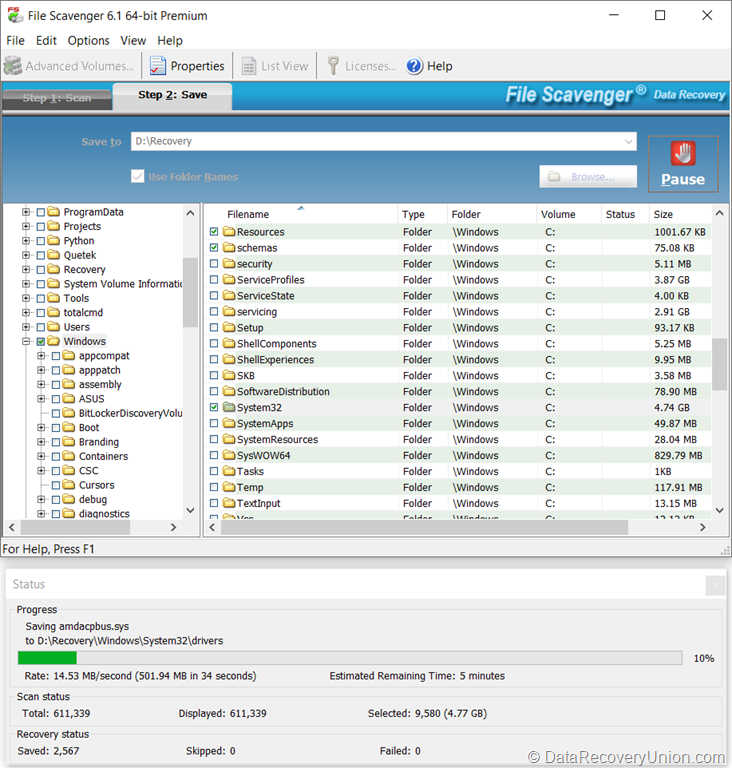
Key Features of File Scavenger Data Recovery Utility
Here are the key features typically associated with File Scavenger Data Recovery:
Comprehensive Device Support
- Storage Devices: Supports HDD, SSD, USB flash drive, memory card (SD, microSD, CompactFlash), external hard drive, digital camera, and more.
- Advanced Storage Systems: Supports RAID 0, RAID 1, RAID 5, JBOD, NAS (Network Attached Storage), and hardware/software RAIDs.
- Disk Interfaces: Compatible with IDE, SATA, SCSI, SAS, NVMe, and USB interfaces.
Multiple Data Loss Scenarios
- Accidental Deletion: Recovers files deleted from Recycle Bin or using Shift+Delete.
- Formatting Recovery: Retrieves data from drives that have been formatted, even to different file systems.
- Partition Recovery: Restores lost or deleted partitions and rebuilds corrupted partition tables.
- Corrupted Drive Recovery: Extracts data from drives that appear as RAW or are inaccessible.
- System Crash Recovery: Creates bootable media to recover data from unbootable computers.
- Virus Attack Recovery: Recovers files hidden, deleted, or encrypted by malware.
Extensive File System Compatibility
File Scavenger supports a wide range of file systems across different operating systems:
- Windows: FAT12, FAT16, FAT32, exFAT, NTFS, NTFS5, ReFS (Resilient File System)
- macOS: HFS, HFS+
- Linux/UNIX: Ext2, Ext3, Ext4
- Other: UFS (from BSD variants), Solaris x86, UnixWare, and more
Advanced Recovery Technologies
- Signature-Based Recovery: Recovers files by their unique file signatures when file system metadata is damaged or unavailable.
- Boot Sector Recovery: Scans and recovers damaged or missing boot sectors.
- Master Boot Record (MBR) Recovery: Rebuilds corrupted or deleted MBR to restore partition access.
- Folder Structure Preservation: Maintains original directory structure whenever possible, making recovered files easy to organize.
File Preview Functionality
Allows users to preview recoverable files before initiating the recovery process. Supported preview types include images, documents, and other common file formats. This enables you to verify file integrity and content before committing to recovery, ensuring you only recover files that are intact and needed.
Selective & Filtered Recovery
Provides the option to selectively recover specific files or folders rather than restoring entire drive content. You can mark individual files or entire folders for recovery, saving both time and storage space.
Deep Scan Mode
Features a comprehensive deep scan mode that thoroughly searches the drive sector by sector. This mode is essential for recovering data from:
- Formatted or reformatted drives
- Corrupted or damaged file systems
- Drives with bad sectors
- Lost or deleted partitions
The deep scan may take longer but significantly improves recovery chances in complex scenarios.
Save and Load Scan Results
Allows you to save scan results to a file and reload them later. This eliminates the need to rescan large drives repeatedly – simply load the previous recovery result and proceed directly to file recovery. This is especially useful for:
- Large capacity drives where scanning takes hours
- Multiple recovery attempts from the same drive
- Forensic analysis where scan results need to be preserved
Bootable Recovery Media
Creates bootable recovery media (USB drive or CD/DVD) that enables data recovery from computers that fail to boot due to:
- System crashes and blue screen errors
- Corrupted operating system files
- Virus or malware infections preventing boot
- Damaged boot sectors or MBR
This feature requires a secondary working computer to create the bootable media.
Disk Imaging Feature
File Scavenger offers the ability to create sector-by-sector disk images of entire drives or selected partitions. Disk imaging is particularly useful when:
- The source drive is failing or has bad sectors
- You need to preserve evidence for forensic purposes
- You want to work on a copy rather than the original drive
- The recovery process needs to be interrupted and resumed later
Command Line Interface
For advanced users and IT professionals, File Scavenger includes a command-line interface (CLI) version. This enables:
- Scripted and automated recovery operations
- Integration into larger data recovery workflows
- Remote recovery via command-line tools
- Batch processing of multiple drives
Supported File Types
File Scavenger Data Recovery Utility supports recovery of hundreds of file types across all major categories, including:
| Category | Supported File Extensions |
|---|---|
| Documents | DOC, DOCX, XLS, XLSX, PPT, PPTX, PDF, RTF, TXT, HTML, XML, ODT, ODS, ODP, WPD, PAGES, NUMBERS, KEY |
| Images & Graphics | JPG, JPEG, PNG, BMP, GIF, TIFF, PSD, CR2, NEF, ORF, RAW, ARW, DNG, HEIC, HEIF, WEBP, SVG |
| Audio & Video | MP3, WAV, WMA, AAC, FLAC, M4A, OGG, AVI, MP4, MOV, WMV, MKV, FLV, 3GP, MTS, M4V, MPEG, VOB |
| Archives | ZIP, RAR, 7Z, TAR, GZ, CAB, ISO |
| Emails | PST, OST, DBX, EML, MBOX, NSF, MSG |
| Database Files | MDB, ACCDB, SQLITE, FDB, SQL |
How to Use File Scavenger Data Recovery Utility
Follow these steps to recover your lost data using File Scavenger:
- Download and Install – Download File Scavenger from the official website. Important: Do not install the software on the drive from which you want to recover data, as this may overwrite lost files. Install it on your local hard drive or another safe location.
- Launch and Select the Drive – Launch File Scavenger. The main window displays all physical drives, logical disks, and detected partitions. Select the drive, partition, or storage device you want to scan.
- Configure Scan Options – Choose the appropriate scan settings:
- Quick Scan: For recently deleted files and simple recovery scenarios. Scans only the master file table (MFT) or directory structures.
- Deep Scan: For formatted, corrupted, or severely damaged drives. Scans every sector of the drive for file signatures.
- Specific File Types: Optionally limit the scan to specific file types to speed up the process.
- Scan the Drive – Click “Scan” to begin the recovery process. The software will display found files and folders in real-time as the scan progresses. Scan time depends on drive size, scan mode, and drive condition – a deep scan of a 1TB drive can take several hours.
- Browse and Preview Results – Once scanning is complete, browse the recoverable files. Files are organized by folder structure when available, or by file type when recovered via signature scan. Use the preview function to verify file integrity before recovery.
- Recover Files – Select the files or folders you wish to restore. Click “Recover” and choose a destination location on a different drive to avoid data overwriting. Files can be recovered to any accessible drive or folder.
Editions and Pricing
File Scavenger offers both free and paid versions to accommodate different user needs:
| Edition | Price | Description |
|---|---|---|
| Free Trial/Demo Version | Free | Allows scanning and previewing of recoverable files. Recovery is disabled or limited in the trial version. Use the trial to verify that your files can be recovered before purchasing. |
| Standard License | Approximately $79 (one-time) | Full recovery capabilities for individual users on a single PC. Includes all core features including deep scan, file preview, and selective recovery. |
| Professional/Technician License | Contact Sales | For IT professionals and data recovery specialists. Includes additional features such as command-line interface, advanced RAID recovery, and commercial usage rights. |
Note: File Scavenger offers a free trial that allows you to scan your drives and preview found files. This lets you verify that the software can find your lost data before you commit to purchasing a license. The trial version does not allow actual file recovery until a license is purchased.
System Requirements
Before installing File Scavenger Data Recovery Utility, ensure your system meets the following requirements:
- Processor: Intel Pentium-compatible or higher
- RAM: 512MB minimum (2GB or more recommended for better performance, especially with large drives)
- Hard Disk Space: Sufficient space for software installation (approximately 50MB) plus additional space for recovered files
- Supported Operating Systems:
- Windows 11, 10, 8.1, 8, 7 (32-bit and 64-bit)
- Windows Server 2022, 2019, 2016, 2012, 2008, 2003
- Windows Vista and XP (limited support)
- Permissions: Administrative privileges required for installation and certain recovery operations
Known Limitations
While File Scavenger Data Recovery Utility offers effective and comprehensive recovery features, users should be aware of the following limitations:
- Trial Version Recovery Disabled: The free trial version allows scanning and previewing only. You cannot recover files without purchasing a license. This is different from some competitors that offer limited free recovery (e.g., 1GB).
- Windows Only: The software is designed for Windows operating systems only. Mac and Linux users need alternative solutions or virtualization.
- Physical Damage Not Covered: Cannot recover data from physically damaged drives (broken connectors, burned circuit boards, water damage, or mechanical failures like clicking sounds in HDDs). Hardware repair is required first.
- Overwritten Data Cannot Be Recovered: If lost files have been overwritten by new data on the drive, recovery becomes impossible regardless of software quality.
- Deep Scans Take Time: Deep scanning large capacity drives (2TB+) can take many hours. Patience is required for complex recovery scenarios.
- Signature Recovery May Lose Folder Structure: When recovering files via signature-based deep scan (without file system metadata), original filenames and folder structures may not be preserved. Files are recovered with generic names and organized by file type.
- TRIM on SSDs: On modern SSDs with TRIM enabled, recently deleted files may be permanently erased almost immediately due to garbage collection. This affects all data recovery software, including File Scavenger.
- RAID Complexity: While File Scavenger supports RAID recovery, complex or proprietary RAID configurations may require manual configuration and technical expertise.
Comparison at a Glance
| Feature | File Scavenger Data Recovery | Typical Consumer Competitors |
|---|---|---|
| Free Tier | Scan & preview only, no free recovery | Often 1GB-2GB free recovery limit |
| Lifetime License | ✓ One-time payment | Often subscription-only |
| Deep Scan Mode | ✓ Comprehensive sector-by-sector | Typically available in paid versions |
| File Preview | ✓ Included | Standard feature |
| RAID Recovery | ✓ Professional version | Rarely available or limited |
| Bootable Media | ✓ Available | Often premium feature |
| Command Line Interface | ✓ Professional version | Not typically available |
| File Systems Supported | FAT, NTFS, exFAT, ReFS, HFS+, Ext2/3/4, UFS | Typically Windows only (FAT/NTFS/exFAT) |
| Platforms | Windows only | Often Windows and Mac |
Common Data Loss Scenarios Where File Scavenger Excels
- Accidental Deletion: You emptied the Recycle Bin or used Shift+Delete – File Scavenger can still recover the files if they haven’t been overwritten.
- Formatting: Whether quick format or full format, even when formatted to a different file system type, File Scavenger can retrieve your data through deep scan.
- Corrupted or RAW Drive: When Windows says “You need to format the disk before you can use it,” File Scavenger can bypass the corruption and extract files using signature-based recovery.
- Lost Partition: After partition deletion or MBR corruption, File Scavenger can scan the entire physical drive and find recoverable files from lost partitions.
- System Crash: When your computer won’t boot, use the bootable recovery media to boot from a USB drive and recover data from the unbootable system.
- Virus or Malware Attack: Viruses often hide, delete, or encrypt files – File Scavenger can recover them from the affected drive.
- RAID Array Failure: When a RAID array becomes inaccessible due to controller failure or multiple drive issues, File Scavenger can help reconstruct and recover data.
- Cross-Platform Recovery: Recover files from Mac (HFS+) or Linux (Ext) drives using the Windows version of File Scavenger.
Support and Customer Service
QueTek Consulting Corporation offers customer support options for registered users:
- Email Support: Available for technical questions and troubleshooting
- Documentation: Comprehensive help file and user manual included with the software
- FAQ: Online frequently asked questions covering common issues
- Registered Users: Full support access for license holders
Final Verdict: Is File Scavenger Data Recovery Right for You?
File Scavenger Data Recovery Utility is a robust, professional-grade data recovery tool that has been serving users for many years. Its combination of powerful recovery technologies, extensive file system support, and advanced features like RAID recovery and command-line interface make it a strong contender in the data recovery market.
This software is ideal for:
- IT Professionals and System Administrators: The command-line interface, RAID recovery support, and extensive file system compatibility make it a valuable tool for professional environments.
- Advanced Home Users: Users who want a no-nonsense, powerful recovery tool without monthly subscriptions.
- Users with Cross-Platform Needs: Those who need to recover files from Mac (HFS+) or Linux (Ext) drives using Windows.
- RAID Array Owners: Users with RAID 0, 1, 5, or JBOD configurations who need specialized recovery capabilities.
- Forensic Analysts: The ability to create disk images and preserve scan results is valuable for forensic workflows.
Consider alternatives if:
- You need a free recovery tier that actually recovers files (not just previews) – competitors like MiniTool or Stellar offer 1GB free recovery.
- You are a Mac or Linux user – File Scavenger is Windows-only.
- You prefer subscription models with ongoing updates – File Scavenger uses a one-time payment model that may not include major version upgrades.
- Your recovery needs are very basic and infrequent – simpler, lower-cost consumer tools may suffice.
- Your drive is physically damaged – professional hardware repair services are required regardless of software.
Pro Tip: After data loss, stop using the affected drive immediately. Do not add new files, run disk repair tools like CHKDSK, or attempt to format the drive. The more you use the drive, the higher the chance that lost files will be overwritten and become permanently unrecoverable. Use File Scavenger’s free trial first to scan and preview your files – this confirms whether your data can be recovered before you purchase a license. Always save recovered files to a different drive than the one you’re recovering from.
Official Website: www.quetek.com
Disclaimer: Recovery success depends on multiple factors, including how long ago data was lost, whether the drive has been used since the loss, and the extent of corruption or physical damage. No data recovery software can guarantee 100% recovery in all situations. This article is for informational purposes only. All product names, logos, and brands are property of their respective owners.