
Finnix is a lightweight, Debian-based Linux distribution designed to be run directly from a bootable CD, USB drive, or over a network. Created by Ryan Finnie, it is specifically intended for system administrators and power users who need a reliable tool for system recovery, maintenance, testing, and network monitoring. Unlike a general-purpose operating system, Finnix is a utility distribution focused on providing a powerful command-line environment for troubleshooting and repairing computer systems.
Key Features and Philosophy
The core philosophy of Finnix is to provide a complete, yet compact, set of system administration tools. It is not meant for everyday desktop use and therefore does not include a graphical user interface, desktop environments, or productivity software. This focus on functionality allows it to maintain a small size while packing in hundreds of utilities for various tasks.
- Lightweight and Fast: Finnix is known for its small download size. While older versions were under 150 MB, the latest releases are under 500 MB to accommodate a greater number of tools. Its compact size results in a very fast boot time.
- Live Environment: Finnix runs entirely from the boot media or, optionally, can be loaded into RAM which allows the boot drive to be freed for other uses. All changes made during a session are written to RAM and discarded upon shutdown, leaving the host system untouched.
- Open Source and Debian-Based: Finnix is fully open-source and built on Debian’s testing branch, providing a stable and well-maintained core. It uses the APT package management system and is freely distributable under the GPL license.
- Proven History: Development of Finnix began in 1999, making it one of the oldest Linux distributions designed specifically as a Live CD. It has been actively maintained for over two decades.
Primary Use Cases
Finnix is a Swiss Army knife for system administrators and is invaluable in several scenarios:
- System Recovery: Rescuing non-booting systems, repairing boot records, and recovering data from failed or corrupted hard drives.
- Data Recovery: Using powerful command-line tools like ddrescue and Partimage to salvage data from damaged partitions.
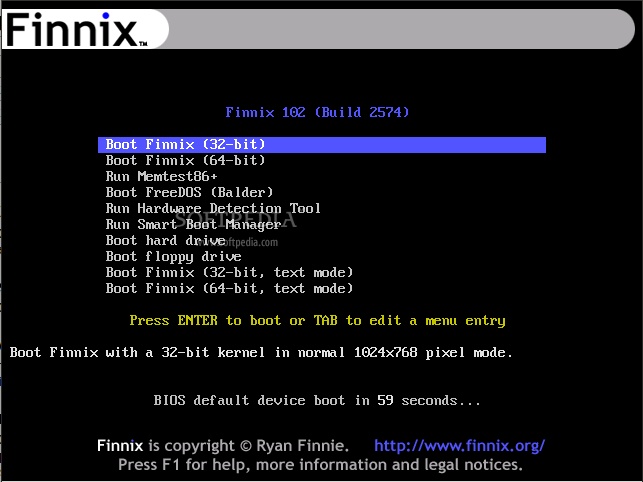
- Hardware Testing and Benchmarking: Running diagnostics like Memtest86+ to test system memory, monitoring hardware health with lm-sensors, and benchmarking system performance.
- Network Monitoring and Administration: Utilizing tools like Nmap for network scanning, tcpdump for packet analysis, and iptables for firewall management.
- Filesystem Management: Creating, manipulating, and repairing a wide range of filesystems, including ext2/3/4, ReiserFS, NTFS, and XFS, often using Logical Volume Manager.
Tools and Utilities
Finnix comes with a rich collection of command-line tools. The distribution includes utilities for disk imaging, filesystem creation and repair, data recovery, network scanning, and performance benchmarking. It also supports advanced storage technologies like encrypted partitions and LVM2. Furthermore, it includes text editors like Joe and Zile for editing configuration files.
Modern versions of Finnix have also introduced improved supply chain assurances by being built on a public CI platform, allowing for verification of the build process and its SHA256 checksums. The project continues to be actively maintained.
Comparison with BartPE
Both Finnix and BartPE serve as emergency recovery tools, but they are fundamentally different. Finnix is a modern, actively developed Linux distribution based on Debian, while BartPE is a discontinued tool that creates a temporary Windows environment from a Windows XP or 2003 installation CD.
Finnix is designed for system administrators who are comfortable with the command line and primarily maintain Linux and other Unix-like systems. In contrast, BartPE was built for Windows administrators to recover Windows machines. Finnix supports modern hardware and file systems natively, whereas BartPE’s old kernel makes it obsolete for contemporary use. As a live environment, Finnix is designed to run entirely from RAM or its boot media, whereas BartPE also operates in memory but is based on a much older Windows kernel.
In essence, if you are looking for a powerful, up-to-date, and command-line-focused recovery tool, Finnix is a modern and capable choice for the Linux ecosystem.
Official Website: www.finnix.org